
How to Send Bitcoin Remittances to Africa Using Bitnob's Lightning Integration
Step-by-step guide to sending Bitcoin to Africa via Bitnob's Lightning Network integration, with fee comparisons and recipient setup.
Sending $200 to family in Nigeria through a traditional remittance service costs roughly $17 in fees. That's based on the World Bank's 2023 finding that Sub-Saharan Africa averages 8.46% in remittance costs, the highest of any region globally. While current-year data isn't available, the structural problems behind those fees haven't disappeared: correspondent banking relationships, currency conversion spreads, and intermediary charges at each step.
Bitnob offers an alternative that sidesteps much of that infrastructure. By using Bitcoin's Lightning Network, the platform enables near-instant transfers to eight African countries with costs that approach zero for the network transaction itself. Here's how it actually works.
What Bitnob's Lightning Integration Does
The Lightning Network is a second layer built on top of Bitcoin that handles transactions off the main blockchain. Instead of waiting for block confirmations and paying miners directly, Lightning transactions settle in seconds through payment channels. The practical result: you can send satoshis (fractions of a Bitcoin) for fractions of a penny in fees.
Bitnob has integrated Lightning since 2021, partnering with services like Strike and CoinCorner to create corridors where someone in the US or UK can send local currency, have it converted to Bitcoin over Lightning, and deliver it to an African recipient who receives local currency in their Bitnob account. The Bitcoin conversion happens in the middle, invisible to users who just want to move money.
The platform currently supports Nigeria, Ghana, Kenya, Rwanda, Senegal, Ivory Coast, Benin Republic, and Togo. Recipients can receive funds and convert to local currency within minutes.
How to Send Bitcoin via Lightning on Bitnob
If you're sending Bitcoin to someone with a Bitnob account, you'll need either their Lightning invoice or Lightning address.
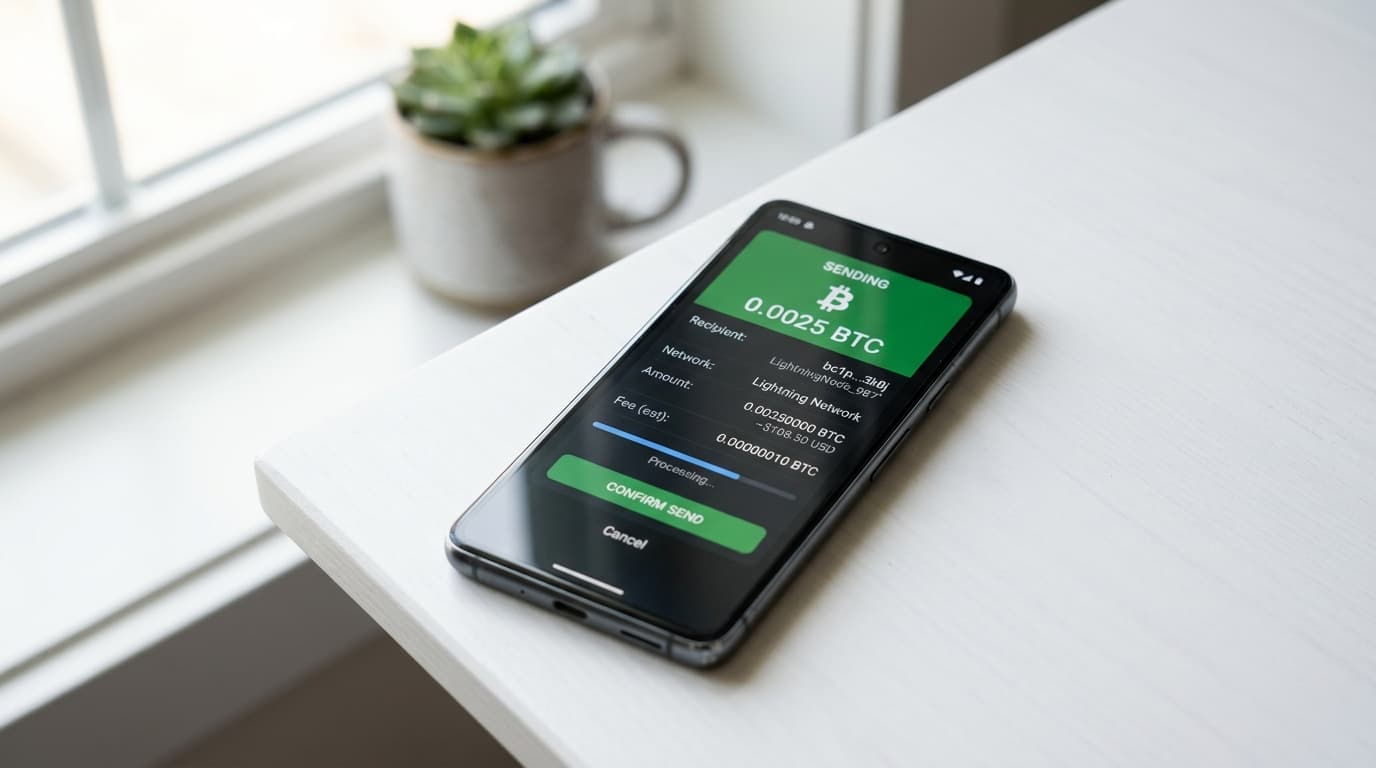
The process from the sender's side (using any Lightning-compatible wallet or exchange):
- Get the recipient's BOLT 11 invoice (a string starting with "lnbc") or their Lightning address (formatted like an email)
- Paste or scan the invoice in your Lightning wallet
- Confirm the amount and send
From the Bitnob app, the recipient generates that invoice by:
- Tapping "Actions" then "Receive"
- Selecting "Generate Lightning Invoice" or setting up a reusable Lightning Address
- Sharing the invoice or address with the sender
Once received, the Bitcoin sits in the recipient's Bitnob BTC wallet. From there, they can hold it or convert to local currency through the app's exchange function.
If you're a Bitnob user sending to another Lightning wallet:
- Tap "Actions" then "Transfer"
- Select "Transfer as BTC"
- Paste or scan the recipient's Lightning Invoice (BOLT 11)
- Tap "Send from BTC" and enter your PIN
Settlement happens in seconds, not days.
Setting Up Recipients in Africa
The recipient needs a Bitnob account before they can receive funds. The app is available on Google Play and the App Store. Account creation requires standard KYC verification, which Bitnob uses to comply with local regulations.
Once verified, the recipient should:
- Set up a Lightning Address for easier repeat payments (this acts like an email address for Bitcoin)
- Link a local bank account or mobile money wallet for withdrawing to local currency
- Enable notifications to know when funds arrive
The Lightning Address is particularly useful for regular remittances. Instead of generating a new invoice each time, the sender can save the address and send whenever needed.
Fee Comparison With Traditional Services
Traditional remittance services charge fees in multiple ways: upfront transfer fees, exchange rate markups, and sometimes receiving fees. The World Bank's 2023 data showed Sub-Saharan Africa averaging 8.46% total cost on a $200 transfer, meaning roughly $17 lost to fees.
Lightning Network transactions cost fractions of a cent for the network routing itself. Bitnob charges a 1% flat fee on Bitcoin payment processing according to their published documentation, with no minimums or monthly contracts.
The math gets more complex when you factor in:
- Bitcoin volatility: If BTC drops between sending and the recipient converting, they receive less local currency than intended. Some users send stablecoins instead to avoid this.
- Exchange spread: Converting BTC to local currency involves an exchange rate that includes some spread.
- On-ramp costs: If the sender is buying Bitcoin with fiat specifically to send, that exchange charges fees too.
For someone already holding Bitcoin, the Lightning route is significantly cheaper than traditional services. For someone starting with dollars and ending with naira, the total cost depends on multiple conversion points. In many cases it's still cheaper, but it's not always as simple as "near-zero fees."
Developer Integration
Bitnob updated their API documentation in March 2026 with expanded Lightning support. Developers can programmatically generate invoices for receiving payments and send payments using BOLT 11 invoices.
This matters for businesses building remittance products, freelancer payment platforms, or any application where Africa-bound payments are part of the flow. The API handles wallet creation, card issuance, and payment processing, allowing developers to build on Bitnob's infrastructure rather than managing Lightning nodes directly.
At the Africa Tech Summit in February 2026, Bitnob showcased enterprise payment use cases in Kenya, emphasizing their Bitcoin and USDT remittance APIs for businesses processing cross-border flows.
What This Approach Doesn't Solve
Lightning remittances work well when both sender and recipient are comfortable with the setup. They're less practical when:
- The recipient doesn't have smartphone access or isn't comfortable with apps
- The sender needs to guarantee an exact local currency amount (Bitcoin volatility makes this hard)
- Either party is in a jurisdiction where crypto regulations create friction
Traditional services, despite their fees, offer simplicity: send dollars, recipient gets local currency at a known rate. The crypto route requires more steps and more understanding from both parties.
The Broader Picture
Bitnob positions itself as infrastructure that uses Bitcoin and Lightning as rails, not as a way to get people to "adopt Bitcoin" ideologically. The recipient doesn't need to care about Bitcoin; they just want money in their account. The sender doesn't need to manage a Lightning node; they just need a compatible wallet.
For African diaspora members sending money home regularly, the fee savings compound over time. A 7% reduction in costs on monthly remittances adds up to meaningful money over a year. For freelancers receiving payments from global clients, Bitnob offers a way to accept crypto and convert to local currency without managing exchange accounts.
The Lightning Network continues to grow as a payment layer, and platforms like Bitnob are building the bridges that make it practical for everyday use. Whether that displaces traditional remittance services depends largely on how accessible and reliable these tools become for people who don't think about Bitcoin at all.