
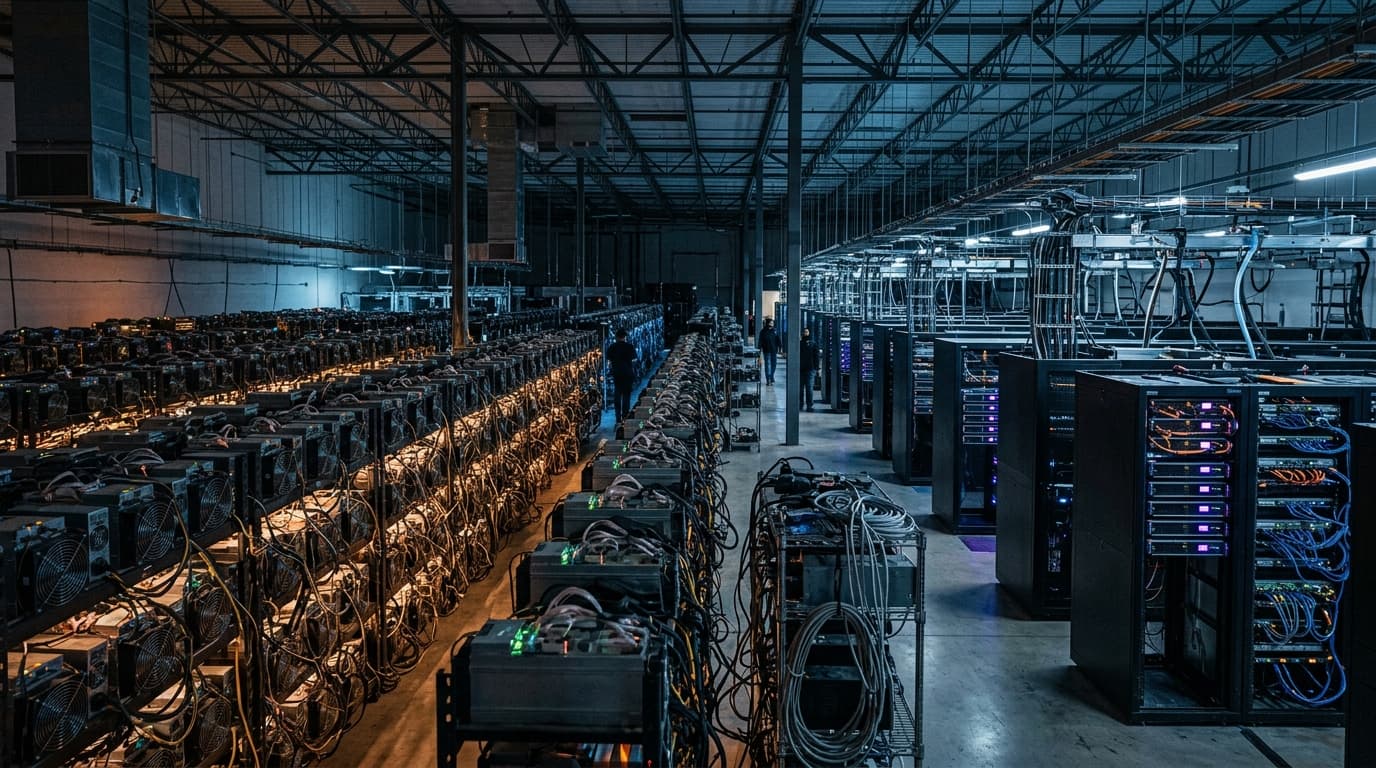
Core Scientific's $208M Bitcoin Sale Reveals How Mining Giants Are Betting Big on AI
Core Scientific sold 2,385 BTC for $208M to fund AI data centers. Here's what this industry-wide pivot means for Bitcoin's institutional narrative.
Core Scientific just liquidated 2,385 Bitcoin for $208.3 million in the first quarter of 2026, not because the company is abandoning crypto, but because it's racing to become something else entirely: an AI infrastructure giant.
The sale funded what might be the most significant strategic transformation in Bitcoin mining history. For the first time, Core Scientific's high-density colocation revenue ($77.5 million) surpassed its Bitcoin self-mining revenue ($30.1 million) in Q1 2026. That's not a blip. It's a fundamental shift in how these companies view their future.
The Numbers Behind the Pivot
Core Scientific's Q1 2026 results tell the story of a company in mid-transformation. Total revenue climbed to $115.2 million, up from $79.5 million in the same quarter last year. But the composition of that revenue has changed dramatically.
The company reported a $347.2 million net loss, which sounds alarming until you examine what's driving it: $266.5 million in non-cash impairment charges on mining assets. Core Scientific is literally writing down the value of its Bitcoin mining equipment while pouring capital into AI infrastructure.
The pivot is backed by serious commitments. A 12-year, $10.2 billion deal with CoreWeave will eventually provide 590 MW of capacity for AI computing. Core Scientific closed $3.3 billion in senior secured notes to finance the buildout, leaving the company with $1.04 billion in liquidity as of March 31.
Management expects over 450 MW billable to CoreWeave by summer's end, with the full 590 MW operational by early 2027. The 2026 capital expenditure budget? A cool $2 billion.
Why Mining Companies Are Selling Bitcoin to Chase AI
Core Scientific isn't alone. IREN, TeraWulf, and Riot are all pursuing similar strategies. Industry projections suggest AI could account for 70% of revenue across major mining operations by the end of 2026.
The logic is straightforward, if uncomfortable for Bitcoin maximalists. The April 2024 halving cut block rewards in half, compressing mining margins at the exact moment AI companies started desperately seeking power and cooling infrastructure. Bitcoin miners happen to have both.
AI hyperscalers like CoreWeave will pay premium rates for reliable capacity backed by long-term contracts. Bitcoin mining offers no such guarantees, just exposure to price volatility and difficulty adjustments.
For publicly traded companies answering to shareholders, the choice increasingly looks obvious. Even if Bitcoin appreciates significantly, the risk-adjusted returns on contracted AI hosting may be more attractive.
What This Means for Bitcoin's Institutional Narrative
Here's where it gets complicated. For years, Bitcoin proponents argued that mining companies represented a form of institutional Bitcoin adoption, businesses whose fortunes were tied to the network's success. That narrative is now being tested.
When mining companies liquidate their Bitcoin holdings to fund non-Bitcoin ventures, they're making a statement about relative opportunity costs. Core Scientific clearly believes the AI infrastructure buildout offers better returns than holding or mining more Bitcoin.
This doesn't invalidate Bitcoin as a treasury asset for other types of businesses. Companies that aren't in the power arbitrage game face different calculations. A software company or retailer holding Bitcoin isn't comparing it against GPU hosting contracts; they're comparing it against cash and traditional investments.
For businesses exploring Bitcoin treasury strategies without the complications of mining operations, services like Sovreign offer a cleaner path, helping companies integrate Bitcoin holdings with institutional-grade custody and management without the infrastructure complexity that's now pushing miners toward AI.
The Market's Skeptical Response
Wall Street hasn't fully bought the transformation story. Core Scientific shares fell 9% after the Q1 2026 earnings release on May 6, partly due to an earnings miss but also because the company announced no new AI/HPC deals beyond existing commitments.
Investors want to see the pipeline growing, not just the existing CoreWeave relationship scaling up. The rejected $9 billion CoreWeave acquisition attempt in October 2025 (shareholders voted it down) suggests the market still isn't sure how to value these hybrid mining/AI companies.
The counterargument to the AI pivot is worth considering: what happens when AI infrastructure becomes commoditized? Today's premium contracts may look less attractive in three years if capacity catches up with demand. Bitcoin mining, for all its volatility, at least offers exposure to an asset with genuine scarcity.
Looking Forward
Core Scientific's transformation represents a calculated bet that AI demand will remain robust long enough for the company to establish durable competitive advantages in that market. The 12-year CoreWeave contract provides meaningful revenue visibility, but a lot can change in a decade.
For now, the Bitcoin liquidations continue. Mining companies are essentially converting their BTC holdings into data center capacity, trading one form of capital for another they believe will generate superior returns.
Whether this proves wise depends on factors ranging from Bitcoin's price trajectory to the pace of AI development to the actions of competitors building similar facilities. The only certainty is that the mining industry of 2027 will look dramatically different from the one that existed before the 2024 halving.
For businesses watching this unfold, the lesson may be simpler: holding Bitcoin and mining Bitcoin are increasingly different propositions. The companies that once seemed like proxies for Bitcoin exposure are becoming something else entirely.