
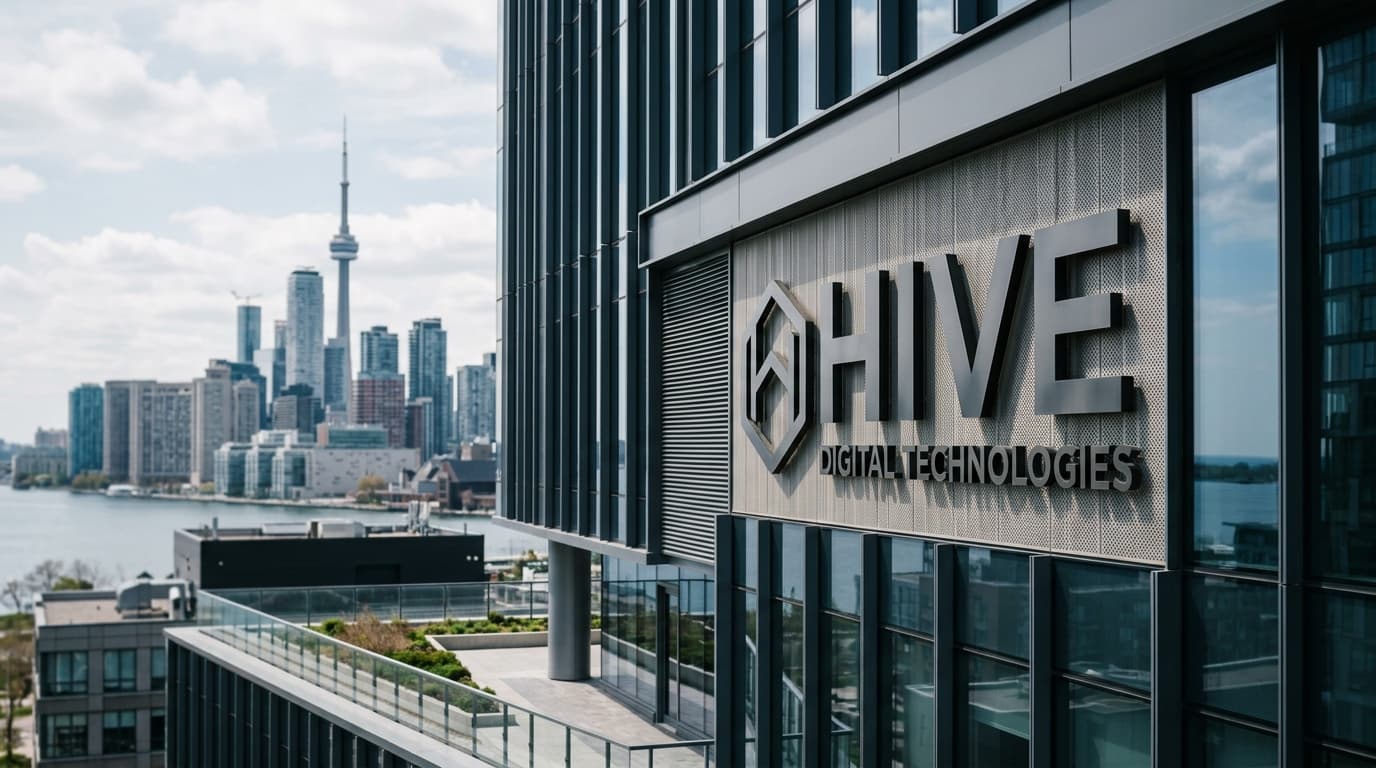
HIVE's $58 Million Toronto Land Purchase Shows Bitcoin Miners Racing Toward AI Data Centers
HIVE Digital spent $58M on Toronto land for a 320 MW AI facility. The move reflects a broader trend of Bitcoin miners leveraging power infrastructure for AI.
HIVE Digital Technologies dropped $58 million on 25 acres outside Toronto in May 2026, betting that the same infrastructure advantages that made it a competitive Bitcoin miner can transform it into a major AI data center operator. The company plans to build what it calls an "AI gigafactory" capable of housing more than 100,000 GPUs, with a target completion in the second half of 2027.
This isn't a pivot away from Bitcoin mining. It's an attempt to run both businesses simultaneously, using the same fundamental asset: access to massive amounts of cheap power.
The Dual-Engine Strategy
HIVE's Toronto project will deliver approximately 320 MW of utility power capacity when complete. The company estimates total capital investment at around CAD $3.5 billion, a number that reflects the enormous expense of building AI-ready data center infrastructure from the ground up.
The numbers tell the story of a company trying to do two things at once. As of late 2025, HIVE had scaled its Bitcoin mining operation to 25 EH/s, while simultaneously growing its high-performance computing revenue by 175% year-over-year. Total revenue jumped roughly 285%, with Bitcoin mining revenue up about 300%.
For anyone tracking Bitcoin network fundamentals on tools like TimechainStats, the competitive pressure driving this strategy is visible in real-time. Hashrate has continued climbing while block rewards dropped after the 2024 halving. Miners who can only sell Bitcoin face constant margin compression. Those who can monetize their power infrastructure in other ways have more options.
HIVE now claims control over 850 MW of power globally, including about 450 MW of operating data centers and a 400 MW development pipeline. The Toronto facility accounts for 320 MW of that Canadian pipeline.
Converting Mining Sites to AI Infrastructure
The Toronto gigafactory is a greenfield project, but HIVE has been practicing conversions at smaller scale. A 7.2 MW Toronto data center acquired in September 2025, originally a Bitcoin mining facility, is being upgraded from Tier 1 to Tier 3 standards for AI and HPC workloads. The company budgeted about $35 million for that transition.
In Sweden, HIVE's Boden site is being retrofitted into a Tier-3, liquid-cooled HPC facility designed to host around 2,000 NVIDIA GPUs. In New Brunswick, a Grand Falls facility is planned to support up to 25,000 GPUs.
By late 2026, HIVE's BUZZ HPC subsidiary projects it will have approximately 6,000 next-generation GPUs operational in new facilities, on top of an existing fleet of 5,000 GPUs.
This pattern of converting mining infrastructure to AI data centers extends beyond HIVE. Reuters reported in January 2025 that Toronto-based Bitfarms had hired consultants to explore similar conversions. Industry analysts estimated that by 2027, about 20% of global Bitcoin miner power capacity could be reallocated to AI compute.
Why Miners Think They Have an Advantage
The bull case for miners entering AI infrastructure rests on what they already own. Large power allocations, industrial sites with substation capacity, and experience operating facilities at significant scale. HIVE's Toronto land deal includes ownership of a 240 MVA substation with 200 MW of capacity.
HIVE emphasizes sustainability credentials that matter to enterprise and government clients: Ontario's relatively clean grid, closed-loop cooling systems that eliminate water use, and renewable energy sources across its global portfolio. The company is explicitly targeting "sovereign AI infrastructure" customers, meaning government agencies and large institutions who may prefer domestic data centers for sensitive workloads.
The project is expected to create more than 800 construction jobs and hundreds of permanent technical positions, a political selling point in any jurisdiction.
The Execution Risks Are Substantial
HIVE's ambitions require approximately $4.6 billion in AI infrastructure funding, according to a June 2026 analysis of miners' capital needs. That's a significant sum for a company navigating the volatility of Bitcoin markets while simultaneously building out an entirely new business line.
More fundamentally, running Tier III data centers for enterprise AI workloads is a different business than operating Bitcoin mining facilities. The operational requirements, including networking, service level agreements, enterprise support, and regulatory compliance, are more demanding.
Some industry observers question whether miners can successfully make this transition. Traditional colocation providers and hyperscale operators have decades of experience serving enterprise customers. A miner that can secure GPUs and power doesn't automatically know how to deliver the reliability and support that enterprise AI customers expect.
The economics also depend on sustained demand for GPU cloud capacity. Returns hinge on winning long-term contracts with hyperscalers or sovereign clients. If competition from established data center operators compresses margins, the business case for these massive capital investments becomes less compelling.
A Structural Shift in the Mining Industry
Public Bitcoin miners collectively signed more than $65 billion in AI and HPC contracts with hyperscalers during 2025, according to industry analysis. That figure represents a fundamental change in how these companies think about their assets.
The halving cycle creates a recurring problem for pure-play miners: every four years, their revenue per unit of hashrate gets cut in half. Diversifying into AI and HPC workloads offers a way to generate revenue that doesn't depend on Bitcoin's price or network difficulty adjustments.
HIVE was positioned for this shift earlier than most ASIC-focused miners. The company originally focused on Ethereum GPU mining before Ethereum's 2022 merge eliminated proof-of-work. Those GPU-centric facilities provided a foundation for AI workloads when the opportunity emerged.
Whether HIVE and its competitors can execute on these ambitions remains an open question. The capital requirements are enormous, the operational complexity is real, and established players aren't standing still. But the logic driving the strategy is clear: power infrastructure that works for Bitcoin mining can potentially work for AI, and AI customers might pay better.
The Toronto gigafactory represents HIVE's biggest bet yet on that thesis. By late 2027, we'll have a much better sense of whether the dual-engine model can actually work at scale.