
How to Set Up Private Bitcoin Trading on Hodl Hodl Without KYC
Step-by-step guide to buying and selling Bitcoin privately on Hodl Hodl using multisig escrow, from account creation to completing your first P2P trade.
Most centralized exchanges now require a passport scan, a selfie, and sometimes proof of address before you can buy a single sat. Hodl Hodl takes a different approach: sign up with an email, pick a counterparty, and trade Bitcoin directly through a multisig escrow that neither the platform nor your trading partner can control alone.
This isn't just about avoiding paperwork. It's about maintaining financial privacy while still accessing liquid fiat on-ramps and off-ramps. But true privacy on Hodl Hodl depends on more than the platform's architecture. It requires understanding how the system works and adopting operational security practices that prevent re-identification through other channels.
Here's how to set up private Bitcoin trading on Hodl Hodl from scratch.
Understanding How Hodl Hodl Actually Works
Before diving into setup, it helps to understand why Hodl Hodl can operate without mandatory identity verification.
The platform never holds your Bitcoin or touches your fiat. Instead, it facilitates peer-to-peer contracts secured by 2-of-3 multisig escrow. In this arrangement, the buyer holds one key, the seller holds another, and Hodl Hodl holds the third. Any two of the three keys can release the funds.
This means Hodl Hodl cannot unilaterally seize coins, and neither can your counterparty. If a dispute arises, Hodl Hodl can join with the honest party to move the funds, but it can't act alone. Because the platform never custodies Bitcoin or intermediates fiat payments, it argues it falls outside the compliance frameworks that govern traditional exchanges.
The tradeoff: you're responsible for vetting your counterparty and managing your own wallet security.
Step 1: Set Up a Self-Custody Wallet First
Don't create a Hodl Hodl account until you have a Bitcoin wallet you fully control. This is non-negotiable for private trading.
Wallets like Sparrow, Electrum, or Blue Wallet give you direct control over your keys. For enhanced privacy, consider a wallet that supports CoinJoin or connects to your own node.
When you buy Bitcoin on Hodl Hodl, the coins will be released directly from the multisig escrow to an address you provide. If that address belongs to an exchange that requires KYC, you've just linked your "private" purchase to your identity.
Generate a fresh receiving address in your self-custody wallet before each trade. Address reuse makes blockchain analysis trivially easy.
Step 2: Create Your Hodl Hodl Account
Registration requires only three things:
- A username (doesn't need to be your real name)
- An email address
- A password
No government ID, no document uploads, no phone number verification. You can even browse offers without creating an account at all.
After submitting these basics, confirm your email address. Then enable two-factor authentication immediately. Hardware 2FA tokens or authenticator apps are both acceptable; SMS-based 2FA is weaker but better than nothing.
One privacy consideration: your email address is the main identifier Hodl Hodl has for your account. If you use your everyday Gmail, you've introduced a link to your real identity. Services like ProtonMail or Tutanota offer privacy-focused alternatives.
Step 3: Browse Offers and Understand the Variables
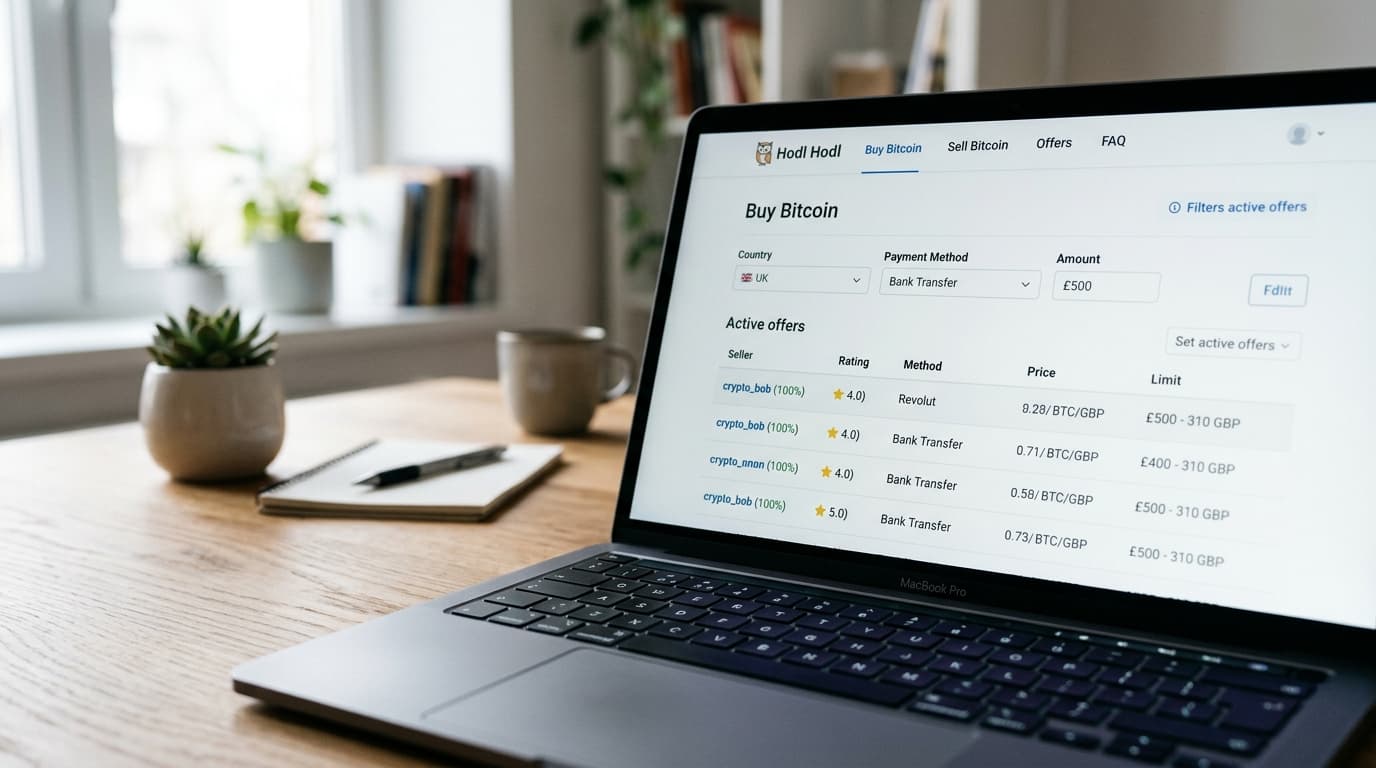
Click "Buy BTC" or "Sell BTC" to see available offers. You'll notice several variables that affect both price and privacy:
Payment method: Bank transfers, Revolut, PayPal, Zelle, Venmo, credit cards, and various e-wallets are commonly listed. The actual options depend on what individual sellers accept. Some methods (like bank wire) leave clearer paper trails than others (like cash by mail in certain jurisdictions, though this carries its own risks).
Premium or discount: Prices are usually set as a percentage above or below a reference exchange rate. Privacy often costs a premium; sellers accepting less traceable payment methods typically charge more.
Seller requirements: Here's the critical point many miss: while Hodl Hodl itself doesn't require KYC, individual sellers can demand whatever verification they want. Some sellers, especially those accepting chargeback-prone methods like PayPal, may require ID photos or selfies before releasing Bitcoin. Always read the offer terms before initiating a contract.
Seller reputation: Check completed trade counts and feedback ratings. New sellers aren't necessarily scammers, but established traders with clean histories reduce your risk.
Filter by your currency and preferred payment method to narrow the list.
Step 4: Initiate a Buy Contract
Once you've found a suitable offer, click it to open the trade details. Enter the amount you want to buy and paste your receiving address from your self-custody wallet.
When you initiate the contract, several things happen:
- A unique 2-of-3 multisig escrow address is generated for this specific trade
- The seller is notified and must fund the escrow with the agreed Bitcoin amount
- You wait for the seller's deposit to receive at least one on-chain confirmation
Do not send any fiat until you see the escrow funded and confirmed. This is a basic precaution against fraud. The contract interface will show the escrow status clearly.
Step 5: Send Payment and Mark as Paid
Once the escrow shows confirmed funding, send your fiat payment according to the seller's instructions. These might include specific payment references or account details visible only after contract initiation.
After sending, click the button to mark the trade as "Paid." This notifies the seller to check their account and release the Bitcoin.
A practical privacy note: even if Hodl Hodl doesn't know who you are, your bank does. Large or unusual transfers may trigger questions from your bank or payment processor. Some traders prefer smaller, more frequent trades to avoid drawing attention.
Step 6: Receive Bitcoin and Confirm
Once the seller confirms receipt of your fiat payment, they'll use their key to release the Bitcoin. Combined with your key (which Hodl Hodl uses automatically on your behalf once you confirm receipt), the funds move directly to your self-custody wallet address.
The transaction will appear in your wallet after it propagates through the mempool and receives confirmations. This typically takes 10-60 minutes depending on network congestion and the fee paid.
Selling Bitcoin: The Reverse Flow
If you're selling rather than buying, the process inverts:
- Select or create a "Sell BTC" offer with your terms
- When a buyer accepts, a multisig escrow address is generated
- You send Bitcoin from your self-custody wallet to this escrow address
- Wait for the buyer's fiat payment to arrive in your account
- Release the Bitcoin from escrow
You can create custom offers specifying your price formula (tied to Binance, Kraken, or other reference exchanges), acceptable payment methods, minimum and maximum trade sizes, and whether the offer is public or visible only to users with a link.
Experienced traders effectively operate as their own P2P desk, setting working hours, first-trade limits for new counterparties, and premium structures that reflect their risk tolerance.
Privacy Beyond the Platform
Hodl Hodl's architecture enables private trading, but Bitcoin transactions remain permanently traceable on-chain. True privacy requires operational security beyond the platform:
Network privacy: Consider accessing Hodl Hodl through Tor or a reputable VPN to shield your IP address. This prevents linking your trading activity to your physical location.
Fund separation: Never mix Bitcoin purchased without KYC with coins withdrawn from exchanges that have your identity. Once you do, blockchain analysis firms can potentially connect your "clean" coins to your known identity.
Post-trade privacy: Some users run their non-KYC Bitcoin through CoinJoin transactions before spending. This breaks the deterministic link between your receiving address and subsequent transactions, though it's not foolproof.
Payment method awareness: Your payment rail may have its own surveillance. Zelle transactions are visible to your bank. Venmo and PayPal maintain detailed records. Even cash deposits leave ATM camera footage. Consider these factors when selecting payment methods.
Disputes and Resolution
If a trade goes wrong, you can start a dispute through the contract interface. Hodl Hodl's support team reviews evidence from both parties and can use their third key to join with whichever party they determine is honest.
Importantly, this process cannot be abused by Hodl Hodl itself. The 2-of-3 multisig means they need cooperation from at least one trading party to move any funds. Your counterparty cannot steal your Bitcoin without also compromising Hodl Hodl.
Documentation helps. Screenshot payment confirmations, keep communication logs, and provide clear evidence if disputes arise.
Legal Considerations
Hodl Hodl's lack of platform-level KYC doesn't exempt users from local laws. Tax obligations, reporting requirements, and the legality of P2P cryptocurrency trading vary significantly by jurisdiction.
Some countries have specific thresholds that trigger reporting obligations for peer-to-peer transactions. Others restrict certain payment methods or require licenses for frequent trading activity. Payment processors may also impose their own AML/KYC rules even for P2P trades.
Private trading means taking responsibility for your own compliance. Research your local requirements before developing a regular trading pattern.
Who Hodl Hodl Works For
This platform makes sense for privacy-focused Bitcoiners who understand P2P dynamics and accept responsibility for vetting counterparties. The multisig escrow provides genuine protection, and the fee structure (at most 0.5% per trade with possible discounts) is competitive with centralized alternatives once you factor in their combined trading and withdrawal fees.
Hodl Hodl is not the right choice if you want a simple retail brokerage experience or if your institution requires regulated venues for compliance reasons. The learning curve exists, and the responsibility is yours.
But for those willing to engage with the system as designed, Hodl Hodl offers something increasingly rare in 2026: a way to acquire Bitcoin while maintaining meaningful financial privacy.