
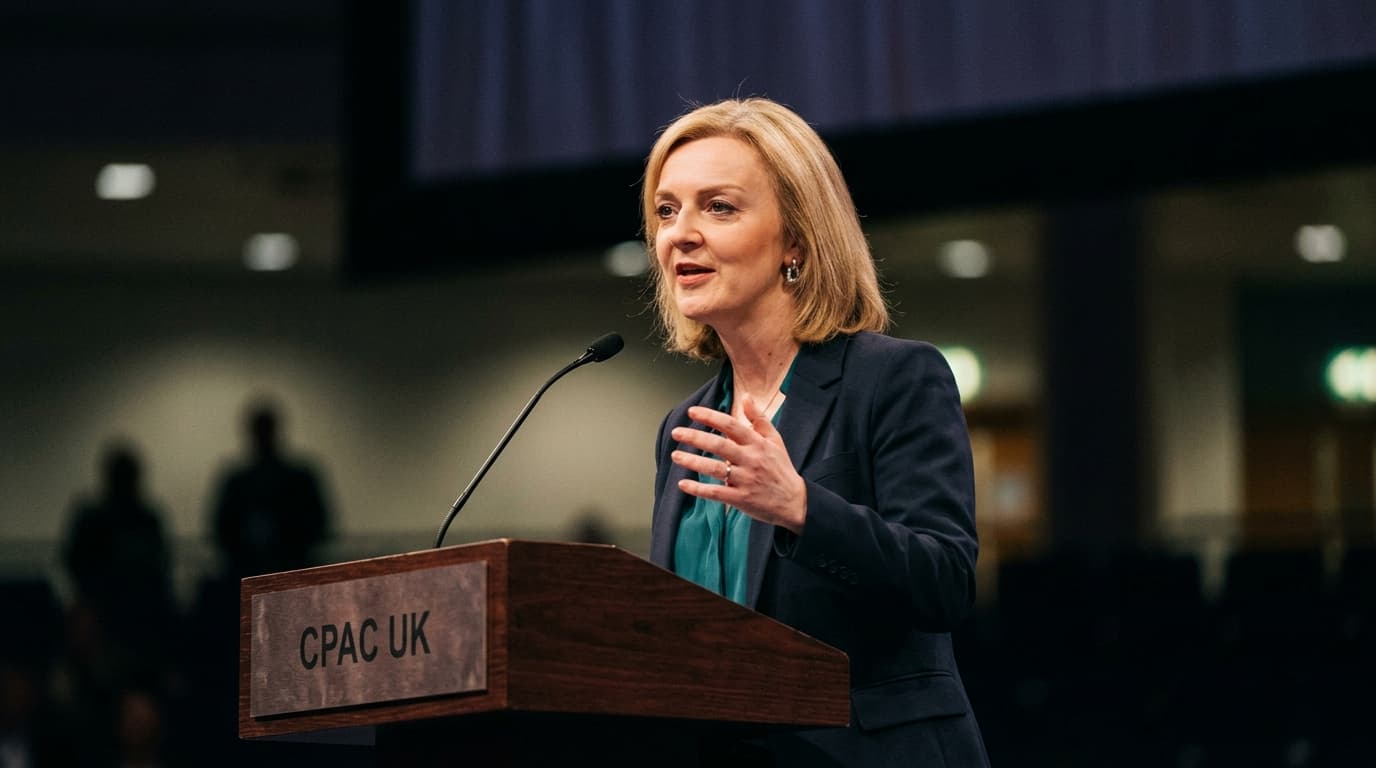
Former UK PM Liz Truss Endorses Bitcoin as Alternative to Central Banking After Economic Criticism
Liz Truss calls Bitcoin 'sound money' and criticizes UK monetary policy at CPAC UK, signaling growing political interest in institutional bitcoin adoption.
Liz Truss, whose 45-day premiership in 2022 ended in market chaos, is now positioning herself as a vocal advocate for Bitcoin as a remedy to what she calls decades of currency debasement in the United Kingdom.
Speaking on April 18, 2026, the former Prime Minister described the UK economy as being on a "very negative trajectory," citing weak growth, high taxes, regulatory burdens, and energy costs. But her sharpest criticism targeted something rarely discussed in mainstream British politics: monetary policy itself.
"I'm very interested in Bitcoin," Truss stated, framing it as "sound money" and a tool against the centralized control she believes has impoverished the public through inflation and money printing.
From Treasury Skeptic to Bitcoin Advocate
Truss's interest in Bitcoin isn't new. She first encountered cryptocurrency during her tenure at the Treasury from 2017 to 2019, where she reportedly supported it despite resistance from the Bank of England. She has since spoken at Bitcoin conferences in 2025 and is now launching CPAC UK, a three-day conference focused on what she calls the "sovereignty and liberty" movement.
Her critique extends beyond policy disagreements into what she characterizes as institutional suppression of debate. The lack of discussion on monetary policy in government and academia, she argued, is "quite sinister" and treated as "taboo," contributing to entrepreneurial disincentives and economic stagnation.
This framing matters because it positions Bitcoin not merely as a speculative asset, but as a political statement about monetary sovereignty, a narrative that resonates with libertarian and conservative movements globally.
Context and Credibility Questions
Truss's economic credibility remains contested. Her 2022 mini-budget triggered a sterling plunge, a surge in gilt yields, and near-collapse of pension funds using leveraged strategies. She now blames systemic fragilities rather than her fiscal proposals, pointing to the vulnerability of pension schemes that were exposed by rate volatility.
Critics will reasonably ask whether someone whose brief tenure destabilized markets should be advocating for alternative monetary systems. Supporters counter that the very market fragility her budget exposed validates her broader critique: that decades of low-rate policy and quantitative easing created an unstable financial architecture.
The timing of her remarks coincides with the IMF's April 2026 downgrade of UK growth forecasts for both 2026 and 2027, attributed to weak late-2025 performance and external factors including geopolitical tensions. This provides ammunition for Truss's argument that current approaches aren't working.
What Institutional Bitcoin Adoption Could Mean for the UK
Truss's advocacy raises a practical question: what would meaningful institutional bitcoin adoption look like for UK economic policy?
In the United States, firms like NYDIG have built regulated infrastructure allowing banks, corporations, and high-net-worth individuals to custody, trade, and integrate Bitcoin into treasury operations. NYDIG's model enables traditional financial institutions to offer Bitcoin services through existing apps, potentially normalizing bitcoin as part of standard banking relationships.
The UK has taken a more cautious approach. While the Financial Conduct Authority has registered some crypto firms, the regulatory environment remains uncertain, with repeated delays to comprehensive crypto legislation. A political figure of Truss's profile advocating for Bitcoin as "sound money" could shift the Overton window, even if she remains outside government.
However, it's worth noting the gap between rhetorical support and policy implementation. Truss has not outlined specific legislative proposals for Bitcoin adoption, and her CPAC UK conference appears focused on movement-building rather than detailed economic reform.
The Broader Political Signal
What makes Truss's endorsement notable isn't necessarily its policy specificity, but what it represents: a former G7 leader explicitly framing Bitcoin as a response to central banking failures.
This is different from politicians who discuss "blockchain innovation" or "digital assets" in vague, technology-neutral terms. Truss is making an ideological argument: that currency debasement through money printing is a deliberate choice that enriches some at the expense of others, and that Bitcoin offers an exit.
Whether one agrees with this framing depends largely on one's views about monetary policy, inflation, and the proper role of central banks. Mainstream economists generally argue that flexible monetary policy provides essential counter-cyclical tools; Bitcoin advocates counter that this flexibility enables endless debasement without democratic accountability.
Looking Forward
Truss's CPAC UK conference will test whether her Bitcoin advocacy can translate into a broader political movement. The conference aims to bring together entrepreneurs and activists concerned about economic decline, creating a potential coalition between cryptocurrency advocates, small-government conservatives, and those skeptical of institutional expertise.
For Bitcoin specifically, having former heads of government as advocates normalizes the asset class in political discourse, even when those advocates carry baggage. The question is whether this translates into substantive policy discussions or remains rhetorical positioning.
Institutional adoption in the UK would likely require regulatory clarity, banking partnerships willing to integrate Bitcoin services, and political will to treat it as more than a speculative asset. Truss may or may not be positioned to deliver any of these, but her public stance ensures the conversation continues.