
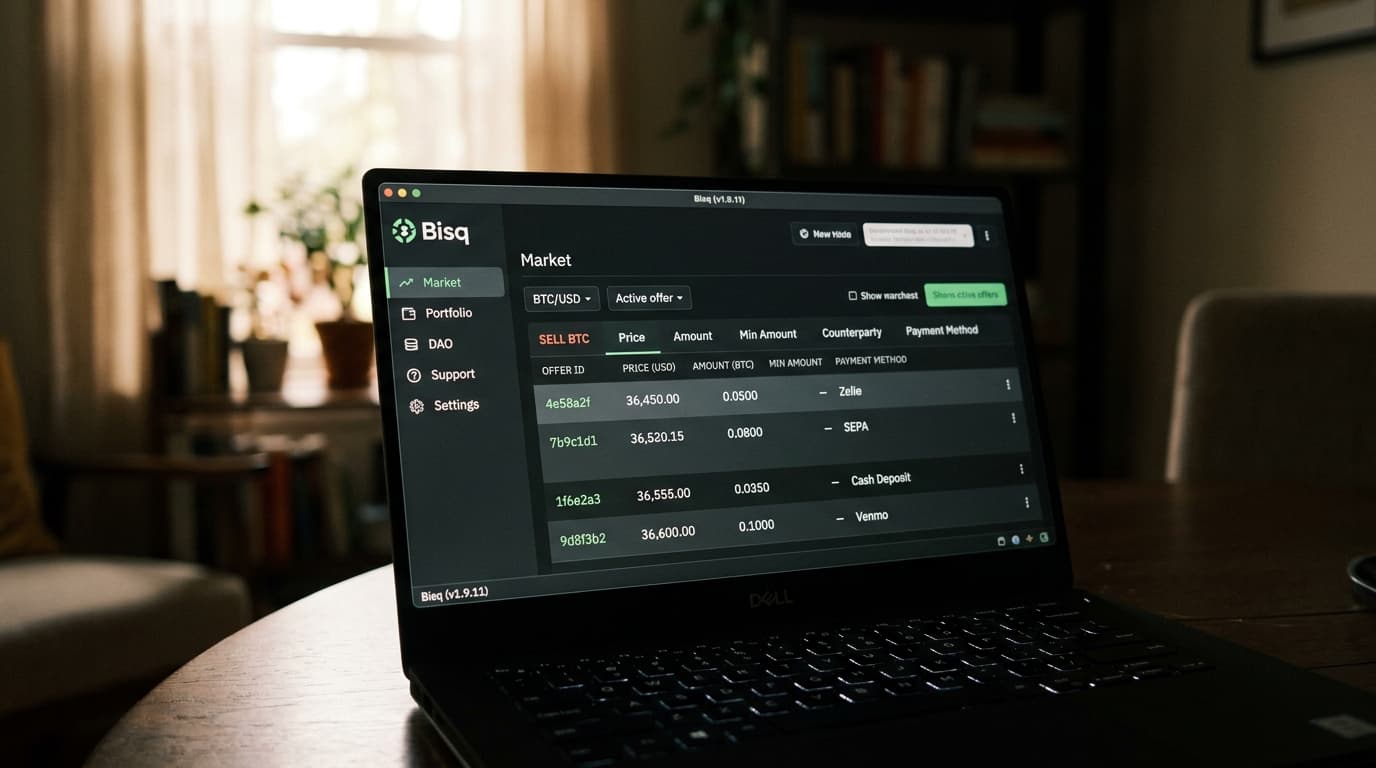
Bisq Review 2026: Is It Safe? Bisq 1 vs Bisq 2
A no-KYC exchange with no company behind it, that made hacked users whole through its DAO. An honest look at Bisq's fees, safety, and which version to use.
Bisq is what a Bitcoin exchange looks like when nobody owns it. There is no company, no CEO, no signup, no identity check, and no central pile of coins sitting on a server waiting to be stolen. It is a piece of free software and a network of people running it over Tor, governed by a DAO that pays its own contributors out of trading fees.
That design gets tested in ways a normal exchange never faces. On May 1, 2026, an attacker using a modified client found a validation gap in the older Bisq software and drained value out of ten active trades. There was no corporate treasury to make those traders whole. So the community did it anyway, fronting roughly 11 bitcoin through a reimbursement effort and routing future DAO revenue to cover it.
Hold both of those facts at once and you understand Bisq. It is one of the only genuinely non-custodial, no-KYC ways to buy and sell bitcoin, and it asks more of you than any app with a support line ever will.
Bisq has no affiliate program and never has, so this review has no reason to push it on you. Here's the honest accounting.
Below: what Bisq actually is, how Bisq 1 and Bisq 2 differ and which to use, whether it's safe after the 2026 incident, what it really costs, and how it stacks up against the other no-KYC options.
Five things to know before you download it:
- It's the real thing. Non-custodial, no KYC, no account, Tor by default. Bisq never touches your coins, and there's no central database of who traded what.
- There are two apps, not one. Bisq 1 is the heavier desktop app with multisig escrow for larger trades. Bisq 2 (running the Bisq Easy protocol) is the lighter, reputation-based on-ramp built for your first small no-KYC buy.
- "Free" and "cheap" aren't the same. Bisq Easy charges zero trading fees, but sellers bake a 10 to 15 percent premium into the price. Bisq 1 charges around 1.3 percent but secures the trade with real bitcoin collateral.
- It got hit in 2026, and the hit was narrow. The exploit affected active traders on Bisq 1 during the attack window. It did not, and structurally could not, drain idle users' funds. Victims were reimbursed.
- It rewards the self-reliant and punishes everyone else. No chargebacks, no undo, no help desk. Lose your seed and it's gone. That's the cost of an exchange nobody can shut down.
At a glance: Bisq in 2026
| What it is | Non-custodial, no-KYC, peer-to-peer Bitcoin exchange run by a DAO (no company) |
| Two apps | Bisq 1 (multisig desktop, larger trades) and Bisq 2 / Bisq Easy (reputation-based, first small buys) |
| Custody | Non-custodial. Bisq 1 locks trades in 2-of-2 multisig escrow; Bisq holds no keys |
| KYC | None. No account, no ID, Tor by default |
| Fees (Bisq 1) | ~1.3% paid in BTC, ~0.65% paid in BSQ, plus on-chain mining fees (per the Sept 2025 schedule) |
| Fees (Bisq Easy) | Zero trading fee; sellers add a ~10–15% premium instead |
| Trade size | Bisq Easy roughly $6 to $600; Bisq 1 up to 0.25 BTC |
| Platforms | Desktop (Windows, macOS, Linux); mobile apps added in 2026 |
| Best for | Bitcoiners who want no-KYC, no counterparty custody, and will trade convenience for it |
| Not for | Anyone wanting instant fills, deep liquidity, live support, or a one-tap phone buy |
| Latest versions | Bisq 1 v1.10.2, Bisq 2 v2.1.11 (mid-2026), both actively maintained |
What Bisq actually is
Most "decentralized" exchanges are a company with a marketing department. Bisq isn't. It's free software under the AGPLv3, a peer-to-peer network where every node runs as a Tor hidden service, and a DAO that funds its own development from trading fees. There's no registration, no email, no identity verification, and no central server holding balances. In Bisq's own words, users always retain control of their funds, and Bisq never holds them.
The thing that makes this more than a slogan is the escrow design on Bisq 1. When you take an offer, the trade amount and a security deposit from both sides lock into a 2-of-2 multisig address that only you and your counterparty can sign. Bisq the project doesn't hold a key. The developers can't move your money, a court can't order them to, and a hack of "Bisq" can't drain a vault that doesn't exist. When the trade completes cleanly, the deposits release back automatically.
You pay for that with effort. Liquidity is thinner than a centralized exchange, fills aren't instant because there's a human on the other side, and the interface assumes you know what a seed phrase is. Bisq isn't trying to be Coinbase without the KYC. It's a different machine entirely, built so that no single party, including the people who wrote it, can stand between you and a trade.
Bisq 1 vs Bisq 2: which one to use
There are two separate Bisq applications, not one. Which you want depends entirely on what you're trying to do, and the difference is worth getting straight before you download anything.
Bisq 1 is the original desktop app: 2-of-2 multisig escrow, security deposits, the BSQ token and the DAO, and trades up to 0.25 bitcoin. Bisq 2 is the successor, and its one live trade protocol is called Bisq Easy. Bisq Easy throws out the security deposit and replaces it with seller reputation. There's no collateral to post, no trading fee, and no mining fee for the buyer, which is exactly what a first-time buyer who owns zero bitcoin needs, because they have nothing to post as a deposit in the first place.
The trade-off is real and worth stating plainly. Bisq 1 secures your trade with bitcoin locked in multisig. Bisq Easy secures it with the seller's reputation, built by burning or bonding BSQ and by account age. That's a weaker guarantee, which is why Bisq Easy caps trades at roughly $600. It's the right tool for stacking your first small no-KYC sats, and the wrong tool for moving real size.
Bisq 2 is the strategic future, but it doesn't fully replace Bisq 1 yet. That handoff is gated on a new protocol called Bisq MuSig, a Taproot-based multisig design meant to give Bisq 2 the same hard collateral guarantees Bisq 1 has today, with fewer on-chain transactions. Until MuSig ships, Bisq 1 remains the tool for larger multisig-secured trades, for BSQ, and for the DAO. The honest 2026 framing: start on Bisq Easy for a small first buy, reach for Bisq 1 when you want size or security, and watch for MuSig to eventually merge the two.
Is Bisq safe?
This deserves a precise answer rather than a reassuring one. Bisq is safe in the way that matters most and demanding in ways that catch people off guard.
Start with what "Bisq got hacked" does and doesn't mean. Bisq has had two notable incidents in its history, in April 2020 and May 2026, and both were the same shape: a logic bug in the Bisq 1 trade protocol, exploited by someone running a modified client, that let them siphon value out of trades they were actively party to. Neither was a breach of a central server, because there isn't one. Neither drained a custodial wallet, because Bisq holds no balances. If you weren't in an active trade during the exploit window, you were never exposed.
The 2026 incident is the one to understand. An attacker exploited a missing check: the taker in a trade defines the miner fee, and that value wasn't validated against negative numbers, which let the attacker manipulate the multisig output and pull value out. Ten users were affected, three of them bearing most of the damage, for a total of about 11.6 bitcoin. Bisq 2 and Bisq Easy were untouched. The project halted trading with an emergency kill switch, shipped a hardening release (v1.10.0) that tightened validation across the protocol, and reimbursed the affected traders, roughly $890,000 worth, through community "Refund Angels" with the cost flowing back through the DAO. Bisq described the attack as likely AI-assisted, though it hasn't detailed what that means, so treat that as the project's characterization rather than an established fact.
What the incident proves is that residual trade-protocol risk on Bisq 1 is real and non-zero, scoped to active traders. What it also proves is that the failure mode is narrow and the recovery worked. Two protocol bugs in six years, both contained by a network-wide halt, both ending with victims made whole. That's a meaningfully different risk profile than the custodial exchanges that simply vanish with everyone's coins.
Then there's the Trustpilot problem. Bisq sits at 1.8 out of 5, rated "Poor." That number is real and shouldn't be buried, but it's 28 reviews, which tells you about complaint themes more than quality. Read them and the pattern is clear: people who expected a centralized exchange and met a peer-to-peer network instead, people who violated a trade's rules and forfeited a security deposit, and people frustrated that there's no live support line. Some are genuine counterparty scams, the kind the deposit and dispute system exists to deter. Very little of it is the platform losing custodied funds, because the platform custodies nothing.
So, is it safe? In the custodial sense, more than almost anything else you can use: you hold your keys, there's no honeypot, and no company can freeze or lose your money. In the operational sense, it's unforgiving. There are no chargebacks and no undo. There's no password reset, so your seed backup is the whole ballgame. The most common real-world danger isn't even the bitcoin side, it's the banking side, where a scammer pays with a stolen account that later reverses, or your bank flags the transfer. Bisq is genuinely secure and genuinely demanding, and anyone who tells you it's one without the other is selling you something.
What Bisq actually costs
Bisq's pricing is honest, which paradoxically makes it look expensive, because it shows you costs that custodial apps hide in the spread.
On Bisq 1, the trading fee runs about 1.3 percent if you pay in BTC, split as roughly 0.15 percent for the maker and 1.15 percent for the taker, per the fee schedule last updated in September 2025. Pay the fee in BSQ instead and you get roughly a 50 percent discount, landing near 0.65 percent. On a $1,000 buy, that's about $13 in BTC or half that in BSQ. On top of the trading fee you pay on-chain mining fees on both the deposit and the payout transactions, and you temporarily lock up a refundable security deposit, so you need to fund more bitcoin up front than the trade itself requires. The BSQ rates float every DAO cycle, so treat the percentages as durable and any exact figure as a snapshot.
On Bisq Easy, the trading fee is zero. Buyers pay no fee and no mining fee. The catch is the seller premium: because the seller is taking on the cost and risk of onboarding a stranger with no collateral, they typically price 10 to 15 percent above market. On a $500 first buy, that "free" trade quietly costs you $50 to $75 in the price itself. For a beginner converting a small amount of fiat into self-custodied bitcoin with no deposit and no friction, that can be a fair trade. For anyone moving real size, it's a terrible one, which is the whole reason Bisq Easy caps trades around $600 and Bisq 1 exists for everything above it.
The takeaway: nothing about self-custody is free. You either run Bisq 1 and pay a transparent ~1.3 percent plus chain fees, or you use Bisq Easy and pay a premium baked into the rate. Both beat handing your identity and your coins to a custodian, which is the actual alternative.
Buying your first sats on Bisq Easy
If you're starting from zero, Bisq Easy is the path, and the flow is short. Download Bisq 2 only from the official site and verify the installer before you run it. On first launch, write down your recovery seed and back it up, because that's your only way back in. Set up a profile nickname, no email or ID required.
From there, open Bisq Easy, start the trade wizard, and choose to buy bitcoin. Pick the currency you'll pay with, an amount under the roughly $600 cap, and a fiat payment method. You'll see available sellers ranked by reputation as a star rating, so favor the higher-reputation ones. Use the built-in Tor chat to confirm details, send the fiat first, and once the seller confirms they've received it, they release the bitcoin to your address. There's no deposit to return, so the trade is simply done. A moderator can step in if something goes wrong. For a fuller walkthrough of the classic multisig flow, our Bisq trading guide covers a first non-KYC purchase end to end.
Bisq vs the other no-KYC options
Bisq isn't the only way to get bitcoin without handing over your ID, and it isn't always the best one. Here's how the honest no-KYC field compares.
| Service | Custody | KYC | Lightning | Typical fee | Best for |
|---|---|---|---|---|---|
| Bisq Easy | Non-custodial, reputation-based | None | Yes (settlement) | $0 fee, ~10–15% seller premium | A first small no-KYC buy |
| Bisq 1 | Non-custodial, 2-of-2 multisig | None | No | ~1.3% BTC / ~0.65% BSQ + chain | Larger no-KYC P2P trades |
| RoboSats | Non-custodial, Lightning escrow | None | Yes (native) | ~0.2% total | Small, fast, private Lightning trades |
| Hodl Hodl | Non-custodial, 2-of-3 multisig | None | Via Arkade L2 | ~0.75%/party (0.5% referred) | Larger non-custodial trades |
| Trocador | Non-custodial swap aggregator | None (filterable) | Yes | Embedded spread | A quick private swap into BTC |
| LocalCoinSwap | Non-custodial escrow | Optional | No | 1% maker, 0% taker | Broad payment-method coverage |
| Peach | Non-custodial, 2-of-2 | None under 1,000 CHF/day | Yes (swaps) | 2% buyer, free to sell | Mobile-first European buyers |
A few honest distinctions behind the table. RoboSats is the Lightning-native pick: a one-click robot identity, the lowest fees in the set at around 0.2 percent, and a federation of independent coordinators so no single operator can shut it down. It's still alpha-tagged with small limits and liquidity fragmented across coordinators, so it's best for small, fast trades rather than size. Hodl Hodl is the one to reach for when you want a larger non-custodial trade, with 2-of-3 multisig and contracts up to 5 bitcoin at the top tier, run by a company that still can't touch your funds. Trocador is a different animal: not a P2P order book but a swap aggregator that routes you to instant exchanges with no account and Tor support, ideal for "I just want to privately swap into bitcoin and move on." LocalCoinSwap is the broad-payment-method successor to the LocalBitcoins era, with hundreds of payment methods, though its momentum has cooled.
Peach Bitcoin is the mobile-first option, with the cleanest phone experience, deep European liquidity, and no KYC under 1,000 CHF per day. Worth disclosing: Peach is backed by Ten31, where I'm Managing Partner, so weigh that against the recommendation as you see fit. It's a regulated Swiss operator that co-signs every trade's escrow, which is a different posture than Bisq's no-entity-to-target design.
The pattern: Bisq is the maximalist's choice precisely because there's no company behind it. If that's the property you care about most, nothing else here matches it. If you care more about Lightning speed, larger trades, or a good mobile app, one of the others fits better.
What you might be looking for instead
- A wallet to hold your sats after you buy them. Buying no-KYC and then parking the coins on the exchange defeats the point. Move them to self-custody.
- A no-KYC purchase without the P2P learning curve. Look at RoboSats for Lightning or Peach for a mobile flow.
- The classic Bisq multisig walkthrough. Our Bisq trading guide covers a first non-KYC purchase step by step.
- The directory view of Bisq. The Bisq listing has the quick-reference card.
Which Bisq path fits you
- You own little or no bitcoin and want your first no-KYC sats. Use Bisq 2 / Bisq Easy. Accept the ~$600 cap and the seller premium in exchange for zero fees, no deposit, and a gentle flow.
- You already hold bitcoin and want to trade real size without KYC. Use Bisq 1. You'll post a deposit and pay around 1.3 percent, but you get hard multisig collateral securing the trade.
- You want the fastest, cheapest private trade and you're comfortable on Lightning. RoboSats over Bisq, with the caveat that it's alpha and small.
- You want a larger non-custodial trade with a smoother interface. Hodl Hodl, up to several bitcoin per contract.
- You mainly want a phone app and you're in Europe. Peach, noting the Ten31 backing flagged in the comparison above.
- You don't actually need P2P at all, just a private swap. Trocador's aggregator, not an order book.
What to actually do this week
If you've never bought bitcoin without KYC, download Bisq 2, verify it, back up your seed, and run one small Bisq Easy trade just to learn the flow. The point isn't the amount, it's removing the mystery.
If you already stack on a custodial exchange, do one no-KYC trade this month as insurance against the day your account gets frozen or your exchange decides your withdrawals are someone else's business. Knowing how to get sats without permission is a skill worth having before you need it.
If you're trading real size, use Bisq 1 and treat the security deposit and multisig as features, not friction. Fund a little extra to cover the deposit and chain fees, and don't violate a trade's terms unless you want to learn how forfeiture works.
If you got spooked by the 2026 incident, re-read what it actually was: a narrow Bisq 1 protocol bug, contained, with victims reimbursed, and Bisq 2 untouched. Then make your own call rather than letting a headline make it for you.
If you're privacy-focused above all, run Bisq over Tor as designed, keep your payment details off centralized rails where you can, and remember that the biggest real-world risk is the banking side of the trade, not the bitcoin side.
Frequently asked questions
Is Bisq safe to use in 2026?▾
Yes, with the right expectations. Bisq is non-custodial, so it never holds your coins and there's no central wallet to be drained. Its two security incidents (2020 and 2026) were both narrow Bisq 1 trade-protocol bugs that affected active traders during the exploit window, not idle users, and both ended with victims reimbursed. The real risks are operational: no chargebacks, no support desk, and the burden of backing up your own seed.
Is Bisq legit?▾
It's one of the most legitimate non-custodial exchanges in Bitcoin, and also one of the oldest, having run for the better part of a decade. The low Trustpilot score reflects users expecting a centralized exchange and rule violations on trades more than any platform-level fraud, since the platform custodies nothing it could steal.
What's the difference between Bisq 1 and Bisq 2?▾
Bisq 1 is the original desktop app with 2-of-2 multisig escrow, security deposits, and trades up to 0.25 bitcoin. Bisq 2 runs the Bisq Easy protocol, which is reputation-based with no deposit and no trading fee, capped around $600, and built for first-time buyers. Bisq 2 is the future but won't fully replace Bisq 1 until the MuSig protocol ships.
How much does Bisq cost?▾
Bisq 1 charges about 1.3 percent paid in BTC, or roughly 0.65 percent paid in BSQ, plus on-chain mining fees, per the September 2025 schedule. Bisq Easy charges no trading fee at all, but sellers typically add a 10 to 15 percent premium to the price, so a "free" small buy still carries a real cost baked into the rate.
Does Bisq require KYC?▾
No. There's no account, no email, and no identity verification, and the network runs over Tor by default. Bisq Easy and Bisq 1 are both no-KYC. The only identity friction anywhere nearby is on certain alternatives, not on Bisq.
Was Bisq hacked?▾
Bisq 1's trade protocol was exploited twice, in April 2020 and on May 1, 2026. Each time an attacker used a modified client to abuse a validation bug and pull value from active trades. Neither was a server breach or a drained custodial wallet. In 2026 about 11.6 bitcoin were taken from ten users, and the affected traders were reimbursed through community and DAO mechanisms. Bisq 2 was not affected.
Can I use Bisq on my phone?▾
Bisq added mobile apps in 2026, including a Bisq Easy mobile app and a companion app for remote control, alongside the long-standing desktop versions for Windows, macOS, and Linux. The desktop apps remain the most complete experience, especially for Bisq 1.
Is Bisq better than RoboSats or Hodl Hodl?▾
It depends on what you're optimizing for. Bisq wins on decentralization, since there's no company behind it to pressure or shut down. RoboSats wins on Lightning speed and low fees for small trades. Hodl Hodl wins on larger non-custodial trades with a simpler interface. Many serious no-KYC users keep accounts on more than one.
What payment methods does Bisq support?▾
Bisq 1 supports more than 20 fiat payment methods, including SEPA, Zelle, Revolut, Interac e-Transfer, and bank transfers, with tighter trade limits on the higher-risk chargeback-prone methods. Bisq Easy supports a range of fiat methods chosen between you and the seller during the trade.
Do I need to hold BSQ to use Bisq?▾
No. BSQ is Bisq's DAO token, and paying your trading fee in BSQ gets you roughly a 50 percent discount on Bisq 1, but you can pay in BTC instead. Bisq Easy has no trading fee, so it needs no BSQ from buyers at all.