
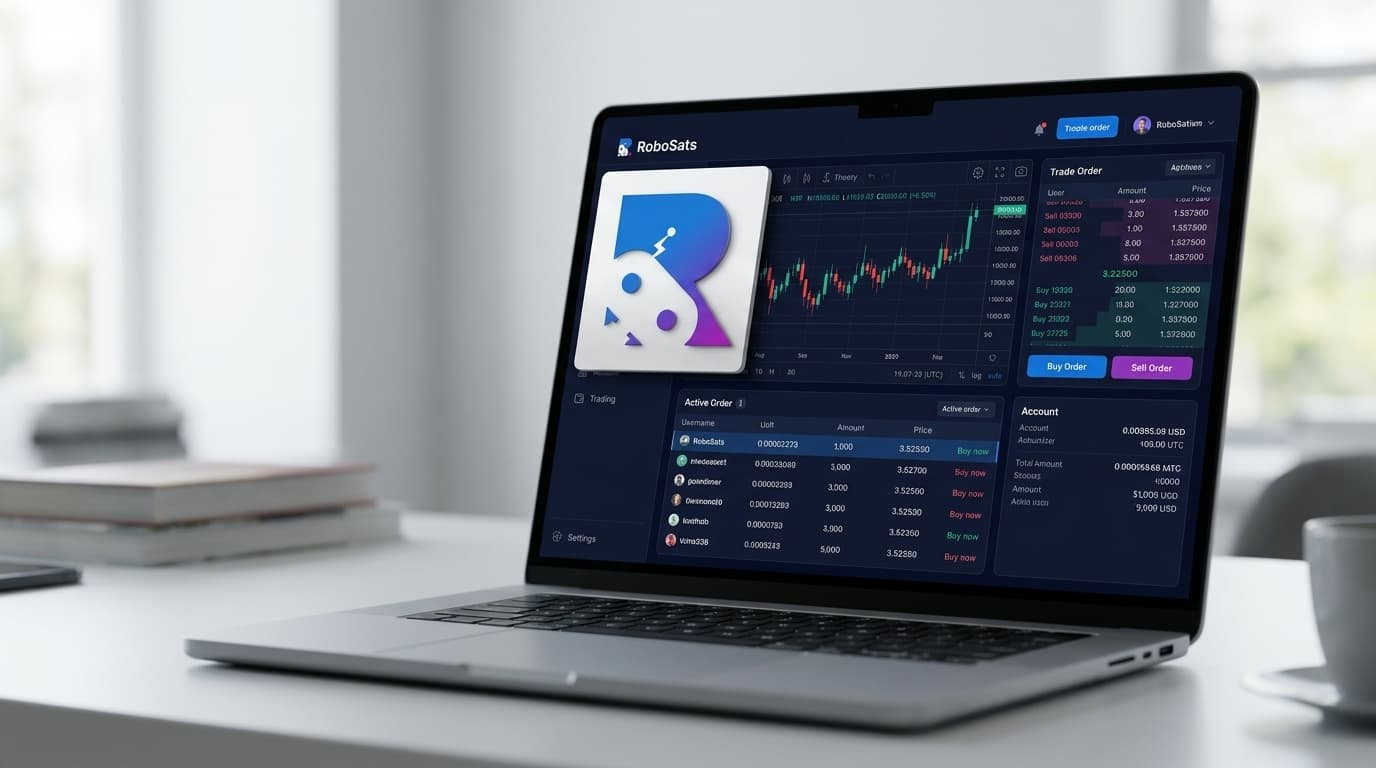
RoboSats Review for P2P Bitcoin Trading and Whether the Privacy Actually Holds Up
Research-based RoboSats review examining privacy features, liquidity, fees, and how this Tor-based P2P exchange compares to centralized alternatives.
A Bitcoin exchange that forgets you exist the moment your trade completes sounds almost too good to be true. RoboSats operates on exactly this premise: no accounts, no identity verification, no persistent data. You appear as a randomly generated robot avatar, trade peer-to-peer over the Lightning Network, and disappear back into the digital ether.
After roughly four years of operation and significant technical evolution, including a transition toward federated architecture, the platform has matured beyond early experimental status. But does the privacy actually hold up under scrutiny? And what practical tradeoffs come with trading in the shadows?
How RoboSats Works
RoboSats runs exclusively over Tor, the anonymity network, which immediately distinguishes it from conventional exchanges. There's no account creation process. Instead, you generate a unique robot identity for each trading session, complete with a disposable avatar. No email, phone number, or government ID required.
The trading mechanism uses Lightning Network hodl invoices as both fidelity bonds and escrow. When you want to buy or sell Bitcoin, you lock up a small amount as collateral. This incentivizes honest behavior without requiring a trusted third party to hold funds for extended periods. Transactions complete before the next blockchain block is mined, meaning the exchange never takes custody of your Bitcoin in any meaningful sense.
Makers (those who post offers) pay just 0.025% in fees, roughly $0.05 on a $200 trade as of the fee structure documented through 2024. Takers pay 0.175%. These rates undercut most centralized alternatives significantly.
For users who prefer traditional Bitcoin addresses over Lightning, the platform also supports on-chain payouts, though the Lightning-native approach remains the primary use case.
Privacy Features Under the Microscope
The privacy architecture goes deeper than just Tor access. Each robot identity comes with its own PGP encryption key pair, enabling end-to-end encrypted communication between trading peers. Notably, users can independently verify this encryption using any OpenPGP-compatible tool, rather than trusting the platform's claims at face value.
No personal information transmits through the system. Your trading counterparty sees your robot avatar and the payment method you've specified, but nothing linking to your real identity. Once a trade completes, you can simply generate a new robot for your next transaction.
The December 2023 introduction of the RoboSats Federation (version 0.6.0) pushed this further. Rather than relying on a single coordinating server, the platform began decentralizing into independent nodes. By March 2025, version 0.7.4 had moved from alpha testing to full release, suggesting the federated model has stabilized.
This architecture means that even if one federation node faces legal pressure or goes offline, others continue operating. The practical implication: no single point of failure for either uptime or user privacy.
Liquidity and Practical Limitations
Privacy comes with friction. The most significant constraint is liquidity. Because RoboSats operates peer-to-peer without market makers providing constant depth, you're dependent on other humans showing up to take the other side of your trade.
Historically, Lightning Network channel capacity limited maximum trade sizes to around 0.03-0.05 BTC per transaction. As Lightning infrastructure has matured, these limits have expanded, though large trades still often require splitting across multiple transactions or accepting wider spreads.
USD and EUR trading pairs historically showed the most active markets, according to reviews through 2024. Users seeking less common currency pairs may face longer wait times or less favorable pricing.
The platform launched a statistics tracking website in July 2024, providing transparency around volume and usage metrics. This helps traders assess real-time liquidity before committing to orders.
The Wallet Compatibility Challenge
RoboSats requires a Lightning-capable wallet, and this dependency creates its own complications. The May 2024 exit of Phoenix Wallet from U.S. markets, driven by regulatory pressure, exemplified how external forces can disrupt the P2P trading ecosystem even when the exchange itself remains accessible.
Users need to maintain compatible wallet infrastructure, which increasingly requires technical sophistication or willingness to use wallets that operate in legal gray areas depending on jurisdiction. Self-custodial Lightning wallets work best, but the learning curve remains steeper than downloading Coinbase.
How It Compares to Centralized Exchanges
The tradeoffs crystallize when you compare RoboSats against conventional platforms:
Privacy: RoboSats wins decisively. Centralized exchanges collect comprehensive personal data, report to tax authorities, and maintain permanent transaction records. RoboSats collects nothing and retains nothing.
Convenience: Centralized exchanges win here. Instant liquidity, bank integrations, and customer support make them easier for casual users.
Fees: RoboSats' 0.025-0.175% structure undercuts most centralized alternatives, though the comparison gets complicated when you factor in Lightning routing fees and potential spread widening on illiquid pairs.
Counterparty Risk: Neither approach eliminates it entirely. Centralized exchanges can freeze accounts, face hacks, or collapse (recall FTX). RoboSats' escrow mechanism minimizes exposure, but you're still trusting the hodl invoice system and potentially dealing with bad-faith traders, though the fidelity bond structure discourages this.
Regulatory Exposure: RoboSats trades leave no KYC trail, which matters for privacy but also means users bear full responsibility for their own tax compliance and legal considerations.
Recognition and Development Status
The Human Rights Foundation included RoboSats among 20 Bitcoin development projects receiving support from a 1 billion satoshi grant pool announced in September 2024, lending credibility to its mission of enabling censorship-resistant trading.
Active development continues through the public GitHub repository, with version updates occurring regularly through early 2025. The transition from experimental tool to functioning federation represents meaningful maturation, though users should still expect the occasional rough edge compared to polished commercial products.
Who Should Consider RoboSats
RoboSats makes the most sense for users who prioritize privacy over convenience and are comfortable with Lightning Network fundamentals. If you already run a Lightning node or use self-custodial Lightning wallets regularly, the learning curve flattens considerably.
It's also practical for smaller, regular purchases where the privacy benefits compound over time. Someone dollar-cost averaging into Bitcoin without creating a comprehensive exchange record will find the disposable robot identity model appealing.
Traders seeking large positions or requiring instant execution should look elsewhere. The liquidity constraints make RoboSats better suited for patient participants than high-frequency traders.
The Bottom Line
RoboSats delivers genuine privacy in a space where that's increasingly rare. The Tor-only access, end-to-end encryption, disposable identities, and federated architecture create meaningful protection against surveillance and data collection.
The costs are real: less liquidity, steeper learning curve, wallet compatibility headaches, and smaller maximum trade sizes. Whether those tradeoffs make sense depends entirely on how much you value financial privacy versus convenience.
For users who've decided privacy matters, RoboSats represents one of the more credible options available, backed by years of operation, active development, and a architecture designed from the ground up to know as little about you as possible.