
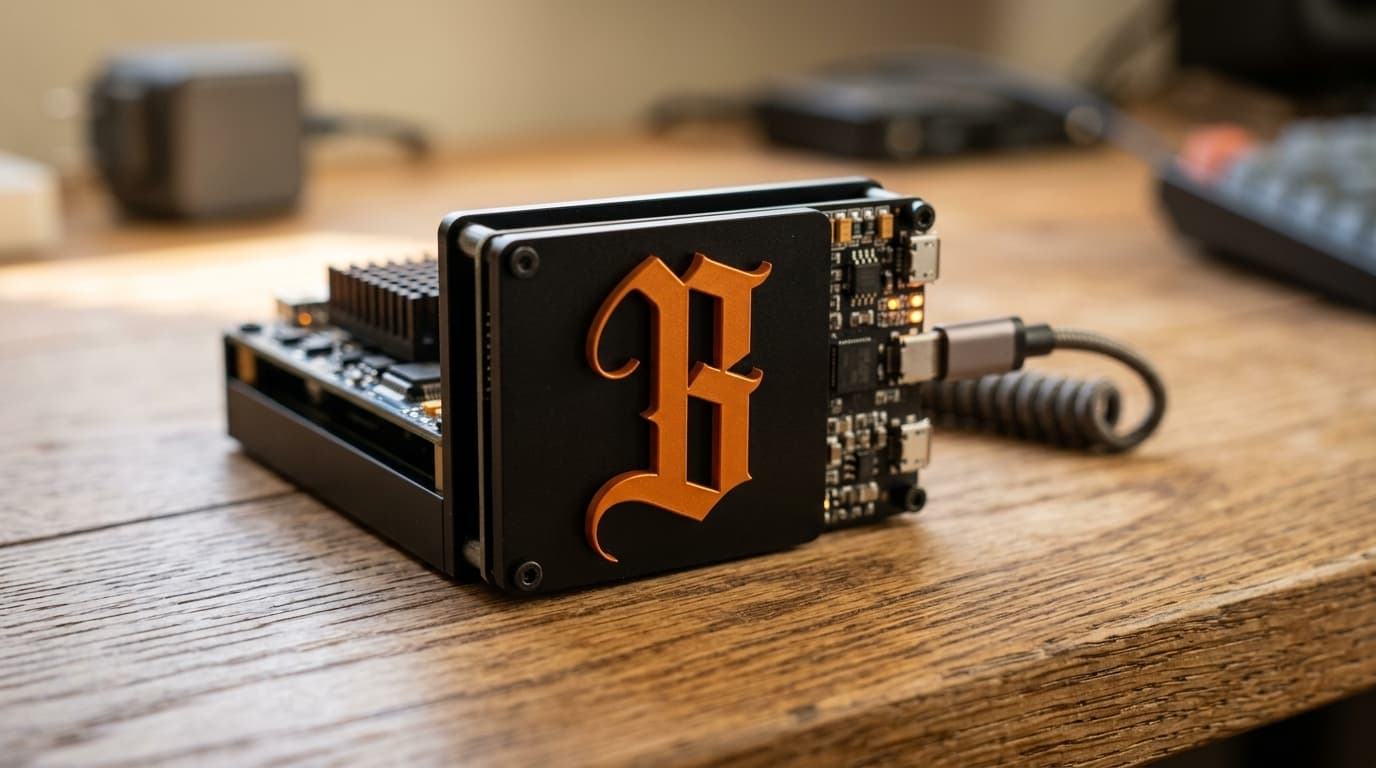
Bitcoin at $40,000 Would Be a Statistical Extreme, and That's Exactly When Bitaxe Miners Should Stay Online
A $40,000 Bitcoin would be a 0.4th percentile event. Here's why small-scale Bitaxe miners benefit most when large operations capitulate.
A drop to $40,000 Bitcoin would place holders in the 0.4th percentile of outcomes according to mean-reversion models. That's not a typo. Analyst James Check called such a move "near-unprecedented" in an April 2026 analysis, noting it would represent a statistical extreme far beyond typical corrections.
Yet some traders are positioning for exactly that scenario. And if it plays out, the dynamics of Bitcoin mining would shift in ways that favor small-scale operators running hardware like Bitaxe in their homes.
The Statistical Case Against $40,000
Bitcoin peaked above $126,000 in October 2025, crashed to $60,000 by February 2026, and now consolidates around $78,000. Even at current levels, the price sits 40% below its all-time high.
Crypto analyst Crypto Bullet has outlined a Double ZigZag wave pattern that projects a potential rebound to $82,500-$85,000 before a final leg down to $40,000 in September or October 2026. That would represent roughly a 50% drop from $80,000.
The historical precedent exists. Bitcoin's 2018 bear market saw a 79% drawdown to $3,200. The 2022 collapse brought a 76% decline to $15,500. A fall to $40,000 from the October 2025 peak would match that pattern at roughly 68% down.
But Check's statistical framing puts this in perspective: while possible, such a move would be an outlier event, not a baseline expectation. Markets can produce outliers, but betting on them requires acknowledging you're positioned against probability.
What Happens to Mining When Prices Collapse
When Bitcoin prices drop sharply, the economics of mining shift dramatically. Large industrial operations with thin margins and significant overhead costs face difficult decisions. Many reduce capacity or shut down entirely.
This triggers a network response that smaller miners can leverage.
Bitcoin mining difficulty dropped 2.43% to 135.59 trillion on April 17, 2026. This adjustment came amid hashrate exceeding 1 ZH/s and hashprice climbing 13.65%. A more significant 7.7% difficulty drop occurred in March 2026, reflecting broader pressure on mining operations.
When difficulty drops, every miner's probability of finding a block increases. The same hardware suddenly has better odds. This automatic adjustment mechanism, recalibrating roughly every two weeks, creates windows of opportunity for efficient small-scale miners.
Why Bitaxe Miners Benefit Disproportionately
The Bitaxe Gamma 601 delivers 1.2 TH/s at just 17 watts, achieving 14.17 J/TH efficiency. That efficiency matches or exceeds what industrial ASIC operations achieve, but at a fraction of the scale and cost.
At $0.07/kWh electricity rates, daily revenue sits around $0.015 as of late April 2026. That's marginal, but the math changes during difficulty drops when large competitors capitulate.
Here's what makes home mining hardware like Bitaxe resilient during downturns:
Ultra-low operating costs. A device drawing 15-18 watts costs roughly $0.03/day to run at average electricity rates. Even at near-zero profitability, the operational burden is negligible compared to industrial facilities paying for cooling, real estate, and staffing.
Low capital commitment. Bitaxe units typically cost $50-100. Losing your entire investment hurts far less than industrial operations with millions deployed.
Automatic difficulty relief. When large miners exit, network difficulty adjusts downward, automatically improving returns for those who remain.
No overhead pressure. Home miners don't face the fixed costs that force industrial operations to shut down. You can keep running through periods that would bankrupt larger competitors.
The Decentralization Argument
Beyond economics, there's a philosophical case for maintaining home mining operations during bear markets.
Bitcoin's security model depends on distributed hashpower. When mining concentrates among fewer large players, the network becomes theoretically more vulnerable. Home miners running open-source hardware contribute to decentralization regardless of whether they ever find a block.
Bitaxe's fully open-source design, with published schematics and modifiable firmware, aligns with Bitcoin's transparency ethos. Running one isn't primarily about profit. It's about participation in the network's security and governance.
The Counterargument
Fair consideration of the other side: mining at sub-penny daily margins ties up capital that could simply buy Bitcoin directly. If you believe Bitcoin will eventually recover, buying $100 worth at $40,000 would give you 0.0025 BTC. A $100 Bitaxe mining for years might never accumulate that much.
The counterpoint is that mining provides ongoing participation and education that purchasing doesn't. Understanding how blocks are found, how difficulty adjusts, and how pools distribute rewards creates knowledge that holding coins doesn't.
What This Means Going Forward
If Bitcoin does approach $40,000 in late 2026, expect significant mining capitulation among overleveraged industrial operations. Difficulty adjustments would follow, potentially dropping by double digits over several recalibration periods.
Those conditions would create the most favorable environment for small-scale miners in years. A Bitaxe that barely breaks even at current difficulty could become meaningfully profitable when industrial hashrate exits.
The question isn't whether to mine at $40,000 Bitcoin. It's whether to keep your hardware running now so you're already positioned when difficulty drops arrive. Powering down during consolidation means missing the adjustment windows that make small-scale mining worthwhile.
For Bitaxe operators drawing 15-18 watts of power, the cost of patience is roughly a dollar per month. The potential upside, both financially and philosophically, makes that a reasonable bet on Bitcoin's long-term trajectory.