
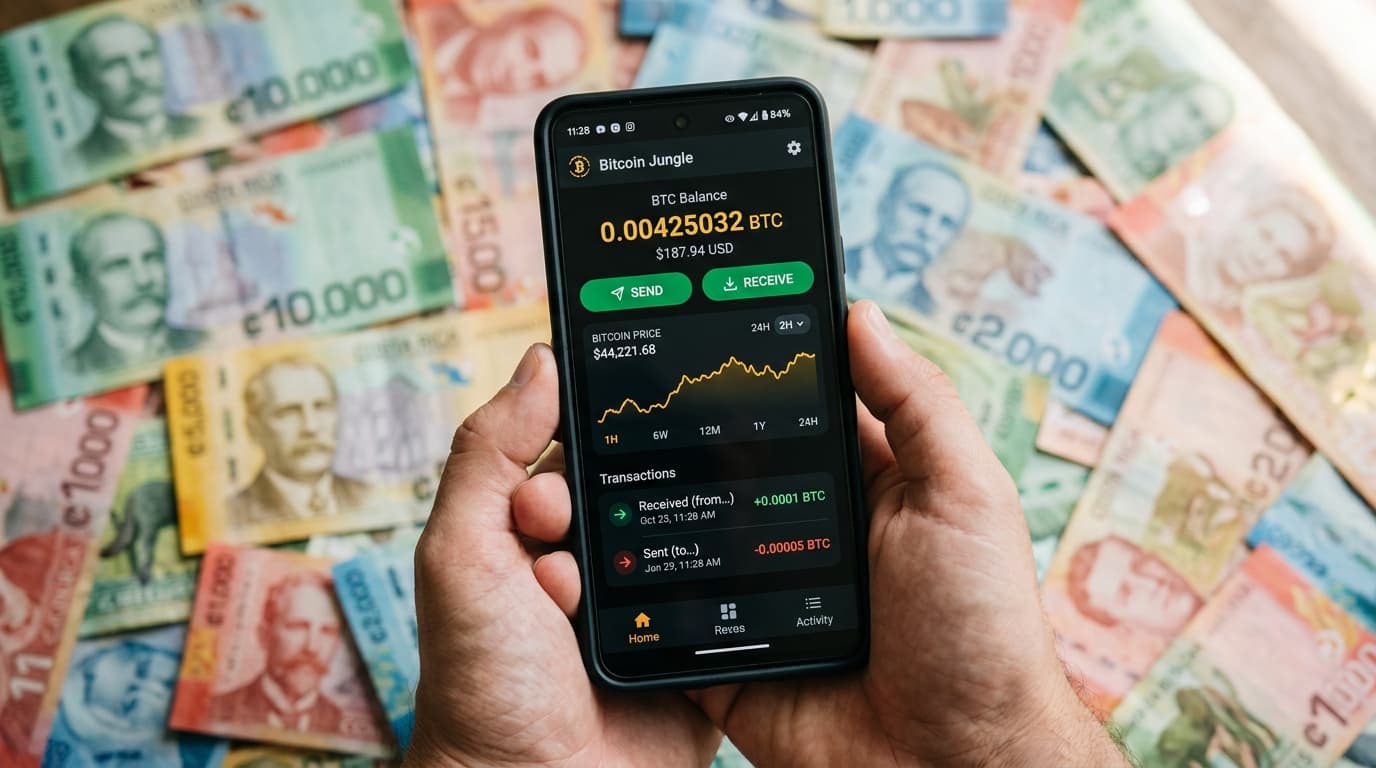
How to Use Bitcoin Jungle for Lightning Payments in Costa Rica
Complete guide to using Bitcoin Jungle for Lightning payments in Costa Rica, from wallet setup to finding merchants and converting to colones via SINPE.
At the Uvita farmer's market on Costa Rica's Pacific coast, up to a quarter of vendor sales now happen through Lightning Network payments. Tourists buy fresh mangoes with the same technology locals use to pay for coffee, and neither side needs a bank account or credit card to make it work.
This is the reality of Bitcoin Jungle, an open-source circular economy that has quietly grown to over 600 merchants across Costa Rica since launching in 2021. Concentrated in the "Golden Triangle" of Dominical, Uvita, and Ojochal, the project demonstrates what happens when Bitcoin infrastructure meets practical daily commerce.
Here's how to actually use it.
Getting Started with the Bitcoin Jungle Wallet
The Bitcoin Jungle wallet is available free on iOS and Android. It's a custodial Lightning wallet built on Galoy's open-source infrastructure (the same technology behind El Salvador's Bitcoin Beach wallet), designed specifically for Costa Rica's context.
Download the app, create an account, and you're ready to receive Bitcoin. The process takes a few minutes. Because it's custodial, you don't need to manage channel liquidity or understand Lightning's technical plumbing. The tradeoff is that you're trusting the Bitcoin Jungle infrastructure with your funds, which makes sense for daily spending money but probably not for your life savings.
Bitcoin Jungle doesn't charge fees for sending or receiving Bitcoin over Lightning. The project is funded by Bitcoin enthusiasts who support its mission rather than transaction revenue, which is unusual and worth understanding: they're betting on adoption, not extraction.
Funding Your Wallet
You have several options for getting Bitcoin into your wallet:
From another Lightning wallet: If you already hold Bitcoin in a Lightning-compatible wallet (Strike, Bull Bitcoin, Relai, or dozens of others), you can send directly to your Bitcoin Jungle wallet using a Lightning invoice. This is the cheapest and fastest method.
Bitcoin ATMs: The Osa region has Bitcoin ATMs where you can purchase amounts from roughly $10 to $300 worth of colones. Expect commissions up to 9%, which is steep but useful for small amounts or if you lack other options.
Exchanges: You can buy Bitcoin on any exchange and withdraw to your wallet, though you'll need an exchange that supports Lightning withdrawals to avoid on-chain fees.
Peer-to-peer: In a community with 1,000 active monthly users, you can often find someone willing to trade colones for sats directly.
Finding Merchants Who Accept Bitcoin
Over 200 businesses in the Osa region accept Bitcoin through Bitcoin Jungle, with another 400+ scattered across Costa Rica. The merchant categories span daily life:
- Restaurants and cafes: Cafe Mono Congo in Dominical, Sibu Cafe in Uvita, L'Epicerie in Ojochal
- Hotels and accommodations
- Breweries and bars
- Tour operators and activity providers
- Farmers' markets and local vendors
The Bitcoin Jungle app includes a merchant directory showing nearby businesses that accept Lightning payments. In the Golden Triangle, merchant density is high enough that you can realistically conduct most daily commerce in Bitcoin. Outside this region, options become sparser.
Making a Lightning Payment
The actual payment process is straightforward:
- The merchant generates a Lightning invoice (usually displayed as a QR code on their phone or terminal)
- You scan the QR code with your Bitcoin Jungle wallet
- Confirm the amount and send
- The payment settles in seconds
No signatures, no waiting for card authorization, no fumbling with cash. The merchant receives confirmation immediately, and you're done.
For peer-to-peer payments between Bitcoin Jungle users, the process works the same way. Generate an invoice, share it, receive payment. This works for splitting restaurant bills, paying a local guide, or buying something from another tourist.
Converting to Colones via SINPE
Here's where Costa Rica's infrastructure creates an interesting advantage: over 90% of Costa Rican residents over 18 use SINPE, the national electronic payment system. Bull Bitcoin has integrated Lightning payments with SINPE, processing over 32,000 bitcoin-to-fiat conversions between May 2024 and May 2025 with greater than 99% success rates.
This means merchants can accept Lightning payments and receive colones in their bank accounts. It also means you can effectively "live off Bitcoin" in Costa Rica by converting to colones as needed for merchants who only accept fiat via SINPE.
The Bull Bitcoin web app handles this integration. You pay with Lightning, the merchant receives colones. For tourists, this dramatically expands where you can spend Bitcoin beyond the 600+ direct merchant network.
Practical Considerations
For tourists: The dense merchant network in the Golden Triangle makes Bitcoin Jungle genuinely practical for daily use. You can eat breakfast, book a surfing lesson, grab lunch, buy produce at the market, and have dinner, all without touching colones if you choose. Outside this region, research merchant availability before assuming you can go Bitcoin-only.
For merchants: Accepting Bitcoin through Bitcoin Jungle costs nothing in fees. You get a simple QR-based point-of-sale system, instant settlement, and the option to convert to colones via SINPE when you need local currency. The project offers community support via WhatsApp for setup questions.
For locals: About 80% of Bitcoin Jungle users are Costa Rican residents. For vendors at farmers' markets, small business owners, or anyone underserved by traditional banking, accepting Lightning payments opens new customer relationships without credit card processing fees.
The Bigger Picture
Bitcoin Jungle co-founder Lee Salminen presented at Bitcoin 2026 earlier this month, discussing how the Lightning wallet, Bitcoin-collateralized loans, and Costa Rica's territorial tax policy combine to create conditions for a genuine Bitcoin economy.
The project isn't trying to replace the colón or convert everyone to Bitcoin maximalism. It's demonstrating that Lightning payments can work for ordinary commerce when the infrastructure exists and the community maintains it.
Whether you're visiting Costa Rica and want to spend Bitcoin directly, running a business interested in zero-fee payment acceptance, or just curious about real-world Lightning adoption, the Golden Triangle offers a working example. The app is free, the merchants are real, and the payments actually work.
That's more than most Bitcoin projects can claim.