
Blockware Solutions Review, Hosted Mining for Retail Bitcoiners Who Want Simplicity Over Sovereignty
An honest look at Blockware's Mining as a Service for retail investors, covering real costs, payout structure, and whether hosted mining beats buying BTC.
A single Bitmain S19 Pro purchased through Blockware Solutions in mid-2025 cost about $650 upfront with a $195 monthly hosting fee. After one month, the owner received 91,000 sats on $112.81 in power costs, translating to an effective BTC acquisition price around $123,967. That same day, buying bitcoin directly on a peer-to-peer exchange would have cost roughly $121,000 per coin.
That anecdote, shared by a retail miner on Stacker News in August 2025, captures the central tension of hosted mining in 2026: the convenience is real, but so is the question of whether you're paying a premium for synthetic bitcoin exposure rather than genuine mining economics.
What Blockware Actually Offers
Blockware Solutions has operated as a U.S.-based ASIC broker and hosting provider since 2017. The company claims to have sold over 400,000 mining rigs and placed clients in more than 500 MW of hosting capacity, enabling the mining of over 10,000 BTC cumulatively through its pool. These figures come from Blockware's own marketing materials and haven't been independently verified.
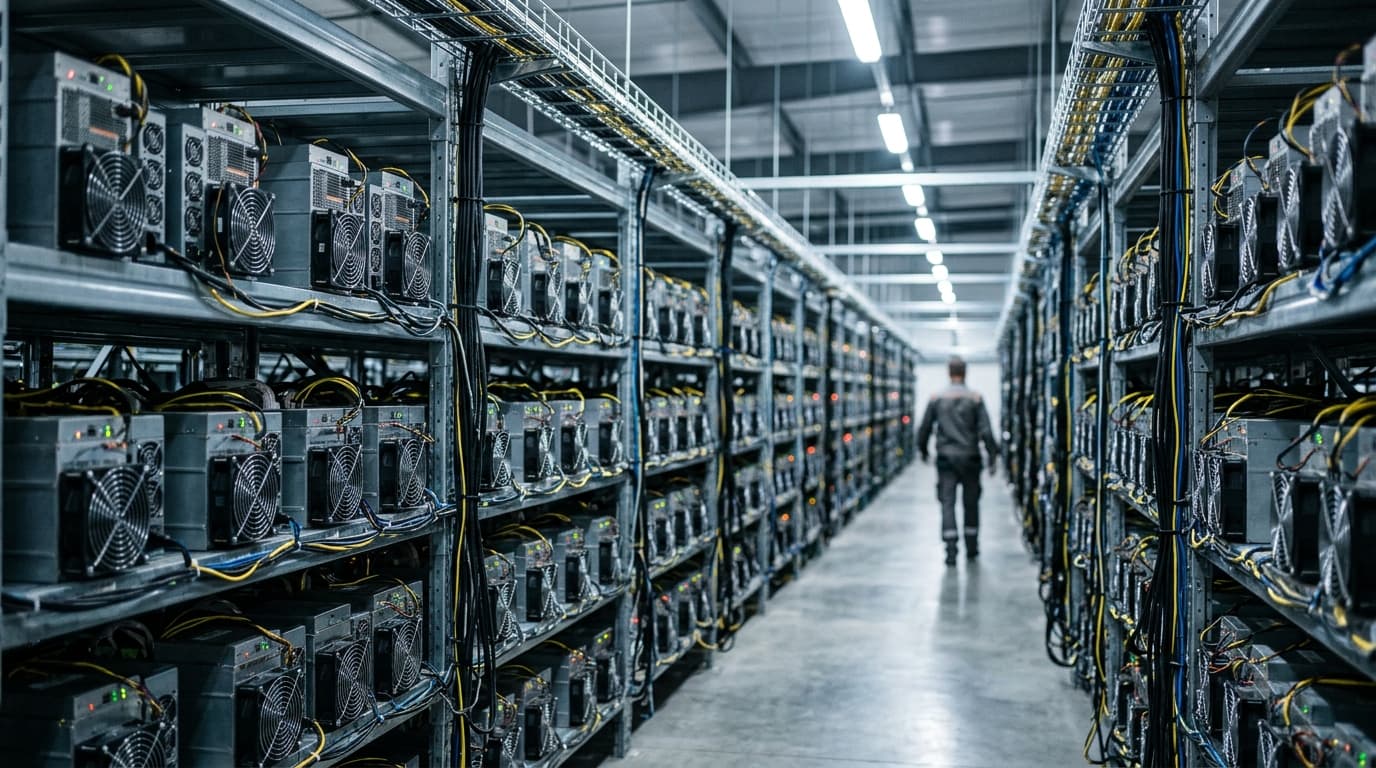
The current retail offering is straightforward: buy hardware through Blockware's marketplace, have it installed at one of their facilities in Texas, North Dakota, Missouri, or Kentucky, and receive daily BTC payouts to your own wallet. An example package advertised in 2026 shows approximately 270 TH/s of hash rate at 13.5 J/TH efficiency, with an all-in power rate of $0.070 per kWh.
Blockware handles repairs, warranty claims, and infrastructure management. The company operates its own data center in Kentucky (originally announced as a 20 MW facility in 2022, since expanded) and partners with third-party facilities in other states. Marketing emphasizes "institutional-grade" infrastructure and "industry-leading up-times."
The 2% PPS+ Pool and Daily Payouts
Blockware runs its own mining pool with a 2% fee using a PPS+ (Pay Per Share Plus) payout model. Daily payouts hit customer wallets at a 0.005 BTC threshold. For retail miners, this structure offers predictable income compared to FPPS or luck-based pools, smoothing out the variance that makes solo or smaller-pool mining feel like gambling.
The tradeoff is control. Some users report being required to use Blockware's in-house pool with no opt-out option. If you're running a single machine through their hosting service, you're essentially locked into their pool economics, their fee structure, and their calculation of what you're owed.
What Users Actually Experience
Trustpilot reviews as of early 2026 show Blockware at roughly 4.8 out of 5 stars across about 40 reviews. Common praise includes reliable uptime, simple monitoring dashboards, and smooth procurement-to-hosting transitions. An independent analysis from HashSight in August 2026 characterizes Blockware as a "legitimate, established operator" with solid industry coverage.
But the picture isn't uniformly positive. HashSight's review documents deployment delays of 7 to 12 months for some customers, instances of billing before hashrate was delivered, and support response times extending to 36 hours. The recurring theme in critical feedback isn't fraud; it's execution problems and contract ambiguity.
One practical takeaway from independent reviewers: get start dates, uptime commitments, and pool policies explicitly written into your contract before signing.
The 2022 Lawsuit and What Happened
Any honest assessment of Blockware has to address the Faes & Company lawsuit filed in December 2022. The London-based firm alleged that Blockware misrepresented its hosting capabilities, claiming to own facilities while relying on third-party data centers, and that miners experienced average uptime below 70% rather than the advertised "100% uptime." The complaint sought at least $250,000 in damages.
Blockware's CEO disputed all allegations at the time, stating the company had "honestly served this industry for over 5.5 years." In June 2023, an Illinois federal judge enforced an arbitration clause, and a joint stipulation of dismissal followed in August 2023. The case ended without a public ruling on the merits.
This isn't evidence of systemic wrongdoing, but it's not nothing either. The dispute highlighted real risks in hosted mining: customers depend entirely on operator claims about infrastructure, uptime, and power costs. When something goes wrong, arbitration clauses often mean disputes stay private.
The Economics Question
Here's the uncomfortable math for retail hosted mining in 2026: after the 2024 halving and with current difficulty levels, the effective cost to acquire BTC through hosted mining often lands close to, or even above, the spot price.
The Stacker News example from 2025 is instructive. Blockware's calculator projected around 170,000 sats monthly, implying an effective BTC price near $114,706. Actual first-month results came in at 91,000 sats, pushing the effective price to roughly $123,967, slightly worse than buying directly.
This doesn't mean hosted mining never makes economic sense. Power costs, hardware efficiency, and BTC price all fluctuate. Blockware markets the 100% bonus depreciation available under U.S. tax code for hardware placed in service after January 2025, which can shift the math significantly for higher-income investors (though you'll need your own tax advisor to confirm eligibility).
But if your primary goal is accumulating bitcoin, you should run realistic numbers rather than relying on promotional calculators.
Control Versus Convenience
The retail miner who shared their 2025 experience made a revealing observation: Blockware's Mining as a Service felt more like "synthetic BTC exposure" than real mining. They had no control over pool choice, no direct verification that a physical machine existed with their name on it, and no ability to configure anything.
For some people, that's fine. Not everyone wants to manage firmware updates, monitor thermals, or negotiate power contracts. Blockware's value proposition is removing all of that complexity while still delivering bitcoin to a wallet you control.
For others, particularly those drawn to mining because of its alignment with bitcoin's decentralization ethos, this level of operator dependence defeats the purpose. You're trusting Blockware's infrastructure, Blockware's pool, Blockware's calculations, and Blockware's maintenance. That's a different risk profile than running your own machine at home or in a facility you've personally vetted.
Should You Consider Blockware?
Blockware Solutions offers a polished, retail-accessible entry point into bitcoin mining. The company has operated for years, maintains facilities across multiple U.S. states, and generates mostly positive user feedback. The daily BTC payouts to customer-controlled wallets and 2% PPS+ pool structure provide predictable, if not spectacular, returns.
The honest assessment is this: Blockware is a legitimate operator in a sector with plenty of questionable ones. But hosted mining carries structural tradeoffs, including dependency on your host's infrastructure, limited transparency into actual operations, and economics that may or may not beat simply buying bitcoin depending on timing and circumstances.
If you're considering Blockware or any hosted mining provider, do the real math with conservative assumptions. Get deployment timelines and uptime guarantees in writing. Understand that you're trading sovereignty for simplicity. And recognize that the effective cost of your mined bitcoin, after hosting fees and operator margins, competes with the simpler option of just buying it.
That's not an argument against hosted mining. It's an argument for going in with clear expectations.