
How to Monetize Stranded Gas with Upstream Data Bitcoin Mining
A practical guide for oil and gas producers to turn flared methane into Bitcoin revenue using modular mining infrastructure at remote wellheads.
Every day, oil and gas operations worldwide flare roughly 16 billion cubic feet of natural gas that could theoretically power 64 gigawatts of electricity generation. Most of that energy simply burns off into the atmosphere because pipeline infrastructure doesn't exist or isn't economical. But a growing number of producers are discovering that Bitcoin mining offers a way to turn that stranded gas into revenue, with modular systems that can deploy at remote wellheads without waiting years for midstream contracts.
The concept is straightforward: instead of flaring methane, you burn it in a generator to produce electricity, then use that electricity to run Bitcoin mining hardware. What makes this economically interesting is that Bitcoin mining is location-independent. The hashpower you generate in a remote field in Alberta or the Permian Basin competes on the same network as miners connected to cheap hydro in Quebec or geothermal in Iceland.
The Scale of the Opportunity
The Cambridge Digital Mining Industry Report's April 2025 edition estimated that stranded natural gas supplied around 507 megawatts of Bitcoin mining capacity globally, representing roughly 3.3% of the industry's total energy mix. That figure comes with caveats (it only covers entities representing about 48% of global hashrate), but it illustrates both current adoption and the enormous room for growth.
Consider the gap: if the 2025 global flare volume were fully captured for generation and mining, analysts estimate it could support approximately 3,232 exahash per second of hashrate. The actual deployed capacity is a small fraction of that theoretical ceiling, constrained by logistics, regulation, and economics rather than available gas.
For producers facing carbon taxes, flaring penalties, or simply watching revenue escape into the sky, the value proposition has become increasingly compelling.
How Modular Mining Systems Work
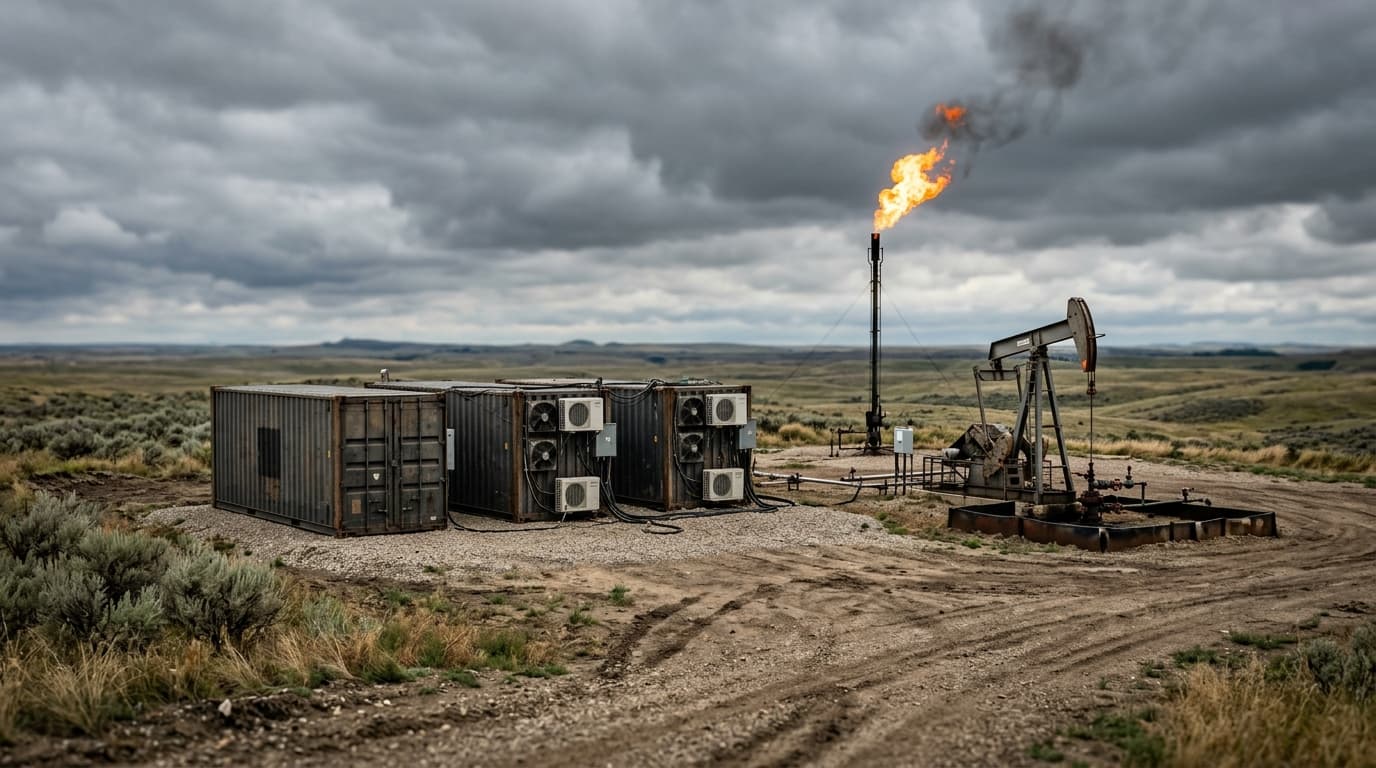
Upstream Data, a Canadian company operating since 2017, pioneered much of the commercial infrastructure for converting stranded gas into hashrate. Their approach centers on modular, relocatable systems that can follow production rather than requiring permanent installations.
A typical deployment stack includes several components working together:
Gas conditioning equipment cleans the wellhead gas to generator specifications, handling the variable composition that makes raw associated gas challenging for standard power equipment.
A prime-mover generator sized to site-specific flare volumes converts the conditioned gas into electricity. These range from smaller units producing 45-80 kW up to containerized power plants generating over a megawatt.
Containerized data centers house the ASIC mining hardware in a controlled environment suitable for remote deployment. Upstream Data's "Hash Generator" systems combine power generation and compute in integrated skid-mounted or containerized packages.
Control systems modulate mining load based on real-time gas flow and generator output. This is critical because wellhead gas production isn't constant. The LoadSync automation that Upstream Data offers handles the complexity of matching mining load to available power, maintaining combustion efficiency while maximizing uptime.
Economics of Wellhead Mining
A June 2025 field report from Upstream Data outlined the economics of one of their 80 kW Hash Generator units. Consuming about 22 thousand cubic feet (MCF) of fuel gas per day, the system delivered continuous power to generate roughly 4.8-5 petahash per second of Bitcoin compute capacity. Under prevailing price and difficulty assumptions at that time, this translated to approximately $240 per day in revenue, or about $11 per MCF of gas consumed.
Compare that to alternatives for stranded gas: flaring produces zero revenue while potentially incurring emissions penalties; venting is increasingly prohibited and environmentally worse; and pipeline connection costs typically can't be justified for marginal wells.
The key variables that determine whether a project pencils out include:
- Gas volume and consistency: Highly variable production makes sizing equipment difficult
- Generator efficiency: Affects how much hashrate you get per MCF
- ASIC performance: Newer machines produce more hashes per watt
- Bitcoin price and network difficulty: External factors that determine revenue per hash
- Carbon pricing: Where carbon taxes exist, avoided flaring has direct value beyond mining revenue
Producers increasingly frame decisions in terms of marginal revenue per MCF compared to alternative disposal or sale options. In many cases, especially for remote or marginal wells, mining represents the only economically viable monetization path.
Industrial-Scale Deployments Are Expanding
The industry has moved well beyond experimental skid operations. In April 2025, Marathon Digital and NGON Solutions energized 25 MW of modular data centers at oil fields in Texas and North Dakota, powered exclusively by stranded natural gas. These aren't science projects; they're industrial installations designed to be relocatable and aligned with oilfield production cycles.
Canaan Inc. launched a gas-to-computing pilot in Calgary, Alberta in October 2025, deploying approximately 700 Avalon A15 Pro miners in containerized modules directly at wellheads. The 2.5 MW project targets power costs below conventional industry norms while projecting annual emissions reductions of 12,000-14,000 metric tons of CO₂-equivalent.
Even more unusual deployments are emerging. Hyperscale Data launched a pilot in November 2024 to install a mobile Bitcoin mining data center with roughly 100 ASIC miners on an offshore platform off Louisiana, powered by natural gas turbines. The goal: monetize stranded offshore gas that's being held but isn't yet transportable.
Deployment Considerations for Producers
If you're an oil and gas operator evaluating this approach, several practical factors deserve attention.
Permitting and regulatory compliance vary significantly by jurisdiction. Some regulators view on-site mining favorably as an emissions reduction measure; others haven't developed clear frameworks. Engage early with state or provincial authorities to understand requirements.
Site assessment should evaluate not just current production but expected decline curves. The modular nature of systems from companies like Upstream Data means equipment can be redeployed as production moves, but understanding the timeline matters for financial projections.
Operational expertise differs from typical oilfield operations. Some producers partner with mining specialists who handle the compute side while the producer supplies gas and site access. Others build internal capabilities. Revenue-sharing arrangements vary widely.
Grid interconnection may or may not be relevant. Many stranded gas sites are entirely off-grid, which is part of what makes the gas stranded in the first place. But where grid connection exists or can be established, hybrid models become possible. Canaan's Alberta project explicitly contemplates selling surplus power to the grid via demand-response programs during periods when mining economics are unfavorable.
The Emissions Question
Proponents argue that stranded gas mining improves emissions profiles by replacing raw methane venting or inefficient flaring with controlled combustion in generators. Methane is roughly 80 times more potent as a greenhouse gas than CO₂ over a 20-year period, so converting it to CO₂ through combustion (while capturing energy value) represents a meaningful improvement.
Canaan's 2025 pilot projected 12,000-14,000 metric tons of avoided CO₂-equivalent emissions annually from a single 2.5 MW installation. Scaled across the industry, the impact could be substantial.
However, critics raise legitimate concerns. Attaching profitable Bitcoin mining to marginal wells could extend their economic life, potentially delaying pipeline investments or keeping fossil fuel infrastructure operating longer than it otherwise would. The net climate impact depends heavily on context: what's the regulatory baseline? Would the gas otherwise be flared, vented, or would the well be shut in?
Advocates counter that the modular, relocatable nature of mining equipment makes it inherently temporary infrastructure that follows production rather than dictating drilling decisions. They also note that revenues from gas monetization can fund better environmental practices or eventual abandonment and remediation.
There's no clean answer here. Both perspectives have merit, and the actual climate impact varies by site and regulatory environment.
Beyond Bitcoin: Broader Compute Opportunities
Recent developments suggest the stranded gas opportunity extends beyond Bitcoin mining alone. Canaan's 2025 wellhead project explicitly positions modular data centers for HPC and AI workloads alongside mining. As demand for AI compute capacity grows, some see stranded-gas-powered edge infrastructure as a potential solution for certain workloads.
The flexibility cuts both ways: when Bitcoin mining economics are favorable, run miners; when electricity can be sold to the grid at premium prices (emergency demand response, for example), sell power instead. This hybrid model may prove more resilient than pure mining plays.
Getting Started
For producers new to this space, the typical path begins with site assessment and economic modeling. How much gas are you currently flaring? What's the production consistency? What are your current emissions compliance costs or risks?
Companies like Upstream Data offer consultation services alongside equipment, helping producers understand what configurations make sense for specific sites. Their off-grid Hash Generator systems are designed for rapid deployment without complex infrastructure, making them suitable for proving the concept before scaling.
The key insight is that Bitcoin mining turns stranded energy into a monetizable commodity. Whether that makes sense for your specific operations depends on the numbers, but for thousands of producers worldwide, it's become a serious option where none existed a few years ago.
As of mid-2026, the industry remains early-stage despite visible growth. The 507 MW of stranded gas mining capacity estimated for 2025 represents just a fraction of the theoretical potential. For producers with the right gas assets and operational flexibility, the opportunity window remains wide open.