
Caravan Review After 6 Months of Real Multisig Recovery Work
A research-based review of Caravan's reliability for Bitcoin multisig recovery and DIY setups, examining what works and where it falls short.
Most Bitcoin multisig tools want you to trust them with your wallet data. Caravan takes a different approach: it runs entirely in your browser, stores nothing on any server, and lets you coordinate multisig transactions without handing over control to anyone. After six months of documented recovery workflows and DIY multisig setups tracked across user reports and Unchained's own guidance, a clearer picture emerges of what this stateless tool actually delivers.
What Caravan Actually Does
Caravan is open-source software developed by Unchained Capital that serves two primary purposes: helping users recover Bitcoin from Unchained vaults without relying on the company's services, and enabling DIY multisig coordination for anyone who wants full sovereignty over their funds.
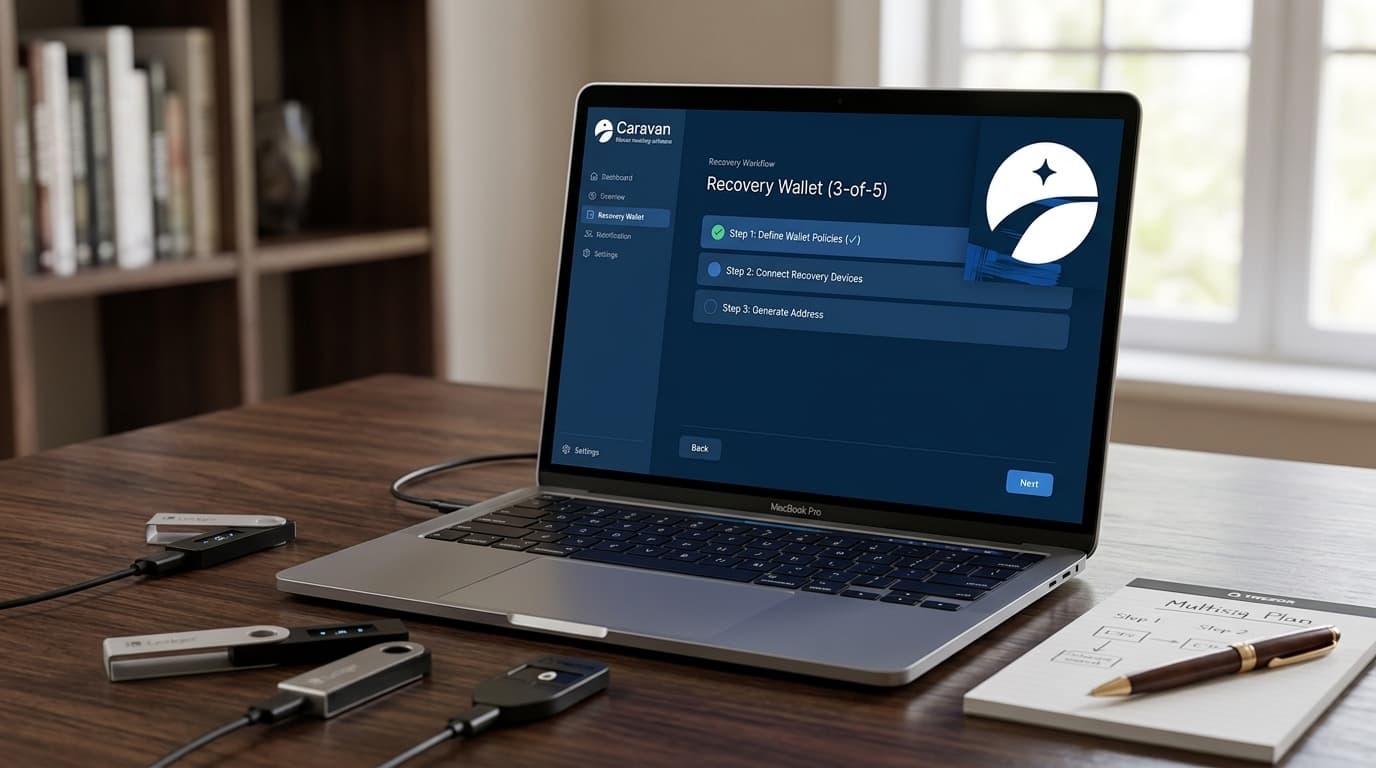
The tool operates statelessly, meaning it doesn't remember anything between sessions. You import your multisig configuration file and connect your hardware wallets (Trezor, Ledger, Coldcard, and others are supported), and Caravan handles the coordination of building transactions, checking balances, and gathering signatures. When you close the browser tab, it forgets everything.
This design is intentional. Stateless operation means there's no server holding your wallet information, no account to hack, and no company that needs to stay in business for your funds to remain accessible.
Reliability in Recovery Scenarios
Based on available documentation and user discussions through early 2026, Caravan has maintained a consistent track record for its core function: getting Bitcoin out of multisig wallets when you have the required keys and configuration data.
The GitHub repository for Caravan shows no major issues flagged in recent activity. The codebase received significant modernization in 2024, including a monorepo structure, improved developer tooling, and support for descriptor wallets and Taproot spends. Since then, the project has entered a more stable maintenance phase.
User reports on Reddit and other forums through 2025 describe successful recoveries without significant problems, though the volume of documented case studies remains relatively small. This aligns with what you'd expect from a tool designed for infrequent, high-stakes use rather than daily transactions.
Where It Gets Complicated for Non-Technical Users
The honest answer is that Caravan remains a tool built for people who understand what they're doing, or who are willing to learn.
Importing multisig configurations requires understanding what a configuration file contains and where to find it. Connecting hardware wallets through a browser involves navigating potential driver issues and browser compatibility quirks. Building a transaction means understanding change addresses, fee rates, and UTXO selection.
None of this is impossible for a motivated beginner, but the documentation assumes familiarity with Bitcoin fundamentals. YouTube tutorials from 2020 through 2024 demonstrate the workflow clearly, and Unchained provides recovery guides for their vault customers. Still, someone who has never worked with multisig before should expect a learning curve.
The stateless design that makes Caravan trustworthy also makes it less convenient. You'll need to import your configuration every time you use it. You'll need to keep that configuration file safe alongside your keys. There's no "remember me" button because there's nowhere to remember you.
Testing Your Setup Matters More Than the Tool
One theme that emerges from multisig recovery discussions in 2025 is that tool reliability matters less than preparation. BitVault's blog recommended testing multisig setups every six months, and this advice applies regardless of which software you use.
Caravan's value isn't that it's the most polished software available. Its value is that it exists independently of any service provider and can be verified by anyone who reads the code. If Unchained Capital disappeared tomorrow, Caravan would still work.
But Caravan can't fix missing configuration files, lost seed phrases, or hardware wallets that won't sign. The tool's reliability is only as good as the preparation that precedes using it.
What the Maintenance Status Means
As of late 2025, Caravan's GitHub repository is largely read-only with no recent releases. This could be interpreted two ways: either the tool is abandoned, or it's stable and feature-complete.
The evidence suggests the latter. Unchained continues to reference Caravan for vault recovery, and the 2024 updates brought the codebase up to modern standards including Taproot support. For a tool designed to do one thing well and operate without ongoing dependencies, minimal active development isn't necessarily a red flag.
That said, Bitcoin software does eventually require updates as the ecosystem evolves. If descriptor wallet standards change or new address types emerge, Caravan would need maintenance to remain fully functional. Users choosing Caravan as their recovery tool should monitor whether it keeps pace with Bitcoin's technical evolution.
Who Should Use Caravan
Caravan makes the most sense for three groups:
First, Unchained vault customers who want a backup recovery option that doesn't depend on the company. The tool was originally built for this purpose, and it remains well-suited for it.
Second, privacy-focused users building DIY multisig setups who want to avoid any tool that phones home or stores data remotely. Caravan's stateless design offers genuine trust minimization.
Third, anyone who values verifiability over convenience. The open-source code means you don't have to trust that Caravan does what it claims; you can verify it.
For users who want a more guided experience, or who aren't comfortable with the technical details of multisig coordination, other options with more hand-holding exist. The tradeoff is that those options typically require trusting someone with your wallet data.
The Bottom Line
Caravan works. Based on documented usage patterns and the absence of significant reported issues, the tool reliably does what it's designed to do: coordinate multisig transactions without storing anything or trusting anyone.
It's not a polished consumer product, and it probably never will be. That's arguably the point. The same minimalism that makes Caravan less convenient also makes it more trustworthy and more durable.
For anyone serious about Bitcoin self-custody in multisig arrangements, Caravan belongs in the toolkit. Just make sure you've tested your recovery process before you actually need it. The six-month testing recommendation that circulates in multisig discussions isn't paranoia; it's practical risk management.
The tool will be there when you need it. The question is whether you'll be ready.