
Caravan Review for DIY Multisig in 2026
A research-based review of Caravan's stateless multisig coordination for DIY Bitcoin self-custody, vault recovery, and how it compares to hosted alternatives.
A 3-of-5 multisig wallet can cost you $2,000 per year on some platforms, or nothing at all if you're willing to coordinate it yourself. Caravan, Unchained's open-source multisig coordinator, represents the latter approach: a browser-based tool that helps you build and manage multisig wallets without storing anything, trusting anyone, or paying subscription fees.
But "free" comes with its own costs. After reviewing Caravan's capabilities, recent upgrades, and the trade-offs of stateless DIY multisig, here's what prospective users should understand before committing to this approach.
What Caravan Actually Does
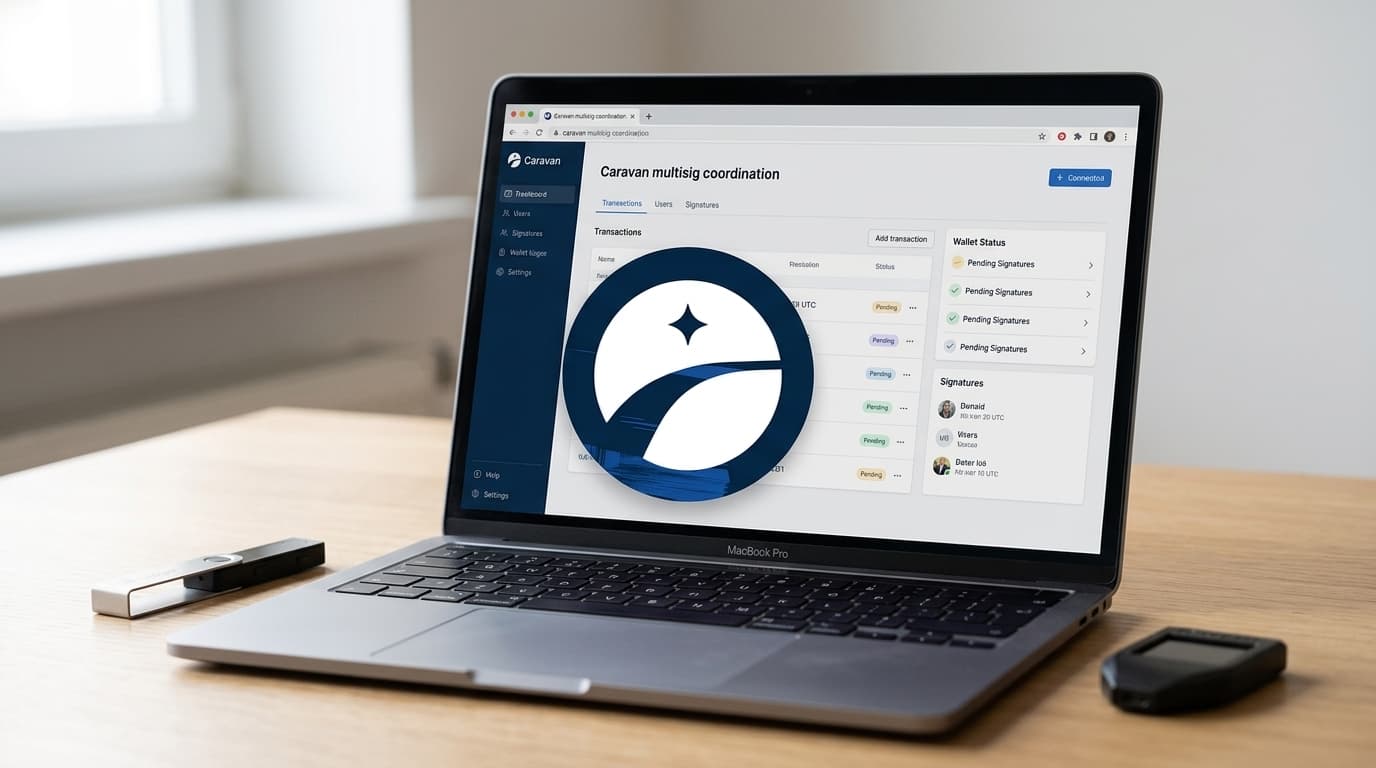
Caravan is not a wallet in the traditional sense. It's a coordination tool. It doesn't hold your keys, doesn't remember your addresses between sessions, and doesn't phone home to any server. Instead, it acts as a stateless interface that helps you generate multisig addresses, build transactions, and coordinate signatures across multiple hardware wallets.
The tool runs entirely in your browser as a React web application. You provide your extended public keys (xpubs) from devices like Trezor, Ledger, or Coldcard, and Caravan handles the mathematics of combining them into multisig addresses. When you need to spend, it helps construct a Partially Signed Bitcoin Transaction (PSBT) that you can then sign with your hardware devices.
Unchained positions Caravan as "the world's most popular stateless multisig bitcoin coordinator," and while that claim is difficult to verify independently, the tool has developed a loyal following among technically proficient Bitcoin users who prioritize sovereignty over convenience.
The 2024-2025 Upgrades That Matter
Caravan's evolution from a recovery-focused tool to a functional multisig wallet came through significant upgrades in late 2024 and early 2025.
The December 2024 update introduced xpub-based wallet coordination. Previously, Caravan worked with individual addresses, which made it suitable for recovery scenarios but awkward for ongoing use. With xpub support, the tool can now generate a continuous stream of multisig addresses, making it practical for users who want to transact regularly rather than just recover funds in emergencies.
Unchained's January 2025 engineering retrospective highlighted additional improvements: descriptor wallet support, spend-to-Taproot capabilities, and PSBT handling that expanded Coldcard compatibility. The underlying codebase was reorganized into a monorepo structure with modernized tooling, making it easier for developers to contribute and audit.
These changes align Caravan with Bitcoin's broader move toward descriptor-based wallets and Taproot adoption. For DIY multisig builders, this means the tool speaks the same language as other modern Bitcoin software.
The Stateless Trade-Off
Caravan's defining characteristic, its statelessness, is both its greatest strength and its most demanding requirement.
On the security side, statelessness means there's nothing to hack. No database stores your wallet configuration, no server holds your xpubs, no persistent state can be compromised. The attack surface is limited to the code itself, and Caravan's relatively small codebase makes auditing manageable compared to feature-rich general-purpose wallets.
On the usability side, statelessness means you are responsible for everything. Every time you open Caravan, it's a blank slate. You must maintain your own records of wallet configuration files, derivation paths, key ordering, and recovery information. Lose that documentation, and you'll face a painful process of reconstructing your setup from scratch.
User reports through late 2025 and early 2026 describe successful fund recoveries using Caravan, with no major issues when users had their configuration data properly organized. The problems arise when they don't.
Who Caravan Works For
Based on documentation, community discussions, and third-party analysis, Caravan makes the most sense for three user groups.
First, Unchained vault customers who want an external recovery channel. Even if you use Unchained's managed services, Caravan provides a way to recover your funds independently, a form of insurance against any single company's failure.
Second, privacy-focused DIY multisig builders who want to avoid tools that require accounts, phone home, or depend on third-party infrastructure. Caravan can connect to your own Bitcoin Core node, keeping your transaction history entirely under your control.
Third, technical users comfortable with manual workflows. If you understand BIP32 derivation paths, can manage configuration files reliably, and don't mind spending time on setup rather than paying for convenience, Caravan rewards that investment with complete sovereignty.
The Repository Archival Question
Caravan's GitHub repository was archived in April 2024, making it read-only. This has raised questions about the tool's long-term maintenance.
The optimistic interpretation: Caravan is stable and feature-complete for its core use case, and Unchained continues developing the underlying libraries and tooling even as the public repository appears static. The UI looks similar to its 2020 version because the innovation is happening in descriptors, PSBT handling, and integrations rather than cosmetic changes.
The cautious interpretation: archived repositories signal reduced commitment to public maintenance, and users who expect frequent updates or community-driven feature development may want to look elsewhere.
Through early 2026, no significant bugs or security incidents tied specifically to Caravan have been publicly reported. The tool appears to work reliably for its intended purpose. Whether that reliability continues indefinitely is a matter of trust in Unchained's commitment to the open-source ecosystem.
Caravan vs. Alternatives
For users evaluating DIY multisig options, Caravan occupies a specific niche.
Sparrow Wallet offers a more traditional desktop experience with built-in multisig support, persistent state, and a broader feature set. It's more approachable for users who want a conventional wallet interface but requires installing software and managing a local database.
Electrum's multisig functionality is mature and well-documented, though its complexity can overwhelm newcomers. Like Sparrow, it's a full wallet rather than a coordination tool.
Casa and Unchained's managed vaults provide turnkey multisig with customer support, guided setup, and recovery assistance. They cost money, typically hundreds to thousands of dollars annually for premium tiers, but reduce the documentation burden and provide a safety net when things go wrong.
Caravan's value proposition is for users who want multisig without the recurring costs or third-party dependencies, and who have the technical confidence to manage the complexity themselves.
Practical Considerations
If you're considering Caravan for DIY multisig, several practical factors deserve attention.
Backup discipline is non-negotiable. Your wallet configuration, including quorum structure, xpubs, derivation paths, and key ordering, must be documented and stored securely. Multiple copies in different locations are prudent. Without this documentation, you cannot reconstruct your wallet.
Hardware wallet compatibility varies. Caravan supports Trezor, Ledger, and Coldcard, and accepts public keys as text from any source. Verify that your specific devices work with the tool before committing significant funds.
Browser security matters. Because Caravan runs in your browser, your endpoint security is critical. Using a dedicated machine, avoiding browser extensions, and following standard operational security practices reduce the risk of compromise.
Node configuration affects privacy. Connecting Caravan to a third-party block explorer exposes your addresses to that service. For maximum privacy, run your own Bitcoin Core node and configure Caravan to use it.
The Bottom Line
Caravan does what it promises: coordinate multisig transactions without storing anything or trusting anyone. It's a robust, conservative tool that has worked reliably for users who understand its constraints and manage their own documentation carefully.
The recent upgrades, including xpub wallets, PSBT support, descriptors, and Taproot spending, keep Caravan aligned with modern Bitcoin practices. The archived repository raises legitimate questions about future development, but the tool's stability suggests it's closer to "feature-complete" than "abandoned."
For technically proficient users who prioritize sovereignty over convenience and can commit to rigorous backup practices, Caravan remains one of the most powerful free options for DIY multisig. For everyone else, the complexity may not be worth the cost savings compared to managed alternatives.
The real question isn't whether Caravan works. It's whether you're prepared to do the work that Caravan requires.