
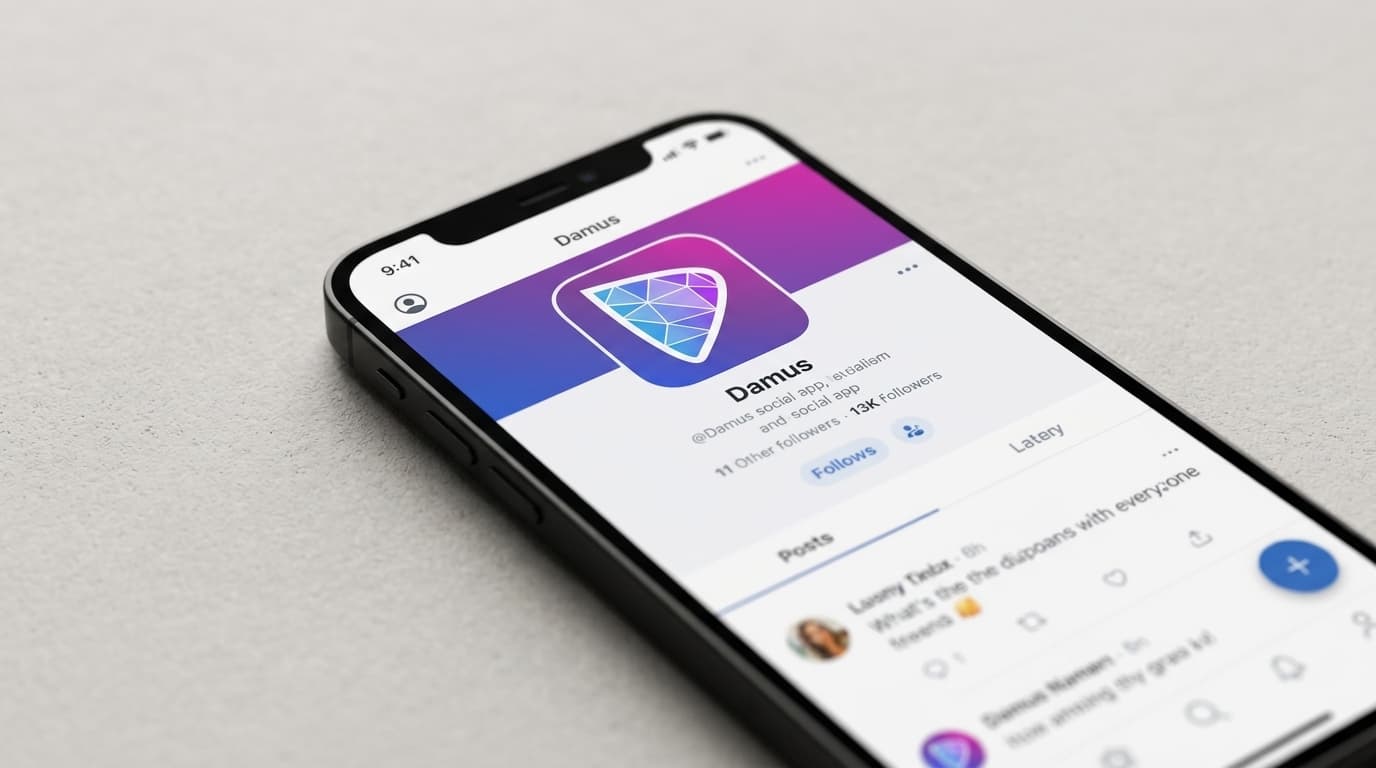
Damus Review After Two Years of Nostr Growth
A research-based review of Damus in 2026, examining Lightning zaps, features, and how this Nostr client compares to Primal and Amethyst.
When Damus launched on the App Store in February 2023, it ranked #10 in iOS Social Networking in the U.S. and carried the weight of Jack Dorsey's $245,000 Bitcoin donation to Nostr protocol development. Two years later, the decentralized social media landscape looks different than early adopters might have hoped.
Damus remains one of the three leading Nostr clients, alongside Primal and Amethyst. But the protocol itself has settled into a niche rather than challenging mainstream platforms. Understanding where Damus stands today requires looking at both what the app does well and the harder truths about Nostr's adoption trajectory.
What Damus Actually Offers
Damus functions as a client for the Nostr protocol, which means it reads from and writes to a network of distributed relays rather than centralized servers. Your identity lives in a cryptographic key pair you control, not in a username owned by a corporation.
The feature set has matured considerably since launch. The app supports picture and video uploading, translations across 24 languages with automatic note translation, and end-to-end encrypted messaging. For Android users, the Damus Android release added multi-column layouts for larger devices and an AI assistant called Dave.
The standout integration remains Lightning Network payments, known as "zaps." Users can send Bitcoin tips to content creators directly through the app. This faced early friction when Apple initially demanded Damus remove zapping from individual notes in June 2023, citing guidelines on digital content sales. The compromise moved the feature to profiles instead, where it remains functional.
OpenSats has provided ongoing grant funding through the Nostr Fund, with awards in July 2023, November 2024, and subsequent waves. Developer William Casarin has maintained a steady release cadence, pushing UI improvements, image caching optimizations, and relay list handling fixes throughout 2024 and 2025.
Lightning Zaps in Practice
The economic layer is arguably where Damus and Nostr more broadly have shown the most tangible progress. According to October 2025 statistics from Glukhov.org, user profiles with Lightning Network addresses grew 82.5% compared to earlier periods. This suggests real adoption of the payment rails, not just theoretical support.
Zapping creates a fundamentally different incentive structure than advertising-based social media. Creators receive direct compensation from their audience, with no platform taking a cut (beyond Lightning routing fees, which are typically fractions of a cent). For users accustomed to Twitter's tip jar or Patreon integrations, the difference is immediacy and permissionlessness.
The practical limitation is that Lightning adoption outside crypto-native communities remains modest. Zaps work well for an audience that already holds Bitcoin in Lightning wallets. For mainstream users who don't, the onboarding friction is significant.
How Damus Compares to Other Nostr Clients
By late 2024 and into 2025, three clients emerged as the primary Nostr options: Damus, Primal, and Amethyst.
Primal has positioned itself as the market leader for feed-focused social networking, with a polished interface and streamlined onboarding. Amethyst, available on Android, offers deep customization and power-user features. Damus sits in the middle, with strong iOS roots and a clean design philosophy that prioritizes the core social experience.
The choice between them often comes down to platform preference (iOS users naturally gravitate toward Damus) and whether you prioritize simplicity or configurability. None of them have solved the fundamental challenge: getting people who aren't already interested in decentralization to care.
The Harder Truth About Nostr Adoption
As of October 2025, Nostr had 21,281 total users, with 3,675 daily active users (17.3%) and 14,777 monthly active users (69.4%). These engagement percentages are impressive for a niche protocol, but the absolute numbers tell a different story. For context, that's fewer users than many individual influencers have followers on mainstream platforms.
Public writing events on Nostr increased 800% at some point during 2025, reflecting genuine growth in long-form content. But observer consensus by late 2025 suggested that censorship resistance as a primary market narrative had become less compelling than early advocates anticipated. The users who arrived and stayed were overwhelmingly crypto-native.
Bitcoin Magazine's September 2025 analysis put it bluntly: despite significant improvements in app quality and client functionality, Nostr's growth had stalled. Incumbent platforms like TikTok, Instagram, and X offer content volume and creator incentives that a 21,000-user network simply cannot match.
This "cold start" problem cuts both ways. Nostr captured the Bitcoin community early, creating what network theorists call an "atomic network" of engaged users. But that same tight community may have prevented the bridge-building necessary for mainstream expansion.
The Pivot Away from Feeds
Builders in the Nostr ecosystem have responded to these realities with what appears to be a strategic pivot. Rather than competing directly with social feeds, some developers are emphasizing utility-first approaches: discovery tools, events coordination, and location-based features.
In January 2026, NIP-05 verification was redesigned to allow relay users to claim human-readable Nostr addresses at no cost, removing one friction point for new users. Relay infrastructure has continued to mature, with distributed servers allowing users to self-host or join relays aligned with their interests.
This suggests a rethinking of what Nostr is for. Maybe it's not a Twitter replacement. Maybe it's infrastructure for a different kind of internet application, with social features as one component among many.
Should You Use Damus in 2026?
Damus does exactly what it promises: it gives you a censorship-resistant social experience where you own your identity and can send Bitcoin directly to people whose content you value. The app is well-maintained, the Lightning integration works, and the development trajectory has been consistent.
The honest assessment is that Damus is excellent software for a protocol that hasn't achieved mainstream adoption. If you're already part of the Bitcoin community, you'll find engaged users and genuine conversation. If you're looking to replace your primary social media experience with comparable content volume and network effects, that's not what Nostr offers today.
The question isn't whether Damus is a good Nostr client. It is. The question is whether the Nostr value proposition resonates with your priorities. For users who care deeply about self-sovereign identity and direct creator monetization, it remains one of the most practical ways to experience those principles in action.