
Nunchuk Multisig Wallet Review After 2 Years of Family Bitcoin Storage
A research-based review of Nunchuk's collaborative custody features for families, covering inheritance planning, privacy controls, and real tradeoffs.
As of December 2025, Nunchuk secures over $1 billion in Bitcoin. That figure alone tells you something about where the market has landed on this Bitcoin-only multisig wallet, but raw numbers don't capture what matters most for families considering it for long-term storage: does it actually work for non-technical users trying to protect generational wealth?
After reviewing documentation, user discussions, and third-party coverage spanning 2024 through early 2026, a clear picture emerges. Nunchuk delivers on its core promise of collaborative custody with serious inheritance planning tools, but the learning curve and pricing tiers create real friction that families should understand before committing.
What Nunchuk Actually Does
Nunchuk is an open-source, Bitcoin-only wallet that launched in 2020 with a specific focus: making multisig accessible for regular people. The app supports flexible configurations from 2-of-3 up to 9-of-N signatures, integrating with major hardware wallets including Ledger, Trezor, and Coldcard.
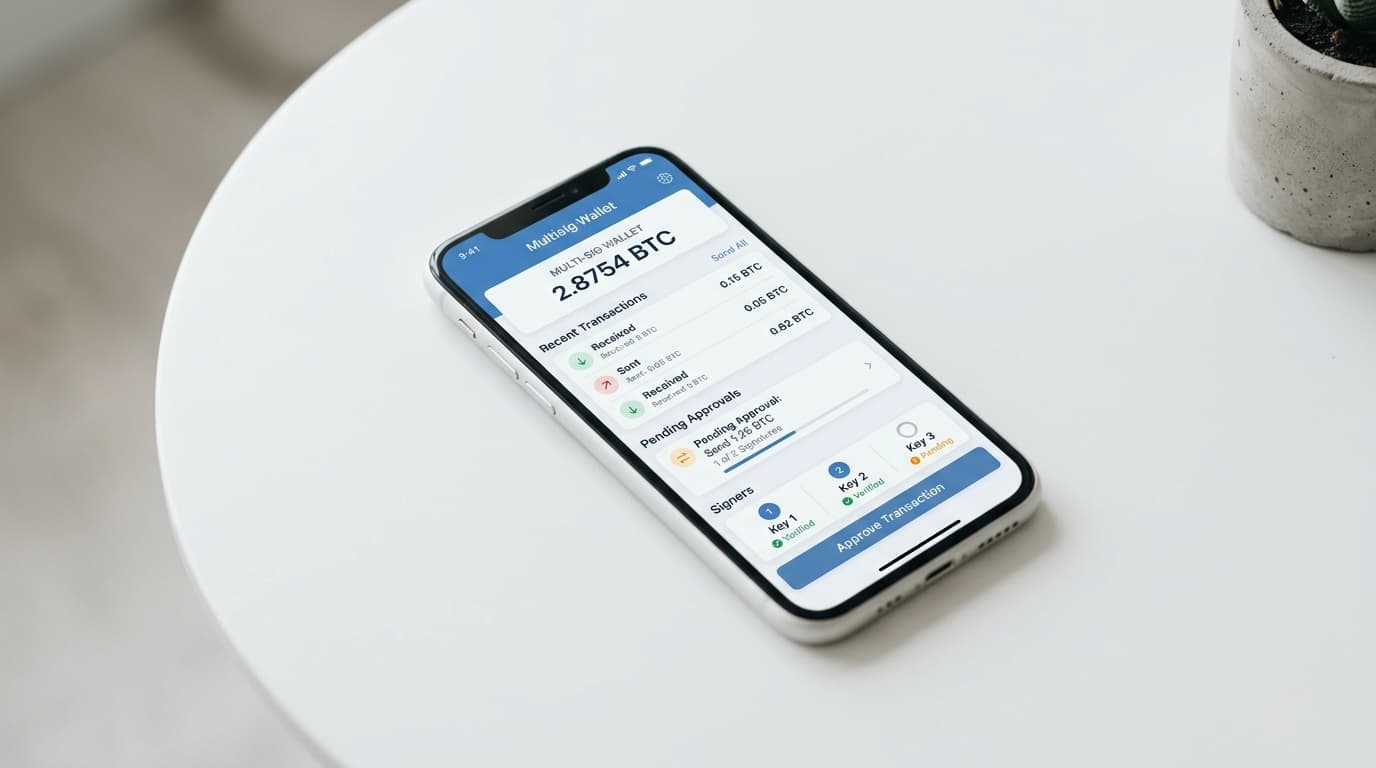
The collaborative custody design sets it apart from typical wallets. Family members or trusted parties each hold keys, with an in-app encrypted chat system for coordinating transaction approvals. Think of it as a Bitcoin vault that requires multiple keyholders to agree before funds move, with built-in communication so everyone stays informed.
The free tier covers basic multisig functionality. Paid tiers like Iron Hand ($120/year) add assisted custody options where Nunchuk holds one key in your multisig setup, providing recovery support if a family member loses access.
Inheritance Planning Done Right
This is where Nunchuk genuinely shines. The inheritance features combine on-chain timelocks with off-chain recovery options, addressing the fundamental problem that kills most Bitcoin inheritance plans: single points of failure.
With timelocks, you can configure coins to become spendable by heirs after a specified period of wallet inactivity. This creates a dead man's switch without requiring lawyers, custodians, or trust in any single party. A February 2026 tutorial demonstrates setups where surviving family members can recover funds even if the primary keyholder becomes incapacitated, without ever compromising security during normal operation.
The September 2025 addition of Miniscript support expanded what's possible here, enabling more sophisticated spending conditions that previously required custom development.
Privacy Controls and Technical Foundation
Nunchuk routes connections through TOR by default and requires no KYC for the core wallet functions. For users prioritizing financial privacy, this matters. The app works across mobile and desktop platforms, with app store ratings reflecting strong user satisfaction (9.0/10 on iOS as of recent reviews, with Android users particularly praising the sovereignty-focused design).
The April 2026 release of open-source AI tools (Nunchuk CLI and Agent Skills) represents an interesting direction. These allow bounded AI wallet management for automation while maintaining human oversight on actual spending. Whether families need or want AI assistance remains questionable, but the tools exist for those who do.
No major security breaches have been publicly reported. Minor issues surface occasionally in GitHub discussions, typically involving PSBT finalization quirks or derivation path interoperability when mixing hardware wallet brands. These are edge cases rather than fundamental problems.
The Real Tradeoffs
Here's where honest assessment matters. Nunchuk's complexity creates genuine barriers for non-technical families.
Setting up a proper multisig inheritance plan requires understanding concepts like derivation paths, PSBTs, and key backup procedures. The February 2025 Group Wallet redesign improved the collaborative experience, but user discussions on Reddit reveal ongoing friction. Multiple family members need to install apps, secure hardware wallets, and coordinate, which sounds simple until you're explaining seed phrase security to a parent who still struggles with email attachments.
The paid recovery tiers draw legitimate criticism too. When Nunchuk holds one key in your multisig setup, you've technically introduced a third party into your self-custody arrangement. The company positions this as assisted custody rather than custodial service, and architecturally that's accurate, but the distinction may not satisfy purists. If Nunchuk disappeared tomorrow, recovery becomes harder (though not impossible with proper backup procedures).
Pricing also deserves mention. The free tier works for basic setups, but families wanting assisted recovery, priority support, or advanced features face recurring annual costs. Whether $120/year is reasonable depends entirely on how much Bitcoin you're securing.
Who Should Consider Nunchuk
The ideal Nunchuk user is a long-term holder with meaningful Bitcoin savings who wants family members involved in custody without trusting any single person completely. If you're thinking in decades rather than months, if you've considered what happens to your Bitcoin after you die, and if you have family members willing to participate in security rather than just inherit it, Nunchuk addresses your actual problem.
For traders, lightning-focused users, or anyone wanting multi-coin support, look elsewhere. Nunchuk is Bitcoin-only by design, and that limitation is also its strength.
The Bottom Line
Nunchuk has earned its position as a top multisig recommendation in 2026. The combination of collaborative custody, genuine inheritance planning, and hardware wallet integration solves problems that most wallets ignore entirely. Expert reviews consistently rank it among the best options for families and groups managing significant Bitcoin holdings.
But "best" doesn't mean "easy" or "right for everyone." The learning curve is real, the complexity isn't accidental (it reflects genuine security requirements), and the paid tiers introduce dependencies that contradict pure self-custody ideals.
For families serious about Bitcoin as generational wealth, the time invested in understanding Nunchuk pays dividends in actual security. For everyone else, simpler options exist, and there's no shame in acknowledging that your threat model doesn't require this level of sophistication.