
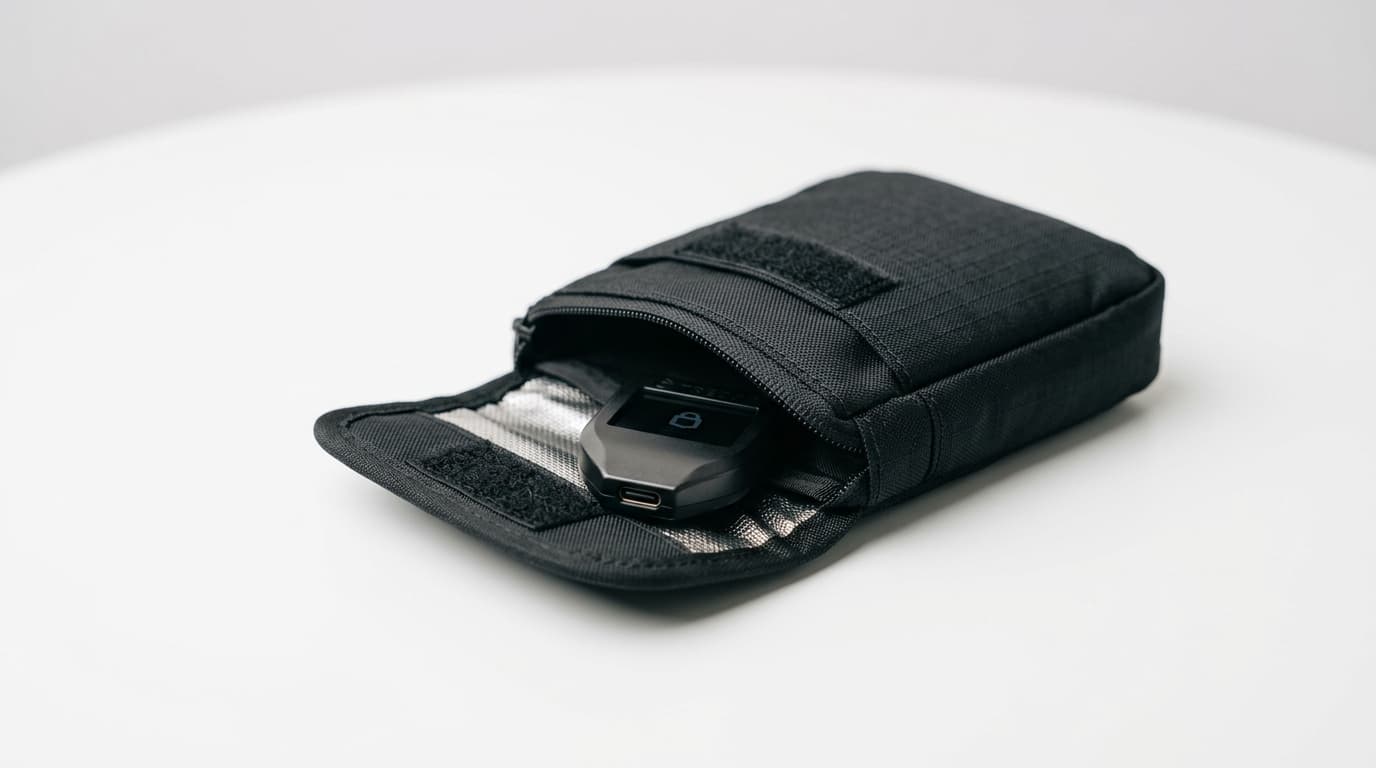
How to Protect Hardware Wallets During Bitcoin Conference Travel Using SLNT Faraday Bags
Learn how SLNT Faraday bags shield hardware wallets from wireless attacks during Bitcoin conferences and travel, with practical security tips.
At Bitcoin conferences in 2026, the biggest threat to your hardware wallet might not be the guy who bumps into you at the coffee line. It could be someone across the room running a silent scan for wireless signals, building a target list of attendees worth following home.
Billions in cryptocurrency were stolen through hacks, wallet breaches, and physical thefts in 2025. Conferences concentrate hundreds or thousands of people who likely hold significant Bitcoin in one building, creating an attractive hunting ground for both opportunistic criminals and sophisticated attackers. The combination of crowded spaces, shared WiFi networks, and the social atmosphere that encourages letting your guard down makes these events uniquely risky.
A Faraday bag offers a straightforward solution to the wireless component of this threat model.
What Faraday Bags Actually Block
Faraday technology dates back to 1836, when Michael Faraday demonstrated that a conductive enclosure blocks external electromagnetic fields. Modern Faraday bags apply this principle to wireless security, creating a shield that prevents signals from entering or leaving the bag.
SLNT manufactures Faraday bags using patented technology with military-grade shielding that blocks RFID, NFC, WiFi, Bluetooth, GPS, and cellular signals. Their products are trusted by organizations including the US Army and Google, which suggests the signal blocking claims hold up under serious testing.
To be fair, most hardware wallets don't actively emit wireless signals during normal operation. A Ledger sitting in your pocket isn't broadcasting your location. But Faraday bags provide broader protection: they guard against electromagnetic interference, prevent any theoretical scanning of NFC-enabled devices, and most importantly, they protect your phone, which almost certainly contains wallet apps, authentication codes, or recovery information.
The real value comes from creating a predictable security state. When your devices are in the bag, you know with certainty they're isolated from all networks. No exceptions, no edge cases to worry about.
The Conference Threat Model
Understanding what you're protecting against helps you make reasonable decisions about security measures.
Remote wireless attacks represent the subtle threat. Sophisticated attackers can probe for device signatures, intercept Bluetooth communications, or exploit vulnerabilities in WiFi protocols. Even if your hardware wallet doesn't connect to these networks, your phone does, and your phone probably has access to exchange accounts, email with recovery information, or authentication apps.
Physical theft remains the obvious concern. Pickpockets and snatch-and-grab thieves work conferences specifically because attendees are distracted and carrying valuable devices. A hardware wallet in a Faraday bag in your front pocket or under-shirt travel pouch adds a physical layer of protection.
Surveillance and targeting is the longer game. Criminals who attend conferences may not steal anything on-site. Instead, they identify targets by observing behavior, noting devices, and gathering information to plan later attacks. Reports of home invasions targeting hardware wallet owners have increased, suggesting some criminals are willing to take significant risks for direct access to crypto holders.
Practical Protection During Travel
SLNT offers several products suited to conference travel. Their Faraday Dry Bags (ranging from $54.95 to $118.99 based on publicly listed prices) combine waterproof protection with signal blocking. Standard Faraday pouches work for hardware wallets and phones. Larger bags can accommodate laptops for those traveling with more equipment.
The magnetic closures on SLNT bags matter for practical use. You'll be taking devices in and out throughout the day; fumbling with complicated seals gets old quickly. A secure closure that actually gets used beats a theoretically superior seal that you start leaving open because it's annoying.
TSA Considerations
Faraday bags are permitted in both carry-on and checked luggage, but they may trigger additional screening. TSA officers can't see through the shielding on their scanners, which naturally prompts questions.
Plan to remove devices from Faraday bags before sending them through x-ray screening. Arrive earlier than you normally would for flights. Being cooperative and matter-of-fact about explaining that it's a signal-blocking bag for electronics usually resolves any concerns quickly.
The key is not looking like you're hiding something. Faraday bags are common enough in 2026 that most security personnel recognize them. Having a simple, honest explanation ready makes the interaction smoother.
Border Crossings
Crossing international borders presents different considerations. Some countries may request access to electronic devices or ask you to power them on. Having devices in a Faraday bag doesn't give you any special legal protection, but it does mean those devices won't have received any remote commands or been connected to networks during transit.
This matters for maintaining chain of custody over your devices. If someone compromised your phone remotely while you were in transit, you'd have no way of knowing. Keeping devices isolated at least narrows the window of potential compromise.
Layered Security Beyond the Bag
A Faraday bag addresses one attack vector. Comprehensive conference security requires additional layers.
Update firmware before traveling. Don't do this at the conference on unfamiliar networks. Verify your hardware wallet firmware is current before you leave home, using your own trusted connection.
Consider multisig setups. If you're traveling with significant holdings, requiring multiple signatures from devices in different locations means a single theft can't drain your funds.
Split seed storage. Never travel with your complete seed phrase in one location. If you must bring recovery information, distribute it across multiple secure locations using a scheme like Shamir's Secret Sharing.
Avoid public WiFi entirely. Use cellular data or a personal hotspot. If you must use conference WiFi, a reputable VPN is mandatory, though imperfect.
Keep hardware wallets in the Faraday bag when not actively signing transactions. The brief moments of exposure when you actually need the device are unavoidable. Extended exposure when the device is just sitting in your bag is not.
Choosing the Right Bag
SLNT ranks among the top Faraday bag manufacturers in 2026 comparisons, alongside Mission Darkness and GoDark. Independent testing suggests quality Faraday bags achieve 65-85+ dB of signal attenuation, which effectively blocks all consumer wireless frequencies.
For conference travel specifically, consider:
Size: A pouch that fits your hardware wallet and phone in one compartment simplifies the routine of storing devices together.
Closure mechanism: Magnetic closures balance security with daily usability. Avoid bags where you'll skip the closure because it's too cumbersome.
Appearance: Something that looks like normal travel gear draws less attention than obviously tactical equipment. SLNT's products generally achieve this balance, looking like standard tech organizers rather than spy equipment.
Reasonable Expectations
Faraday bags aren't magic. They don't protect against social engineering, phishing, physical coercion, or supply chain attacks on your devices. They won't help if you've already installed malware on your phone or if your seed phrase is stored in a compromised cloud backup.
What they do offer is certainty about wireless isolation. When your devices are in the bag, they're not communicating with anything. In an environment full of unknown networks, unknown people, and unknown threats, that certainty has real value.
The $55-120 investment in a quality Faraday bag is trivial compared to the value most conference attendees are protecting. The minor inconvenience of putting devices in a bag is trivial compared to the peace of mind of knowing your hardware wallet isn't being probed by the person sitting behind you.
Conference security isn't about being paranoid. It's about matching your precautions to your actual risk level. If you're attending Bitcoin events and carrying hardware wallets, your risk level justifies taking wireless isolation seriously.