
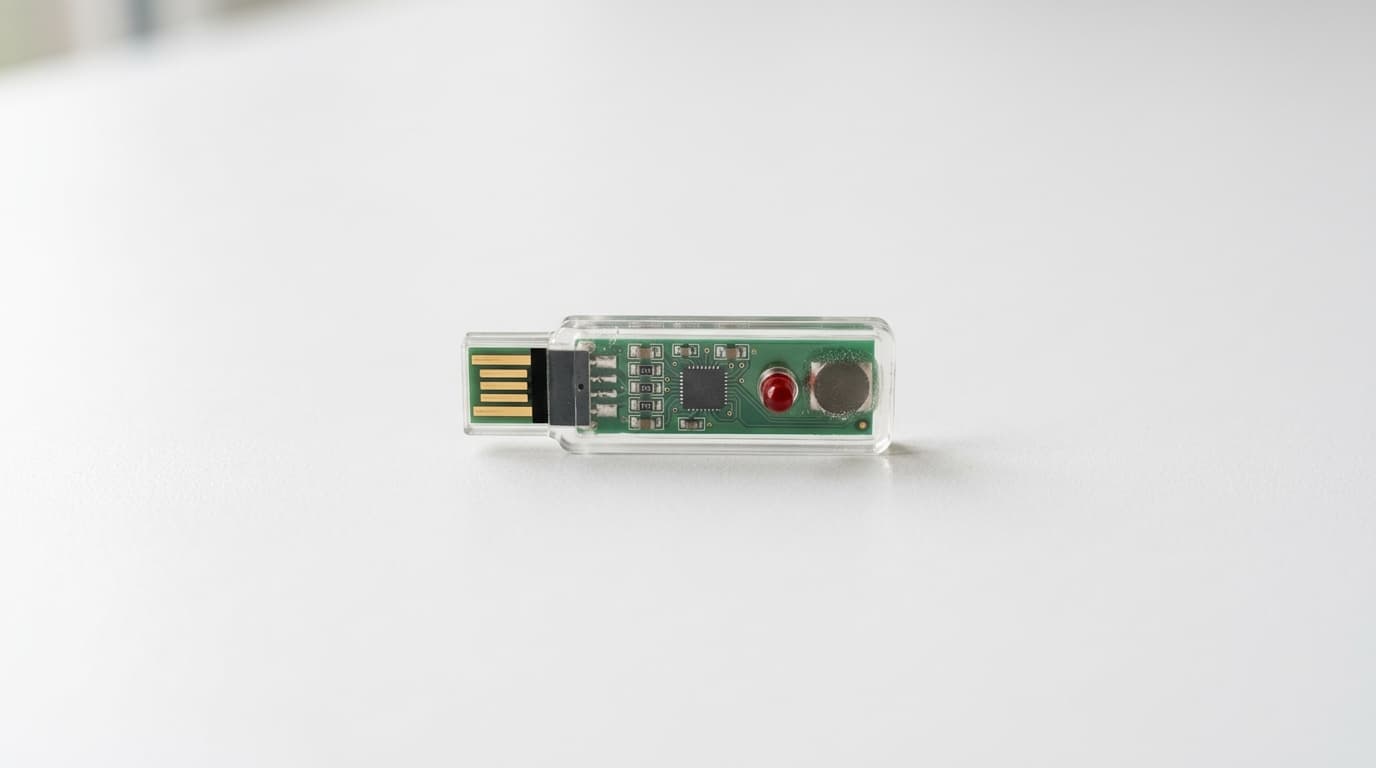
OpenDime Review as a Physical Bitcoin Cash Alternative in 2026
OpenDime turns Bitcoin into physical cash you can hand over. This research-based review covers setup, security trade-offs, and BCH compatibility.
Imagine handing someone a USB stick and walking away, knowing you just transferred Bitcoin with zero blockchain fees and no trace until they decide to spend it. That's the premise behind OpenDime, Coinkite's disposable hardware wallet that's been turning digital currency into something resembling physical cash since around 2016.
The concept sounds almost too simple: load Bitcoin onto a small USB device, pass it around like a bearer bond, and only when someone physically breaks the seal does the private key become accessible. But does this cypherpunk ideal hold up as a practical tool in 2026? And can it work for Bitcoin Cash users looking for the same off-chain privacy?
How OpenDime Actually Works
OpenDime is essentially a single-use cold storage device. When you plug it into any USB-compatible computer, phone, or tablet, it generates a random private key using entropy files you provide. The public Bitcoin address is immediately visible, allowing anyone to send funds to it and verify the balance.
Here's the critical part: the private key remains completely inaccessible until you physically unseal the device by pushing through a marked section. Once unsealed, the key exports in standard WIF (Wallet Import Format), which any Bitcoin wallet can sweep. Until that moment, the device functions as a trustless bearer instrument.
This means two parties can exchange an OpenDime without either needing to trust the other or wait for blockchain confirmations. The recipient simply plugs it in, verifies the balance, and accepts it. No fees. No mining delays. No on-chain record of the transfer.
The Bitcoin Cash Compatibility Question
OpenDime was designed for Bitcoin, and Coinkite has remained firmly Bitcoin-only in their product philosophy. However, because Bitcoin Cash shares the same address format and private key structure as Bitcoin, an OpenDime can technically hold BCH.
Community discussions dating back to 2017, and still applicable today, confirm this works. You fund the OpenDime's address with BCH instead of BTC, and when unsealed, you import the private key into any BCH-compatible wallet to sweep the funds.
There's an important caveat: Coinkite hasn't announced any BCH-specific integrations or features. This is unofficial use. The device works because of underlying cryptographic compatibility, not because it was designed for BCH users. If you're specifically seeking a physical Bitcoin Cash bearer instrument, OpenDime functions, but you're operating outside the manufacturer's intended use case.
Practical Use Cases That Make Sense
OpenDime shines in specific scenarios. For in-person trades where both parties want privacy, handing over a sealed device beats waiting for confirmations or exposing wallet addresses. For gifting Bitcoin to someone unfamiliar with cryptocurrency, the physical object makes an abstract concept tangible.
The roughly $12-16 per-unit cost (as of recent pricing) positions it well for moderate amounts. Loading $500 worth of BTC onto an OpenDime for a private sale costs the same as loading $50, with no percentage-based fees eating into smaller transactions.
Reviews from April 2026 describe the current V4 version as an "innovative Bitcoin piggybank," praising its simplicity for physical storage. Reddit users have discussed successfully sweeping funds from V4 devices as recently as January 2026, suggesting the product continues functioning as intended.
Security Trade-offs Worth Understanding
OpenDime's security model differs fundamentally from seed-phrase hardware wallets like Coldcard or Trezor. Those devices protect recoverable keys; OpenDime protects a single-use secret.
The upside: if you never unseal it, no one can access the funds. The device doesn't connect to the internet, doesn't run firmware updates, and has no attack surface beyond physical theft.
The downside: once unsealed, the device is finished. You can't reload it. This makes OpenDime wasteful compared to reusable hardware wallets for personal cold storage. It's designed for transfers, not long-term hodling across multiple deposit and withdrawal cycles.
There's also the trust question. When receiving a sealed OpenDime, you're trusting that the previous holder didn't somehow extract the private key before passing it along. The physical seal is meant to prevent this, but sophisticated tampering remains theoretically possible. For high-value transfers, this risk deserves consideration.
How It Compares to Digital Wallets
A standard mobile or hardware wallet gives you flexibility: multiple addresses, transaction history, backup recovery, and reusability. OpenDime gives you one thing extremely well: untraceable peer-to-peer handoffs.
If you're sending Bitcoin across the internet, a digital wallet makes more sense. If you're physically handing someone value and want the transaction to stay off-chain until they choose otherwise, OpenDime fills a gap that conventional wallets can't.
Alternative physical Bitcoin products have emerged, like Material Bitcoin for engraved metal storage, but OpenDime remains unique in its USB bearer instrument design. Nothing else quite replicates the "pass it like cash" experience.
The Bottom Line for 2026
OpenDime continues doing exactly what it set out to do a decade ago: enable private, physical Bitcoin transfers without on-chain friction. The V4 version reviewed in 2026 maintains the same core proposition that earned it a following among privacy-conscious users.
For Bitcoin Cash users, compatibility exists through shared key formats, though without official support. BCH's volatile price history (ranging from roughly $247 to $605 during 2025 according to predictions from that period) doesn't change the device's functionality, but it does affect whether physical bearer instruments make sense for your specific situation.
If you need reusable cold storage with recovery options, look elsewhere. If you want to hand someone Bitcoin the way you'd hand them a twenty-dollar bill, with no accounts, no apps, and no blockchain record until they decide to spend, OpenDime remains the most direct solution available.