
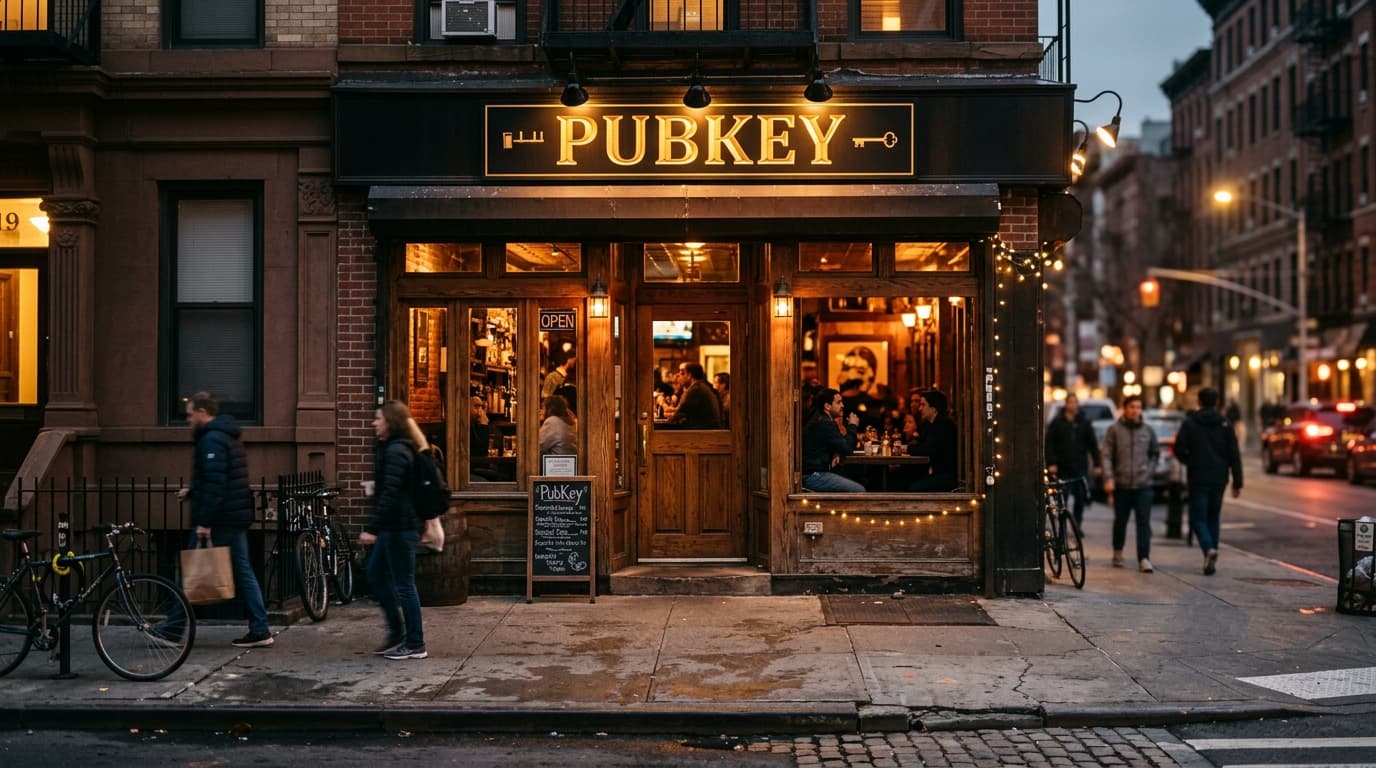
PubKey NYC Review and Why This Bitcoin Bar Has Become a Global Pilgrimage Site
A research-based review of PubKey in Greenwich Village, examining how this Bitcoin bar evolved into a legitimate community hub and cultural institution.
A basement tavern on Washington Place in Greenwich Village has become something unusual: a genuine third place for Bitcoiners that also functions as a perfectly normal neighborhood bar. PubKey opened in late 2022, and in the years since, it has evolved from a curious crypto novelty into what industry coverage now describes as a dominant cultural force in New York's Bitcoin community.
The premise sounds gimmicky. A "Bitcoin bar" could easily devolve into themed kitsch, the monetary equivalent of a sports bar plastered with memorabilia nobody actually cares about. But PubKey has threaded a difficult needle, embedding Bitcoin into its operational DNA while remaining accessible to the 80% of patrons who, according to a November 2024 report, show up simply because they want a dive bar with decent food.
What PubKey Actually Is
The name itself is a play on "public key," the cryptographic concept fundamental to Bitcoin. But walk down the stairs into PubKey on a random Tuesday, and you'll find wood-paneled walls, burgers, hot dogs, wings, and prices that remained under $21 per menu item when the bar opened. The aesthetic is deliberately unpretentious: Greenwich Village tavern, not crypto conference.
What distinguishes PubKey is the programming layered on top of this classic bar framework. Thursday nights feature free, open-to-the-public Bitcoin education and meetups. The bar hosts podcasts like "Hit Send" recorded on-site. And the venue has become a natural gathering point for milestone moments in Bitcoin's trajectory, including watch parties for the January 2024 spot Bitcoin ETF approval.
Owner Thomas Pacchia, a former Fidelity blockchain executive, has consistently pushed back against the "theme bar" criticism. In interviews, he's described the bar's mission as hosting serious conversations about Bitcoin, socioeconomics, and policy alongside casual drinking. The goal, as he's articulated it, is a space where meaningful discussions can happen across socioeconomic lines.
The Lightning Network Integration
PubKey accepts Bitcoin payments via the Lightning Network, though this wasn't always the case. Early 2022 coverage noted the irony that a self-described "Bitcoin bar" initially didn't accept Bitcoin. That gap between branding and function has since closed.
As of 2024, approximately 5% of PubKey's revenue came through Bitcoin payments, a figure that reportedly increased following high-profile political visits. This is modest but meaningful. It demonstrates that Lightning integration in a retail hospitality setting can work at scale, even if most customers still reach for credit cards or cash.
For visitors wanting to experience Lightning payments in a real-world merchant setting, PubKey offers a low-friction opportunity. The transaction itself is unremarkable, which is arguably the point.
The Political Spotlight
In September 2024, Donald Trump visited PubKey during his presidential campaign, ordered 50 burgers and 50 Diet Cokes, and paid via Bitcoin on Lightning. The visit threw the bar into the national spotlight and crystallized its status as a symbolic Bitcoin venue.
Whether you view this as a triumph or a cringe-inducing spectacle depends on your politics and your feelings about Bitcoin's entanglement with partisan campaigns. But the visit undeniably raised PubKey's profile and demonstrated the venue's role as a legitimate space where policy and culture intersect.
PubKey has attracted other pro-Bitcoin political figures and industry leaders, functioning as neutral ground where conversations can happen outside formal conference settings.
The Embassy Model
Early Bitcoin embassies, like those that emerged in Montreal and Tel Aviv, were primarily educational centers focused on merchant onboarding and public outreach. They served important functions but often struggled with sustainability. Running a nonprofit educational space is difficult; running a profitable bar is merely very difficult.
PubKey represents a different model: layer the embassy functions onto a functioning hospitality business. The bar generates revenue through food and drinks. The community programming draws Bitcoiners. And the two reinforce each other, with Thursday meetups bringing in customers who might return on other nights.
This approach has proven sustainable enough that PubKey is expanding. A 12,000 square foot location in Washington D.C.'s Penn Quarter opened in December 2025, incorporating a substantial stage, podcast studio, and proximity to policymakers. The D.C. venue adds steakhouse dining and explicit positioning as a space where Bitcoin advocacy can happen adjacent to political power.
Counterarguments and Limitations
Not everyone buys the narrative. Early local coverage treated PubKey as part of a fad of crypto-branded venues, capitalizing on hype rather than genuinely advancing adoption. The initial refusal to accept Bitcoin reinforced skepticism about whether such spaces are more marketing than mission.
There's also a reasonable question about whether PubKey serves a niche that would exist anyway. New York's Bitcoin community held meetups before PubKey opened. The bar provides a dedicated home, but dedicated homes require rent payments that get passed on through prices and potentially exclusivity.
And while the "80% of customers aren't Bitcoiners" statistic suggests mainstream appeal, it also raises the question of whether PubKey is actually orange-pilling anyone or simply providing comfortable space for existing Bitcoiners to congregate.
Who Should Visit
Bitcoiners traveling through New York should consider PubKey a legitimate destination. The Thursday programming provides structured opportunities to meet the local community, and the bar itself is a pleasant enough place to spend an evening regardless of the Bitcoin angle.
Curious newcomers might find the low-pressure environment useful. Unlike conferences with registration fees and formal programming, PubKey lets you show up, order a beer, and absorb whatever's happening. The "comedy club for nerds" self-description captures something real about the atmosphere.
Business travelers and anyone professionally adjacent to Bitcoin benefit from the organic networking. The venue's track record of hosting substantive figures means you never quite know who might be at the next barstool.
The Verdict
PubKey has earned its reputation through consistent programming, genuine Lightning integration, and a refusal to lean too heavily on gimmicks. It's not the only place to experience Bitcoin culture in New York, but it's become the most visible and arguably the most sustainable.
The expansion to D.C. will test whether the model can replicate outside Greenwich Village's specific context. A 12,000 square foot venue is a different beast than a basement bar, with different economics and different failure modes.
For now, PubKey demonstrates something valuable: Bitcoin community infrastructure can exist within mainstream commercial spaces rather than confined to niche educational centers or purely online forums. Whether that's enough to matter depends on whether you believe physical gathering places still shape culture in an era of Discord servers and Twitter threads.
The answer, judging by the crowds on Thursday nights, appears to be yes.