
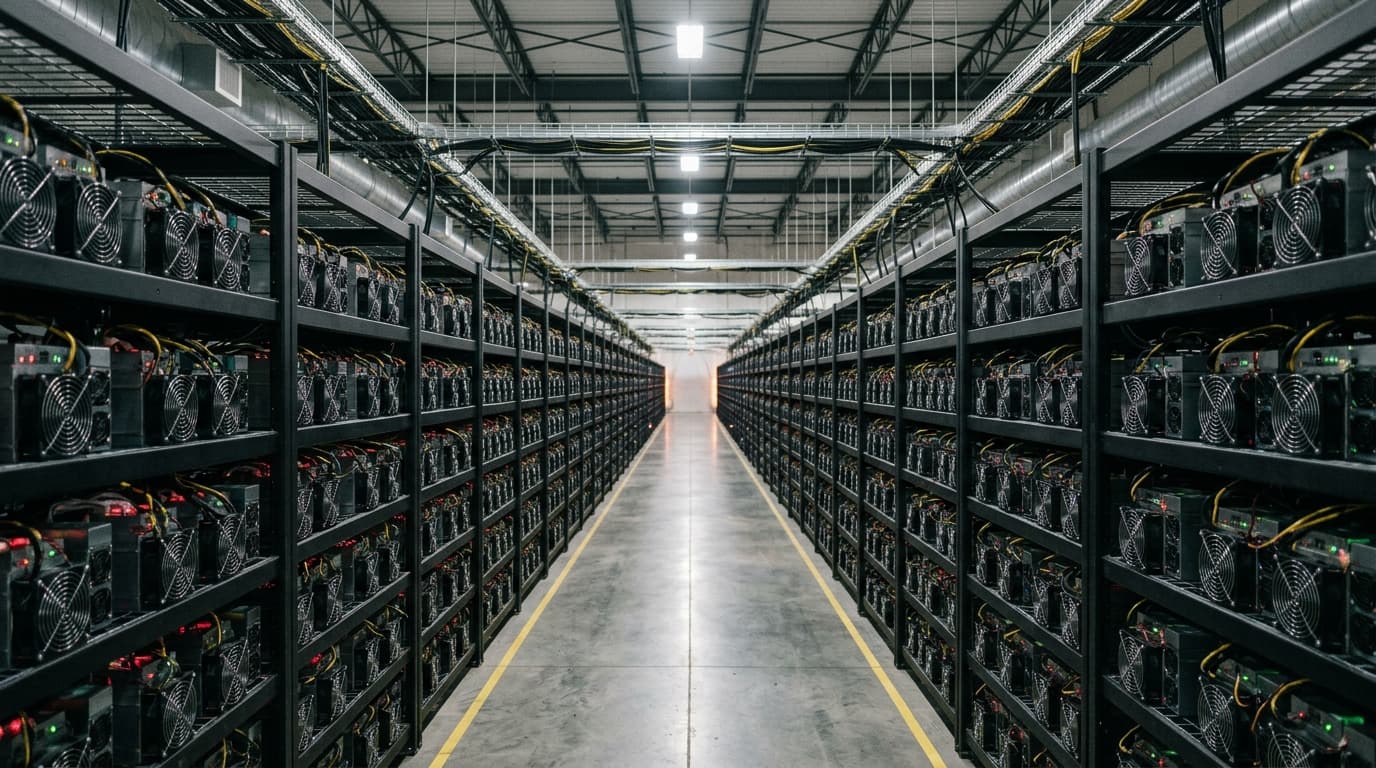
Simple Mining Review (2026): Rates, Uptime & Repairs, Honestly
The cleanest-record host in a category full of horror stories. What Simple Mining's rates, uptime, and repairs actually get you, and where it won't.
In April 2022 the U.S. sanctioned a Russian data-center operator called BitRiver, and thousands of American-owned mining machines sitting in Siberia through a marketplace called Compass went dark, tens of millions of dollars in hardware stranded on the wrong side of a sanctions list. Blockware got sued by the feds over a "100% uptime" claim it made while its machines were curtailed for weeks. This is the part of hosted mining nobody puts in the ad copy: your machine lives in someone else's building, on someone else's grid, under someone else's counterparties, and that is the actual risk you are underwriting when you let a company host it for you.
Which is the lens to judge Simple Mining through. Not the rate, not the uptime percentage, the record. Simple Mining is a Cedar Falls, Iowa company that owns and runs its own data centers, has been hosting since 2021, and carries a clean sheet: no sanctions saga, no fraud suit, an A-rated BBB profile, and an Inc. 5000 listing. In a category this littered with cautionary tales, "boring and still here" is the headline feature.
Disclosure: Bitcoin Products has a referral partnership with Simple Mining. If you sign up through the links on this page, we may earn a referral fee at no extra cost to you. That relationship does not shape the assessment: this review states the cons as plainly as the wins, because a review you can't trust is worthless to you and worthless to us.
Here is the honest accounting of what hosting with Simple Mining actually gets you, what it costs, and where it will and won't fit.
Five things to know before you commit:
- You own the machine, and the Bitcoin is yours. You buy the ASIC, Simple Mining deploys and runs it in its own facility, and your mined Bitcoin pays out to the pool and wallet you choose. This is hosting, not a cloud contract where you own nothing at the end.
- Trust is the product, not price. It is not the cheapest option in the category. What it sells is a clean operating record, in-house repair, and rate stability, and for most buyers that is worth more than shaving a penny off the kilowatt-hour.
- There is no hard uptime guarantee, on purpose. The advertised figure is a 95%+ average, not a contractual SLA. That is not a weakness the company is hiding. The ability to power down fast is exactly what keeps the electricity cheap. More on that below, because it is the most important thing to understand about the model.
- The rate has not moved since 2021. The all-in fee sits around $0.07–$0.08/kWh and lower with volume, and Simple Mining says it has never raised it. In a business where your landlord's power cost can climb under you, a host that hasn't touched its rate in years is a real signal.
- You can try it before you buy hardware. A 7-day risk-free trial runs 100 TH/s of live hashrate into your dashboard, so you see real payouts before committing capital to a machine.
At a glance: Simple Mining (2026)
| What it is | US-based Bitcoin mining hosting; you own the ASIC, they power and maintain it |
| Who runs it | Simple Mining, Cedar Falls, Iowa. Founder/CEO Adam Haynes |
| Facilities | Owns and operates its own Iowa data centers (10 sites); 4+ EH/s, 150+ MW under management |
| All-in rate | ~$0.07–$0.08/kWh, down toward ~$0.065 with volume bundles. A single fee, no separate setup/hosting/security add-ons |
| Rate history | In business since 2021; says it has never raised its rate |
| Billing | Precision billing: you pay only for the hours a machine is actually hashing. Pause any time |
| Uptime | 95%+ average (a soft average, not a contractual SLA) |
| Power mix | ~65% renewable (Iowa wind); air-cooled and closed-loop hydro |
| Repairs | Certified in-house ASIC repair: free repair labor, unlimited fan replacements. Parts via an optional Protection Plan |
| Ownership | You own the machine, pick your pool, payouts go straight to your wallet. No minimum (1 to thousands) |
| Free trial | 7-day risk-free trial at 100 TH/s |
| Credibility | A-rated BBB profile; Inc. 5000 honoree; real operator, not a reseller |
| Best for | Investors who want Bitcoin mining exposure without running the hardware themselves |
| Not for | Anyone chasing the absolute lowest rate, or who needs a contractual uptime guarantee |
What Simple Mining actually is
Start with the model, because it decides everything else. You buy a current-generation ASIC from Simple Mining's shop. They deploy it in one of their own Iowa data centers, power it, monitor it, and repair it, and you watch the hashrate, uptime, payouts, and billing from a dashboard. Your Bitcoin mines to the pool you choose and lands in the wallet you control. You hold or sell it on your terms.
The word that matters there is own. This is not a cloud-mining contract, where you rent hashrate and walk away at the end with nothing. You hold title to a physical machine, and the coins are yours as they're produced. On the ownership spectrum of this industry, that puts Simple Mining on the good end: pure hosting with self-custody payouts, not a rehypothecated hashrate IOU.
What separates it from a lot of "hosts" is that Simple Mining owns its buildings. Plenty of companies in this space are really marketplaces or middlemen that place your machine in a third party's facility, which is precisely how customers ended up exposed when those third parties got sanctioned or went under. Owning the sites means Simple Mining controls the power contracts, the maintenance, and the service quality directly, and it is why the rate can stay flat and the repairs can happen in-house instead of on a boat.
How the pricing actually works
Electricity is the whole game in mining. By 2026 power is roughly 75–85% of a miner's ongoing cost, so the rate you pay for it is very close to the entire question of whether you make money. A machine running at $0.07/kWh instead of $0.12/kWh saves on the order of $1,200 a year, and across a small fleet that difference is the margin.
Simple Mining charges an all-in rate in the neighborhood of $0.07–$0.08/kWh, dropping toward roughly $0.065 as you bring more machines. "All-in" is the load-bearing word: it is a single hosting-service fee, with no separate line items bolted on for setup, security, or basic maintenance. That matters because the oldest trick in hosting is advertising a low headline rate and then reconstructing the margin through add-ons. One number, no surprises, is a cleaner deal than a lower number plus a menu.
Two details make the pricing genuinely unusual. First, billing is by actual hashing time, not a flat monthly allocation, and you can pause a machine whenever you want. If Bitcoin's price craters and mining goes underwater for a stretch, you are not paying to run a machine at a loss. Second, Simple Mining says it has not raised its rate since 2021. Rate stability is easy to overlook and hard to fake: a host that leases its power can have its own cost climb and pass it straight through, and several have. Years of a held rate is the kind of claim that only a facility-owner can make.
One point of hygiene, because the company is careful about it and you should be too: that $/kWh figure is a bundled hosting-service fee shown for reference. Simple Mining is not a utility and does not sell or resell electricity. You are buying a hosting service priced against power, not power itself.
Uptime and the honesty test
This is the section that separates a real review from a brochure, so read it before you weigh anyone's uptime number, Simple Mining's included.
The advertised figure is a 95%+ average. Not a contractual service-level agreement, not a guarantee, an average. Your first instinct is to read that as a downgrade from the "99.9% uptime" language you see elsewhere in hosting. It is the opposite, and understanding why is the single most useful thing you can take from this page.
A Bitcoin mine is, in Haynes's own framing on The Investor's Podcast, "really like a tier zero data center. It's the bare bones, it's as little capex as possible in order to be as profitable as possible on the mining side of things." The reason it can run that lean is that it is allowed to switch off. "On the bitcoin mining side of things," Haynes explained, "we can be interrupted in order to have our cost of power be as low as possible. We can be on, off, on off. And it doesn't really affect operations at all." When Iowa's wind drops on a cold, high-demand day, Simple Mining can curtail: "We can shut down our full load within sixty seconds at our facilities." Those interruptions are the deal it strikes with the grid, and they are why the power is cheap.
An AI or traditional data center can't do that. As Haynes put it, "Unlike bitcoin mining, these traditional data centers cannot be a flexible load. They require five nines of uptime, 99.9999% uptime on an annual basis. And you're not going to get that out of the standard bitcoin mining facility as of today." To hit that kind of uptime you need redundancy, battery backup, backup generation, and roughly ten times the capital cost, and every dollar of that shows up in the electricity price. So when a host promises you data-center-grade uptime on a mining rig, one of two things is true: they are quietly charging you for infrastructure you don't need, or they are describing something they can't actually deliver. Blockware advertised "100% uptime" and got sued by the federal government over it while its machines sat curtailed for weeks.
Set against that backdrop, "95% average, and here's exactly why it isn't higher" is one of the more honest framings in the category. The occasional downtime is not a service failure. It is the mechanism that gives you the rate. Simple Mining pairs the average with precision billing (you don't pay for the hours a curtailed machine isn't hashing) and downtime credits, which is the correct way to handle it. Just go in clear-eyed: if your mental model requires a machine that is never, ever off, hosted Bitcoin mining is the wrong instrument, and no honest host can sell you one at these rates.
Repairs and protection
ASICs run 24/7/365 in hot rooms, and they break. The most common failures are fans and control boards, which is exactly the kind of thing you do not want to ship across an ocean and wait two months for. Simple Mining runs a certified in-house ASIC repair operation, and the standard offering includes free repair labor and unlimited fan replacements. Some other hosts in the industry actually route their own broken machines through repair centers like this one, which tells you something about the depth of the capability.
Be precise about what's included, because the company is. Labor and fan replacements are covered. Other parts are handled through an optional Protection Plan, which provides a $500 annual parts allowance per unit plus downtime "Mining Recovery Credits." That plan is a paid add-on, and it is explicitly not insurance, so don't mistake it for something that makes you whole after a catastrophe. It is a parts-and-credits program. For most owners the free labor plus unlimited fans covers the routine failures, and the Protection Plan is there if you want to cap your parts exposure.
The 7-day free trial
The single best feature for a first-timer is that you can test the whole thing before you spend a dollar on hardware. Simple Mining offers a risk-free 7-day trial that runs 100 TH/s of live hashrate into a real dashboard. You see actual hashrate and actual payouts, and you get a feel for the interface and the operation, before you commit capital to a machine you can't easily un-buy. In a category where the usual on-ramp is "wire us five figures and trust us," a live trial is a genuine de-risking tool, and it's the first thing I'd point a nervous newcomer at.
What to know before you commit
The honest cons, stated plainly, because they're the reason to believe the rest:
- It is not the cheapest. All-in rates across the serious hosts cluster in the $0.06–$0.08 range, and you can find a lower headline number, Compass has run cheaper. But the cheapest operator in this industry has also had the worst track record, and the spread is small enough that counterparty trust dwarfs it. You are paying slightly more for a clean record. Decide if that trade is worth it to you; I think for most people it is.
- No hard uptime SLA. Covered above. It's a soft 95% average by design. If you contractually need a hard uptime SLA, this model can't give it to you, and neither can the cheap ones.
- Geographic concentration. Every site is in Iowa. That buys a cool climate, cheap wind power, and low natural-disaster risk, but it is one state and one grid. A more distributed host spreads that risk differently.
- The parts plan costs extra. Free labor and fans are included; broader parts coverage is the paid Protection Plan. Budget for it if you want the parts cap.
- Some terms live in the PDF. Not every contractual detail is on the public marketing page, some of it is in the Hosting Agreement. Read that document before you sign, not the landing page.
- ROI is genuinely uncertain, and they'll tell you so. This is the part I respect most. Asked point-blank about payback, Haynes refused to sell a number: "We very much don't really like to discuss a return on investment because we don't know, nobody knows exactly how things are going to play out. And our goal is not to mislead anybody. Our goal is to offer the best service out there." The honest range he gave: "We've seen some of our clients return their investment as quickly as six months. We've seen some clients that have taken two years or longer to recoup their investment." Anyone who quotes you a confident payback date on a mining rig is guessing or selling. Simple Mining doesn't, and that's a point in its favor.
Simple Mining vs the alternatives
Where Simple Mining lands against the other hosts a retail buyer actually considers. This is the short version, oriented around the one variable that matters most in hosting, counterparty risk. For the full head-to-head, see the TFTC comparison of Bitcoin mining hosting companies.
| Host | Model | Roughly the rate | Contractual uptime SLA | Track-record flag |
|---|---|---|---|---|
| Simple Mining | Owns its sites, pure hosting | $0.07–0.08 all-in, to ~$0.065 | None (soft 95% avg + credits) | Clean: A-rated BBB, Inc. 5000, flat rate since 2021 |
| Compass | Marketplace + hosting | Can run lower (~$0.06–0.07) | 95% via credits, disputed | 2022 BitRiver sanction stranded customer machines in Siberia |
| Sazmining | Mining-as-a-service | Revenue share + service fee | None (rig-performance, not uptime) | Clean on fraud, but uncapped fee and thin exit terms |
| Blockware | Service + marketplace | ~$0.078 all-in | None | 2022 federal fraud suit over "100% uptime"; CEO ousted 2026 |
The honest calls. Compass is cheaper and has the widest hardware selection, and it is also the cautionary tale that frames this whole review, cheapest rate, worst counterparty history. Sazmining is the other genuinely clean operator here, non-custodial and renewable, and if you want that model our Sazmining review goes deep on it; the catch is an uncapped service fee and exit terms it doesn't publish. Blockware bundles a tidy buy-and-host flow with a real tax-depreciation angle, weighed against a fraud suit over uptime claims and a 2026 management blow-up. Simple Mining wins this set on exactly one thing, the cleanest record, and in hosting that is the thing worth winning.
What you might be looking for instead
- Comparing every host side by side? That's the full TFTC mining-hosting comparison, built to weigh all of them at once. This page is the deep dive on one.
- Want the non-custodial, revenue-share model instead of owning outright? Read the Sazmining review.
- Just want to understand hosted mining generally? Start at the mining hub for the category overview.
- Trying to run the numbers first? Simple Mining publishes a public cost-to-mine and mining calculator set that's genuinely useful even before you're a customer.
Who Simple Mining is for
| If you are… | Simple Mining is… |
|---|---|
| An investor who wants mined-Bitcoin exposure without touching hardware | The strongest pick in the category, on record and service |
| A first-timer nervous about a five-figure commitment | A good on-ramp, because the 7-day trial lets you test before you buy |
| Someone who values a clean counterparty over the last penny of rate | Exactly the trade this company is built to make |
| A fleet operator who wants in-house repair and flat pricing | A fit; no minimum, and the rate scales down with volume |
| Chasing the absolute cheapest kilowatt-hour | The wrong tool; a cheaper host exists, with a worse record |
| Requiring a contractual uptime SLA | Not your model, and no honest host at this price offers one |
What to do this week
If you're mining-curious but have never done it: take the 7-day trial before anything else. Run 100 TH/s into the dashboard, watch real payouts land, and learn the interface on someone else's machine. It's the cheapest education in the space.
If you're deciding between mining and just buying Bitcoin: do the honest math on both. Haynes frames hosted mining as "a forced DCA," a way to accumulate Bitcoin daily without the emotional whipsaw of timing buys, plus a possible depreciation angle on the hardware (talk to your own tax professional, not a mining host, about that). It's a reasonable framing. It is not a reason to skip buying spot; for most people it's a complement, not a replacement.
If you're comparing hosts: read the full TFTC comparison so you're weighing all of them on the same axes, then come back here for the Simple Mining detail. And whichever host you pick, read its actual hosting agreement, the PDF, not the landing page, before you wire anyone money.
If you've settled on Simple Mining: start here, pull the Hosting Agreement, and price a machine against the current rate card while you're logged in. Decide up front whether you want the Protection Plan for parts coverage, and start small enough that the first month is a test, not a bet.
Frequently asked questions
Is Simple Mining legit?▾
Yes, by the checkable signals. Simple Mining has operated since 2021, owns and runs its own data centers in Iowa, holds an A-rated BBB profile and an Inc. 5000 listing, and has no sanctions or fraud history, which is more than several better-known names in hosted mining can say. It's a real mining and repair operator, not a reseller. As with any host, the residual risk is counterparty risk, your machine sits in its building, so read the hosting agreement before you commit.
How much does Simple Mining cost?▾
The all-in hosting rate runs roughly $0.07–$0.08/kWh and drops toward about $0.065 with volume bundles. It's a single fee with no separate setup, hosting, or security add-ons, and billing is by actual hashing time, so you pay only for the hours your machine runs. You buy the ASIC separately, and the $/kWh figure is a bundled hosting-service fee shown for reference, not a utility electricity rate.
Do I own the miner and the Bitcoin?▾
Yes. You purchase and own the physical ASIC, you choose your own mining pool, and your Bitcoin pays out directly to your wallet. This is hosting, not a cloud contract, so you hold the hardware and the coins, not an IOU on someone else's hashrate.
What is Simple Mining's uptime, and is there a guarantee?▾
The advertised figure is a 95%+ average, and there is no contractual uptime SLA. That's by design: the facilities run as a flexible load that can curtail within about a minute when the grid needs it, and that flexibility is what keeps the power cheap. Precision billing means you don't pay for hours a machine isn't hashing, and downtime is offset with Mining Recovery Credits under the Protection Plan.
What happens if my machine breaks?▾
Simple Mining runs a certified in-house ASIC repair operation. Repair labor is free and fan replacements are unlimited, which covers the most common failures. Other parts are handled through an optional Protection Plan that provides a $500 annual parts allowance per unit. That plan is a paid add-on and is not insurance.
Is there a free trial?▾
Yes. Simple Mining offers a 7-day risk-free trial that runs 100 TH/s of live hashrate into your dashboard, so you can see real hashrate and payouts before buying any hardware.
Is Simple Mining cheaper than Compass?▾
Not usually. Compass can advertise a lower headline rate. The counterargument is track record: Compass is the operator whose customers had machines stranded in Siberia after its host BitRiver was sanctioned in 2022, while Simple Mining has a clean record. The rate spread across serious hosts is small, and for most buyers the cleaner counterparty is worth paying slightly more for.
Is the electricity really renewable?▾
Largely. Simple Mining is based in Iowa, which produces the highest share of wind power of any U.S. state, and roughly two-thirds of the state's generation is renewable. The company puts its own power mix at about 65% renewable, and its facilities use air cooling and closed-loop hydro cooling, which uses effectively no water.
Is there a minimum order?▾
No. Simple Mining hosts anything from a single machine to a fleet of thousands, and the rate scales down as you add machines. That makes it workable for a first-time retail buyer and for a larger allocator.
Can I get out if I want to?▾
Yes, with more options than most hosts give you. You can pause a machine any time if mining goes unprofitable, and Simple Mining runs a client marketplace where you can resell an already-hosted miner, an exit and liquidity path that most hosting companies don't offer at all.