
How to Track Your Bitcoin Transaction Fees with Mempool.Space Analytics
Learn to use Mempool.Space for Bitcoin fee estimation, transaction tracking, and avoiding overpayment during network congestion.
Right now, as of early May 2026, a high-priority Bitcoin transaction costs about 2 sat/vB. A low-priority transaction? Just 1 sat/vB. The difference might seem trivial until you realize that overpaying by even a few sats per virtual byte on a standard transaction adds up quickly if you transact regularly. The challenge is knowing what "right now" actually looks like, and that's where Mempool.Space becomes essential.
This open-source block explorer has become the Bitcoin community's go-to tool for understanding fee dynamics in real time. Whether you're sending your first transaction or managing a business treasury, understanding how to read and use its analytics can save you meaningful amounts of bitcoin over time.
Understanding What You're Looking At
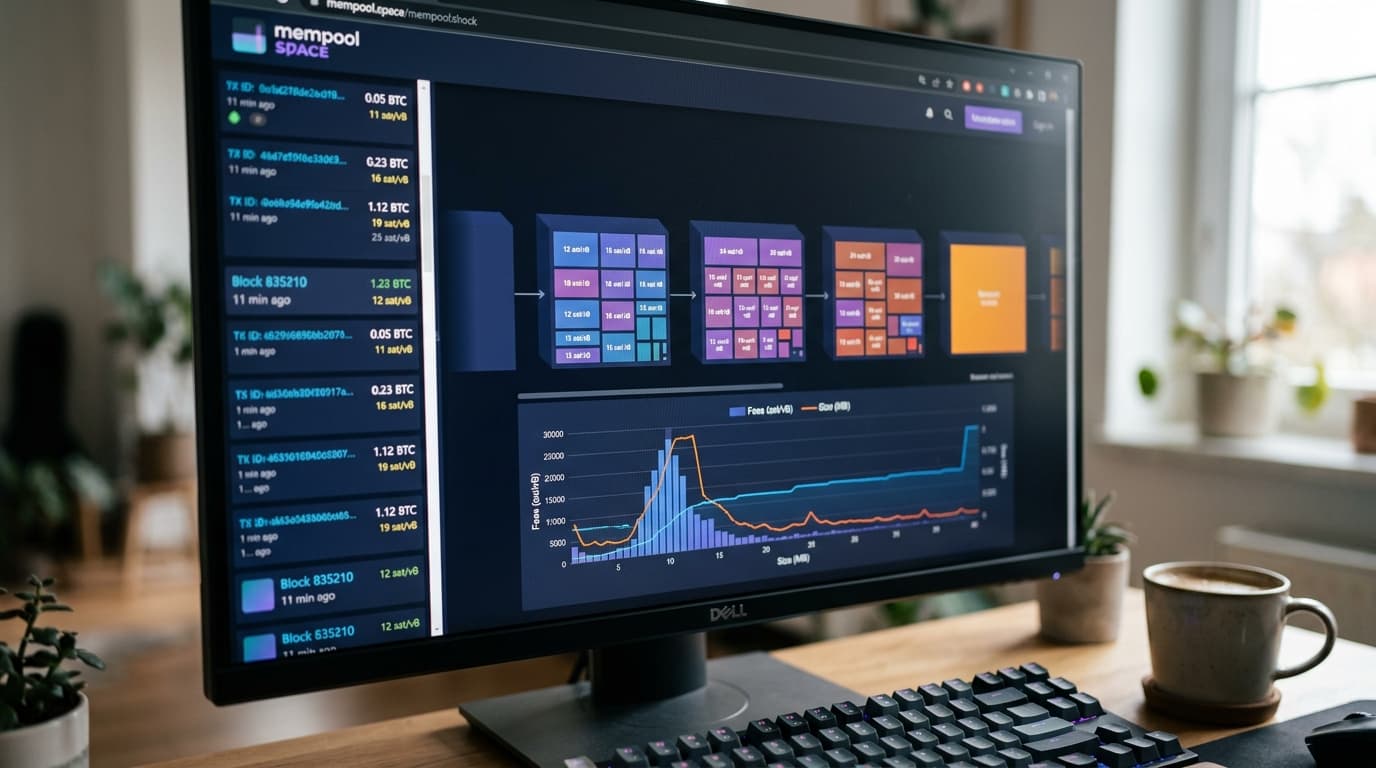
When you first land on Mempool.Space, the homepage displays several key pieces of information. The most prominent are the fee rate estimates, categorized by priority level. As of May 2026, the platform shows No Priority at 1 sat/vB, Low and Medium Priority also at 1 sat/vB, and High Priority at 2 sat/vB. These numbers update continuously based on current mempool conditions.
Below the fee estimates, you'll see a visual representation of the mempool itself, displayed as projected blocks stacked by fee rate. This visualization shows all unconfirmed transactions waiting to be mined. In the current low-congestion environment, the mempool contains roughly 49,756 transactions using about 178.63 MB of space. During busier periods, these numbers climb significantly, and so do fee rates.
The block visualization isn't just pretty; it's functional. Each projected block shows you which transactions are likely to be included in upcoming blocks based on their fee rates. Miners generally prioritize higher-fee transactions, so watching this stack tells you whether your chosen fee rate will get you into the next block or leave you waiting.
Tracking a Specific Transaction
Once you've sent a transaction, tracking its status is straightforward. Paste your transaction ID (TXID) into the search bar, and Mempool.Space reveals everything you need to know: the fee rate in sat/vB, the effective fee after any Child Pays for Parent (CPFP) adjustments, and the current confirmation status.
This lookup is particularly useful when a transaction seems stuck. If you sent a transaction with a fee rate that made sense yesterday but the mempool has since filled up, you can see exactly where your transaction sits in the queue. The platform shows whether it's likely to confirm in the next block, the next hour, or potentially much longer.
For context, the average fee per transaction over the last 144 blocks (roughly one day) has been around 525 sats, with average block fees at approximately 0.0196 BTC. These figures reflect the current low-congestion environment, but historical data shows fees can spike dramatically during busy periods.
Planning Before You Send
The real power of fee tracking comes before you broadcast a transaction, not after. Mempool.Space offers a fee calculator at mempool.space/tools/calculator that estimates costs based on your transaction's size and desired priority. The current minimum relay fee sits at 0.1 sat/vB, meaning transactions below this threshold won't propagate across the network at all.
Here's the practical workflow: Before sending any significant transaction, check the homepage fee estimates. If you're not in a hurry and fees are elevated, you might wait for a quieter period, often weekends or late nights in major time zones. If you need faster confirmation, you can see exactly what fee rate gets you into the next projected block.
The platform also displays a "Purging" threshold when mempools approach their default 300 MB limit. During severe congestion, nodes begin dropping the lowest-fee transactions from their mempools entirely. If your transaction's fee rate falls below this purging threshold, it may not propagate widely across the network, effectively getting lost. Staying above this threshold during congestion is critical.
When Transactions Get Stuck
Sometimes you'll underpay, either because congestion spiked unexpectedly or because you were trying to save sats and the gamble didn't pay off. Bitcoin offers two mechanisms to unstick transactions: Replace-by-Fee (RBF) and Child Pays for Parent (CPFP).
RBF lets you broadcast a new version of your transaction with a higher fee, replacing the original. Your wallet needs to have enabled RBF when creating the original transaction. CPFP works differently: you create a new transaction that spends the output of your stuck transaction, attaching a high enough fee that miners are incentivized to confirm both.
Mempool.Space shows you the effective fee rate after CPFP adjustments, so you can verify whether your fee bump actually moved your transaction higher in the queue. This visibility removes the guesswork from the fee-bumping process.
For Developers and Power Users
If you're building applications or want to automate fee decisions, Mempool.Space provides an API. The endpoint /api/v1/fees/recommended returns current fee estimates programmatically, allowing wallets and services to pull real-time data rather than relying on static fee settings.
For maximum privacy and reliability, technically inclined users can self-host their own Mempool.Space instance connected to their own Bitcoin node. This eliminates any trust in third-party servers for transaction lookups and fee data, though it requires maintaining infrastructure.
The Bigger Picture on Fee Optimization
Since the SegWit upgrade in 2017, Bitcoin transaction fees have been measured in sat/vB (satoshis per virtual byte), which accounts for the data efficiency gains from SegWit's transaction format. Understanding this measurement helps explain why different transaction types cost different amounts: a simple single-input, single-output transaction uses fewer virtual bytes than a complex multi-input consolidation.
The current low-fee environment won't last forever. Network activity fluctuates based on price movements, new use cases, and broader market conditions. Building the habit of checking fee conditions before transacting, rather than relying on wallet defaults, positions you to handle both quiet periods and congestion spikes without overpaying or getting stuck.
Mempool.Space turns what would otherwise be an opaque process into something you can actually see and understand. The few seconds it takes to check current conditions before hitting send can easily save you hundreds or thousands of sats over time, and more importantly, it gives you confidence that your transaction will confirm when you need it to.