
How to Verify Document Timestamps Using Simple Proof and Bitcoin
Learn to timestamp and verify documents on Bitcoin's blockchain using Simple Proof and OpenTimestamps. A practical guide for institutions.
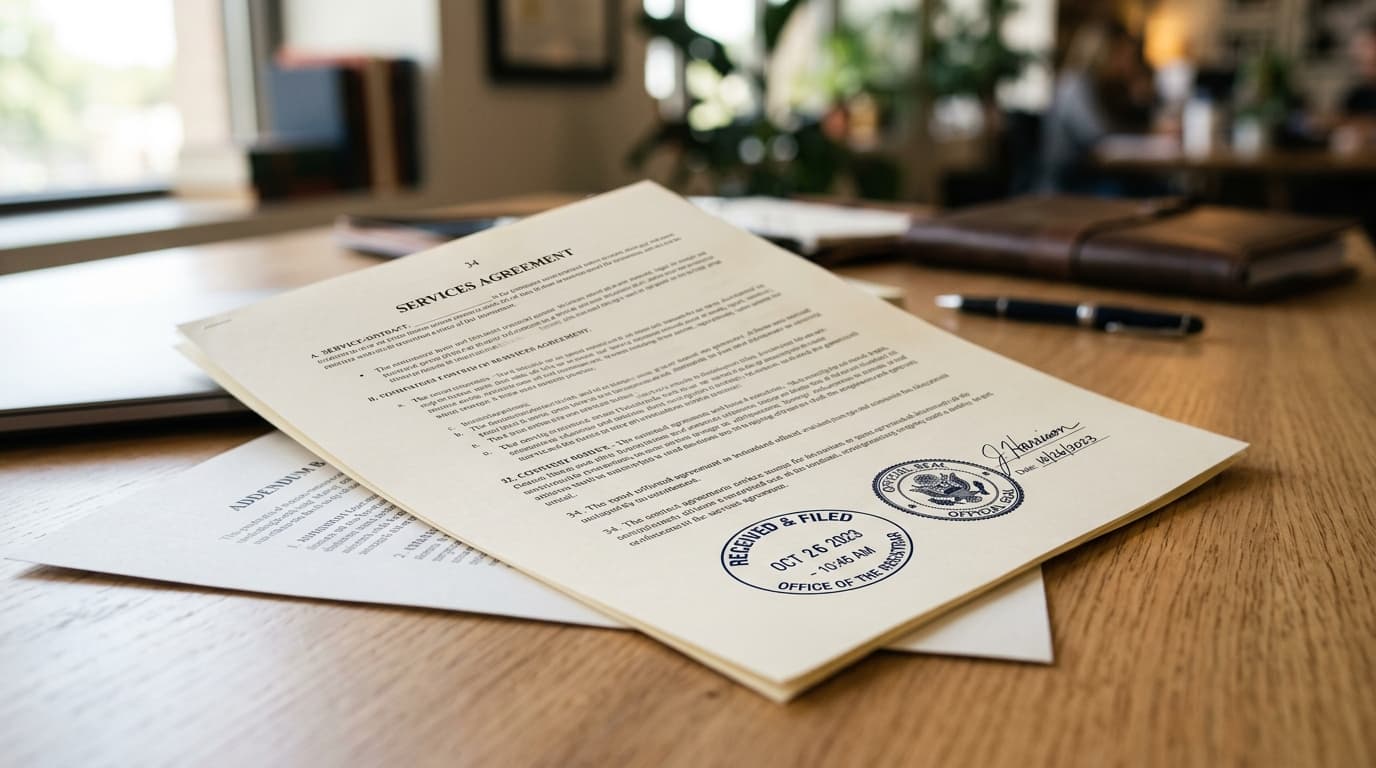
A document's timestamp can mean the difference between a valid election result and a contested one, between a binding contract and a disputed claim. Yet most timestamps rely on centralized servers that could be manipulated, hacked, or simply shut down. Bitcoin offers something better: a timestamp that anyone can verify independently, anchored to the most secure computing network ever built.
This guide walks through how document timestamping works on Bitcoin, how to verify proofs yourself, and why institutions from government registries to election boards are adopting this approach.
How Bitcoin Timestamping Actually Works
The core idea is elegantly simple. Instead of storing your entire document on the blockchain (which would be expensive and privacy-compromising), you store only a cryptographic fingerprint called a hash. This hash is unique to your document; change even a single character, and the hash changes completely.
The OpenTimestamps protocol, which has been running since 2017, standardized this process. Here's what happens behind the scenes:
- Your document gets hashed using SHA-256
- That hash gets combined with thousands of others in a Merkle tree
- Only the root hash of that tree gets written to Bitcoin using an OP_RETURN output
- You receive a .ots proof file linking your specific document to that Bitcoin transaction
This aggregation is what makes the system practical. Free public calendar servers (like btc.ots.dgi.io) batch thousands of hashes into a single Bitcoin transaction, so timestamping costs essentially nothing while maintaining full security.
Step-by-Step Verification Process
Verification requires two things: your original document and the .ots proof file. Here's how to confirm a timestamp is legitimate:
Using Web-Based Tools:
- Navigate to opentimestamps.org or dgi.io/ots/
- Drag both your original document and its .ots proof file onto the page
- The tool computes your document's hash and checks it against the proof
- If valid, you'll see confirmation like "Bitcoin block 925847 attests existence as of 2025-03-15"
Using Local Verification:
For maximum trust, you can verify against your own Bitcoin node. This removes any reliance on third-party servers, since once the hash is anchored in a Bitcoin block, verification is entirely independent. Organizations handling sensitive records often prefer this approach.
The key point: after anchoring, you don't need to trust any company, server, or institution. The proof lives in Bitcoin's blockchain, which would require rewriting the entire chain's history to falsify.
What Timestamps Prove (and What They Don't)
Bitcoin timestamps prove one thing with mathematical certainty: your document existed in its exact form before a specific block was mined. This is powerful for many use cases, but it's important to understand the limitations.
What you get:
- Proof the document wasn't created or modified after the timestamp
- Day-level precision (Bitcoin blocks average 10 minutes, with roughly ±2 hour tolerance)
- Tamper-evident records that anyone can verify independently
What you don't get:
- Proof of authorship (the timestamp doesn't know who created the document)
- Proof the content is accurate or valid
- Sub-minute precision
For authorship, you'd need to combine timestamping with digital signatures. Some implementations, like ProofSnap, bundle SHA-256 hashes with eIDAS-compliant signatures in verifiable ZIP packages for forensic evidence applications.
Practical Use Cases for Institutions
Simple Proof has focused specifically on bringing this technology to governments and public institutions, where trust and transparency matter most.
Election integrity: After certification, election officials can timestamp results to create immutable proof that figures haven't been altered. Any future dispute can be resolved by checking the original timestamp against the blockchain.
Government registries: Birth certificates, property records, and other vital documents can be secured against future disputes about authenticity. Because verification uses open source tools, there's no vendor lock-in or dependency on any single company's continued existence.
Legal and compliance: Contracts, audit trails, and regulatory filings gain cryptographic proof of when they were finalized. This matters in disputes where parties disagree about document versions or timing.
Research and intellectual property: Scientists can timestamp research data and findings, establishing priority without publishing prematurely.
Recent Technical Improvements
Bitcoin Core v30, released in October 2025, raised the OP_RETURN data limit from 83 bytes to 100,000 bytes. While OpenTimestamps was already efficient (aggregating many hashes into minimal data), this change improves scalability for timestamping services and reduces any friction around transaction relay policies.
Peter Todd, who created OpenTimestamps, confirmed in 2025 that the protocol remains compatible with various Bitcoin node policies, with calendar servers typically using one transaction per block maximum.
The protocol itself has remained stable through 2025 and into 2026, a sign of mature, battle-tested design rather than stagnation. Extensions exist for other blockchains (like Cardano's C-OTS), but Bitcoin remains the most secure anchor due to its hash rate and decentralization.
Getting Started
For individuals exploring timestamping, the free tools at opentimestamps.org let you experiment immediately. Upload a file, receive a .ots proof, and verify it yourself.
For institutions needing production-ready solutions with proper documentation and support, Simple Proof offers implementations designed for government and enterprise requirements. Their focus on democratic governments and transparency makes them a natural fit for public sector applications where accountability is paramount.
The verification process remains the same regardless of how you create timestamps: hash the document, check the proof against Bitcoin, and confirm the block. That independence is the whole point. You're not trusting a company's promise that a timestamp is valid; you're verifying it yourself against the most immutable record humanity has ever created.