
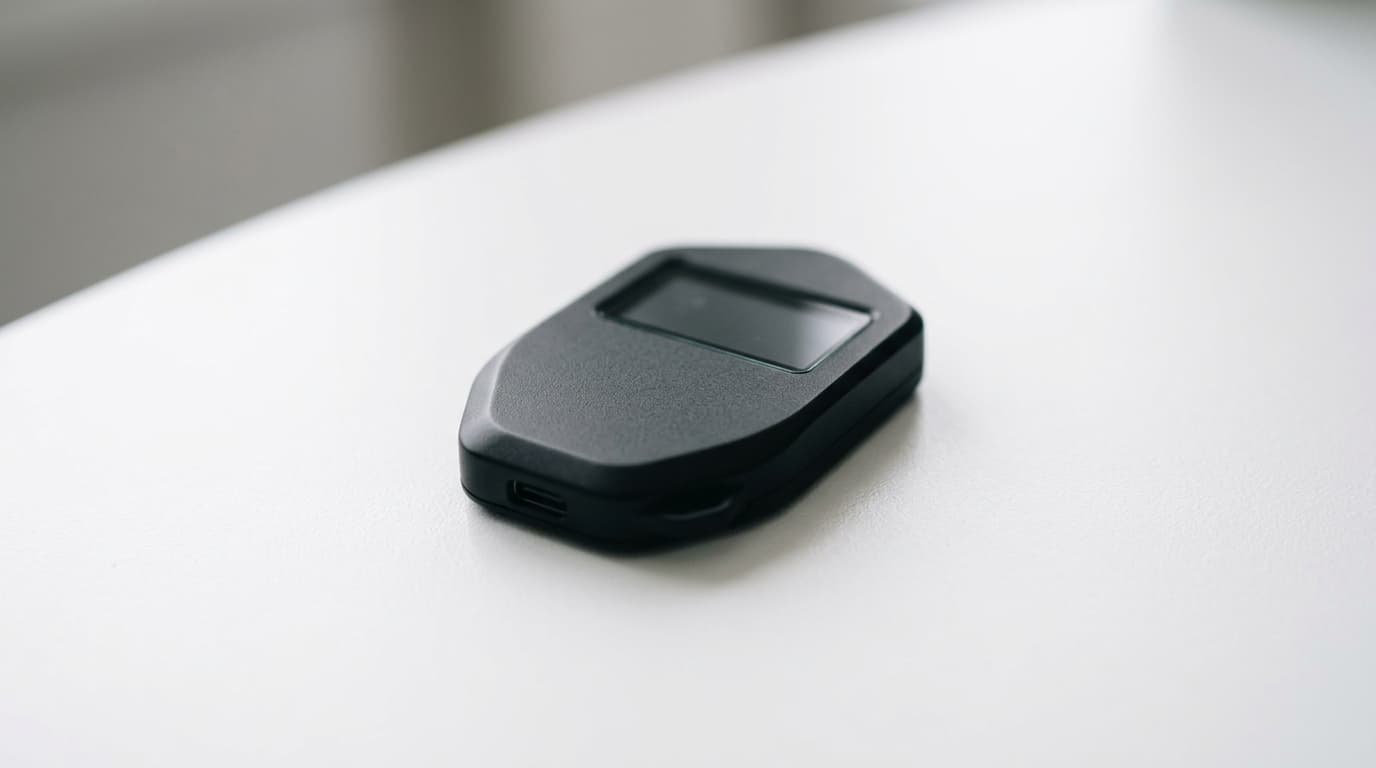
Bitkey Review After Six Months of Daily Use and What Long-Term Users Report
A research-based Bitkey review examining long-term user experiences, battery life, recovery features, and whether Block's seedless approach works for daily Bitcoin use.
Block's Bitkey promised to make Bitcoin self-custody feel less like defusing a bomb. No seed phrase to lose. No paper backup hidden in a fireproof safe. Just a hardware device, a mobile app, and encrypted cloud recovery working together in a 2-of-3 multisig arrangement.
After more than two years on the market, we have enough long-term user feedback to assess whether that promise holds up for daily Bitcoin use. While no formal six-month review studies exist, aggregated user experiences paint a clear picture of what works, what frustrates, and who this wallet actually serves.
The Multisig Architecture in Practice
Bitkey's 2-of-3 multisig setup distributes your Bitcoin security across three keys: one on the hardware device, one on your mobile app, and one encrypted in Block's cloud infrastructure. Any two of these can authorize a transaction.
This design solves a genuine problem. Traditional hardware wallets create a binary failure mode: lose your seed phrase and you lose everything. Bitkey's architecture means losing your phone, your hardware device, or even both doesn't permanently lock you out of your funds.
Users consistently praise this recovery model. The inheritance feature, rolled out in February 2025, allows designating a beneficiary with a six-month security period to prevent unauthorized claims. For people who worry about what happens to their Bitcoin if something happens to them, this addresses a real gap in most self-custody solutions.
Battery Life and Daily Carry
The hardware device itself resembles a slim card, easy to keep in a wallet or on a keychain. Official specifications updated in April 2026 claim the battery lasts three to twelve months with daily use, or over a year with infrequent use.
User reports generally support these claims. The device doesn't need charging often, which removes friction from the daily carry proposition. For a wallet designed around frequent use rather than cold storage, acceptable battery life matters more than it might for a Ledger or Trezor that stays in a drawer.
Mobile Limits for Everyday Spending
Bitkey allows setting a mobile spending limit, enabling small transactions using just your phone while larger amounts require tapping the hardware device. This design choice acknowledges how people actually use Bitcoin: you don't want to pull out a hardware wallet to buy coffee, but you do want that friction for significant transfers.
The flexibility here serves both convenience and security. Users report the mobile-only spending works smoothly for day-to-day transactions, though the app itself has drawn criticism for bugs and stability issues.
App Stability Remains a Weak Point
As of early 2026, Bitkey's app ratings average 4.3 out of 5 from 249 reviews. The praise centers on ease of setup and minimalist interface design. The criticism consistently targets app stability, bugs, and missing features.
Lightning Network support remains absent, which limits Bitkey's utility for users who want instant, low-fee transactions. For a wallet marketed around daily Bitcoin use, this gap stands out. Other hardware wallets have added Lightning integrations, and users waiting for this feature continue to express frustration.
The bugs appear to be ongoing rather than resolved. Multiple user reports from 2025 and into 2026 mention app crashes and glitches, though Block has released updates. Whether these issues will persist remains unclear.
The Privacy and Security Tradeoffs
Bitkey's design requires trusting Block's infrastructure more than traditional hardware wallets demand. The cloud key that enables recovery also creates a dependency on Block's servers. Some security-focused users argue this undermines the point of self-custody.
The hardware device lacks a screen, which means transaction verification happens on your phone rather than the device itself. Critics point out that this creates a potential attack vector: malware on your phone could theoretically display a different transaction than what you're actually signing. Traditional hardware wallets with screens address this by showing transaction details on a separate, more secure display.
The fingerprint authentication has also drawn scrutiny. Early 2024 reviews raised concerns about coercion risks, noting that someone could force you to unlock the device biometrically. This isn't unique to Bitkey, but it's worth considering.
These are legitimate concerns. They're also tradeoffs rather than fatal flaws. Bitkey optimizes for accessibility over maximum security, betting that more people will benefit from approachable self-custody than will be harmed by the security compromises involved.
Who Bitkey Actually Serves
The user feedback divides cleanly along experience lines.
Beginners and people transitioning from exchange custody consistently praise Bitkey. The seedless approach removes the most anxiety-inducing aspect of self-custody. The recovery options provide a safety net. The integration with popular exchanges makes purchasing and transferring Bitcoin straightforward.
Experienced Bitcoin users are more critical. The lack of interoperability with other wallets, the server dependency, and the missing hardware screen all represent compromises that security-conscious users may not want to make. Advanced users also miss features like multisig with their own keys or support for multiple cryptocurrencies.
This polarization makes sense. Bitkey isn't trying to be the most secure Bitcoin wallet. It's trying to be the most approachable one that still offers meaningful self-custody protections.
The Honest Assessment
Based on aggregated user experiences and product documentation, Bitkey succeeds at its core mission: making self-custody less intimidating for mainstream users. The multisig architecture provides genuine security improvements over leaving Bitcoin on an exchange. The recovery system handles realistic failure scenarios without requiring perfect operational security.
The app bugs and missing features like Lightning support are real problems that persist into 2026. Users comfortable with traditional hardware wallets will find Bitkey limiting rather than liberating.
For families considering inheritance planning, for exchange users ready to take self-custody, or for experienced Bitcoiners looking to onboard less technical family members, Bitkey offers a reasonable middle path. The tradeoffs are real, but so is the accessibility.
Whether those tradeoffs are acceptable depends entirely on what you're optimizing for.