
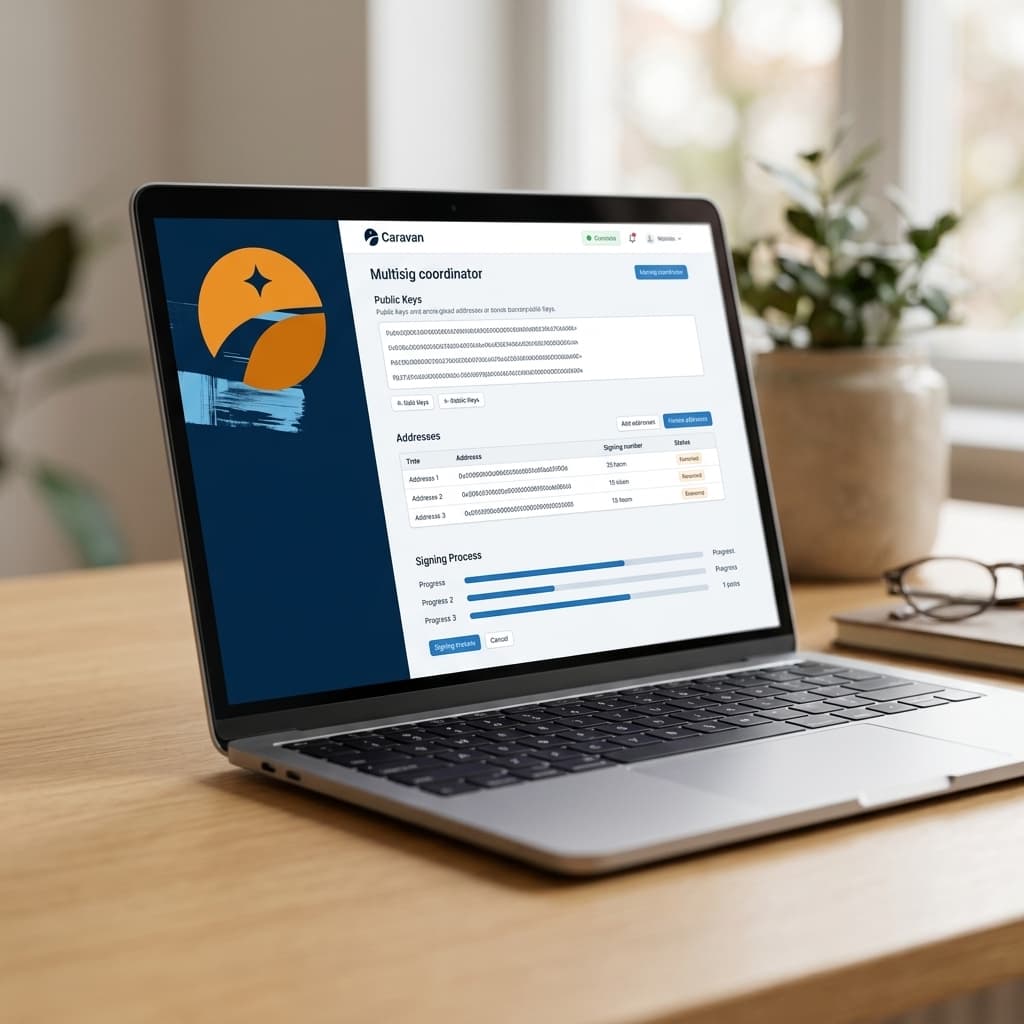
Caravan Review as the Ultimate DIY Multisig Solution
A research-based review of Caravan, the stateless open-source multisig coordinator for DIY Bitcoin custody and Unchained vault recovery.
Most multisig software wants to hold your hand. Caravan hands you a toolkit instead.
Developed by Unchained as an open-source, browser-based multisig coordinator, Caravan occupies a distinctive niche in the Bitcoin self-custody landscape. It never stores your private keys, never persists your wallet data, and never asks you to create an account. Close the browser tab, and your wallet configuration vanishes, unless you've exported it yourself. This stateless design is either a feature or a friction point depending on your philosophy, but it represents one of the purest expressions of DIY multisig coordination available.
What Caravan Actually Does
Caravan functions as a coordinator, not a wallet in the traditional sense. It connects three components: a source of Bitcoin consensus (your own node or a block explorer), one or more hardware signing devices, and the PSBT workflow that lets you construct and broadcast transactions.
The software supports building full multisig wallets derived from extended public keys (xpubs) as well as individual multisig addresses built directly from bare public keys. Users can define flexible quorums with up to seven keys and set arbitrary thresholds, whether that's a simple 2-of-3 family vault or a more paranoid 3-of-5 geographically distributed scheme.
The wallet creation flow walks through defining your quorum, choosing script and address types (native SegWit is the standard), selecting mainnet or testnet, and then importing key information from hardware wallets or other sources. Once complete, Caravan generates your wallet descriptor and receiving addresses.
Sending funds involves constructing a transaction in the UI, specifying outputs and fee rates, previewing the result, and then passing a PSBT to your hardware wallets for signing before broadcast. Every operation implicitly tests your ability to retrieve the correct configuration and coordinate all necessary signers.
The Stateless Tradeoff
Caravan's statelessness is its defining characteristic, and it cuts both ways.
On the security side, there's nothing to hack. No database of wallet configurations sitting on a server. No account credentials to phish. The software runs entirely client-side, and the GitHub-hosted instance at Unchained's site serves static files only. For privacy-minded Bitcoiners who want multisig without KYC or account creation, this architecture is genuinely appealing.
But statelessness creates operational demands. Once you close that browser tab, your wallet is gone unless you've exported the JSON configuration file or descriptor. This file becomes a critical backup artifact, separate from your seed phrases but equally important for wallet reconstruction. Educational content around Caravan repeatedly emphasizes keeping redundant copies of wallet descriptors, xpubs, and derivation paths in both digital and physical form.
Lose that descriptor, and recreating the exact same multisig wallet from seed backups alone requires sophisticated knowledge of derivation paths and policy templates. This isn't a bug; it's the natural consequence of a system that pushes all responsibility onto the user.
Recovery and Escape-Hatch Guarantees
Unchained originally built Caravan as a recovery tool for its collaborative custody products. The company offers 2-of-3 vaults where Unchained holds one key, but Caravan acts as the escape hatch if Unchained's platform goes offline or a client wants to move funds without touching the commercial interface.
This recovery-first design philosophy shows in the user experience. Caravan doesn't try to be a full-featured daily driver wallet. Instead, it focuses on reliable multisig creation and recovery with minimal dependencies. For Unchained customers, this provides genuine exit guarantees. For independent users, it offers a clean, quorum-centric workflow that closely mirrors best-practice collaborative custody architectures.
Unchained's documentation explicitly positions Caravan as suitable for anonymous Bitcoiners, not just corporate clients. The company has consolidated all its client-side open-source code under the Caravan umbrella as of late 2024, suggesting ongoing maintenance investment and a maturing codebase.
Hardware Wallet Integration
Caravan integrates with popular hardware wallets via standard PSBT workflows. Community tutorials demonstrate smooth operation with Ledger and Trezor devices for signing multisig transactions. Because Caravan uses PSBTs, it can also be combined with air-gapped signers like SeedSigner, though most accessible documentation focuses on mainstream hardware wallets.
The key-generation and backup hygiene are pushed entirely onto the user and their hardware devices. Caravan never sees seed phrases or private keys; it only handles xpubs and partially signed transactions. This separation of concerns aligns with security best practices but requires users to maintain their own key-management discipline.
Self-Hosting for Trust Minimization
The default usage pattern, visiting the GitHub-hosted Caravan instance and connecting hardware wallets, is convenient but introduces some supply-chain risk. You're trusting that the static site serves unmodified code.
For users who want to minimize trust further, the GitHub repository documents how to self-host Caravan behind Nginx and proxy requests to a local bitcoind node via a CORS proxy. This deployment pattern eliminates reliance on third-party infrastructure entirely, though it requires technical comfort with server configuration.
Community discussions note that Caravan's browser-based nature introduces an extra layer of environment risk compared with reproducibly built desktop binaries. Power users who build from source and verify code get the strongest guarantees.
Comparing Caravan to Desktop Alternatives
In community discussions from 2024 and 2025, users frequently compare Caravan with Sparrow Wallet and Specter Desktop for DIY multisig setups.
Sparrow offers detailed coin control, labeling, fee management, and on-chain analysis tools in a thick desktop client. For users managing large UTXO sets, navigating complex tax situations, or implementing privacy-sensitive spending patterns, Sparrow's feature depth matters. Caravan's deliberately minimalist feature set can't match this breadth.
Specter Desktop integrates tightly with Bitcoin Core and supports more advanced policy types and Liquid assets. For users who want a full-featured desktop environment that extends beyond straightforward Bitcoin multisig, Specter offers more surface area.
Caravan's advantages lie elsewhere: browser-based convenience, no installation required, no account creation, and a focused workflow oriented around safe multisig creation and recovery rather than comprehensive wallet management. One 2025 Reddit thread captured the common sentiment: use Caravan for Unchained-style descriptors and recovery scenarios, use Sparrow when you need broader tooling.
Comparing Caravan to Commercial Multisig Services
Collaborative custody services like Casa and Nunchuk charge annual fees for white-glove support, inheritance planning, and guided recovery. YouTube reviews from 2023 and 2024 frame Caravan as a potential alternative when combined with a stack of hardware wallets, but with the clear tradeoff of losing concierge support and UX polish.
Caravan is free software. That means no subscription fees, but also no customer service line when something goes wrong. The responsibility for operational procedures sits entirely with the user. For technically confident Bitcoiners, this is liberating. For those who want hand-holding during a recovery scenario, commercial services may justify their fees.
Who Should Consider Caravan
Caravan works best for users who are comfortable managing descriptors, hardware wallets, and self-hosted infrastructure. It's ideal for:
- Unchained customers who want a tested escape hatch for their collaborative custody vaults
- Privacy-focused individuals who want multisig without KYC or account creation
- Technical users building DIY multisig setups with multiple hardware wallet brands
- Anyone who values open-source, client-side, non-custodial tooling and accepts the operational overhead
It's less suitable for users who want transaction history, balance tracking, labeling, or coin control in the same interface. Caravan doesn't store that data; serious long-term users pair it with other tooling for accounting and analysis.
The Bottom Line
Caravan represents a deliberate design philosophy: minimize dependencies, maximize user control, accept the resulting operational friction. It's not trying to be an all-in-one wallet. It's trying to be a reliable coordination layer that connects hardware wallets to Bitcoin consensus without ever touching your keys.
For DIY multisig, that focus is valuable. The stateless architecture provides genuine security benefits and enables anonymous, no-account usage. The recovery-first design means it actually works when you need to spend from your multisig years later. The open-source codebase allows verification and self-hosting for those who want to minimize trust.
The tradeoffs are real: no persistent state means exporting and protecting configuration files becomes critical, and the feature set is deliberately sparse compared with desktop alternatives. But for users who understand these constraints and accept them, Caravan delivers exactly what it promises: a clean, quorum-centric multisig coordinator that puts you, not a vendor, in control of your Bitcoin.