
CryptoCloaks Bitaxe Solo Mining Setup Review for 2026
A research-based review of CryptoCloaks' Bitaxe solo mining hardware, covering specs, real-world performance, and honest profitability expectations.
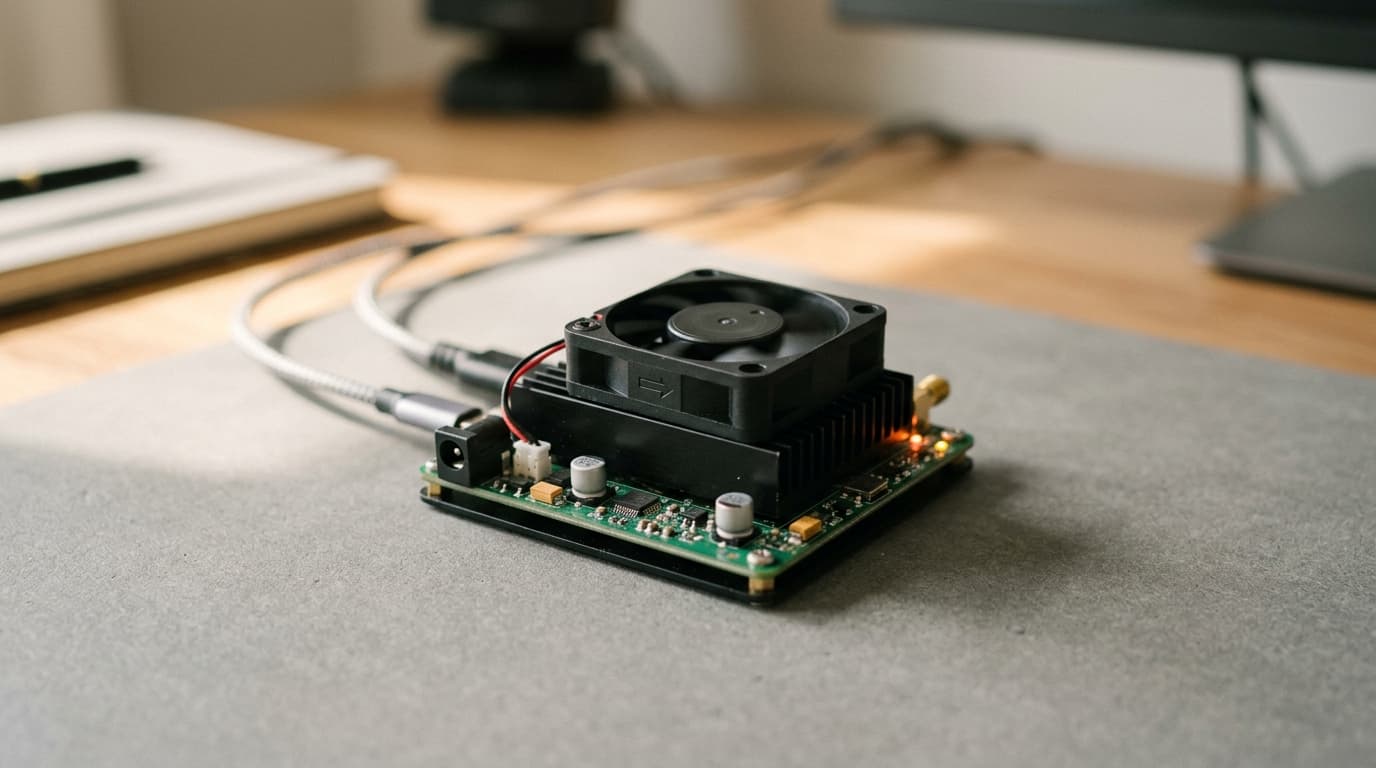
A Bitaxe Gamma running in a CryptoCloaks enclosure draws about as much power as a laptop charger while producing roughly 1.2 terahashes per second. It's also mathematically expected to find a Bitcoin block approximately once every 15,000 years.
That tension, between genuinely impressive engineering and nearly impossible odds, defines the CryptoCloaks Bitaxe solo mining experience in 2026. This review examines the hardware, the setup process, the real performance numbers, and the honest calculus of whether any of it makes sense.
What You're Actually Getting
CryptoCloaks has established itself as a go-to provider for Bitaxe-compatible enclosures, offering 3D-printed cases, fan shrouds, and wall-mount systems tailored to various Bitaxe models. The most commonly recommended pairing for 2026 is the Bitaxe Gamma (601/602), which uses Bitmain's BM1370 chip, the same ASIC found in full-size industrial miners.
The hardware specifications are genuinely impressive for the form factor:
- Hashrate: 1.0 to 1.2 TH/s
- Power consumption: 17 to 18 watts
- Efficiency: Approximately 15 J/TH (comparable to industrial Antminer S21 Pro units)
- Noise: Low enough for desktop or home office placement
- Power delivery: USB-C compatible
CryptoCloaks' contribution is primarily the enclosure and mounting hardware. Customer reviews from 2025 consistently highlight print quality and fit, which matters because Bitaxe boards are exposed PCBs that need third-party cases for safe, everyday deployment. The company also offers multi-unit racks for those who want to cluster several Bitaxe devices together.
Setup and Configuration
Bitaxe devices integrate their own web interface, which eliminates the need for external controllers or complicated software. Based on available documentation and user guides, a typical setup involves:
- Mounting the board in its CryptoCloaks enclosure
- Connecting power via USB-C
- Connecting to your network via Ethernet or Wi-Fi
- Accessing the web interface through a browser
- Entering your Bitcoin payout address and pointing to a solo pool like Solo CKPool
For multi-unit setups, guides recommend connecting several Bitaxe boards via a simple Ethernet switch. Each device independently communicates with the pool while sharing the same Bitcoin address, effectively multiplying total hashrate while keeping wiring straightforward.
The firmware, typically AxeOS or similar community-driven software, supports overclocking and undervolting through the browser interface. Users report stable, extended operation when the hardware is properly housed and cooled.
The Profitability Question, Answered Honestly
Let's address the elephant in the room: expected profitability on Bitcoin's mainnet in 2026 is essentially zero in any conventional sense.
At current network difficulty, a single Bitaxe Gamma at 1.2 TH/s has:
- Daily odds of finding a block: approximately 1 in 5.5 million
- Annual odds: approximately 1 in 15,000
- Expected time to find a block: over 15,000 years
Even clustering multiple devices doesn't fundamentally change the math. A 3.3 TH/s cluster (roughly three Bitaxe Gammas) still faces odds below one in a million per day. Analysis of confirmed solo wins through early 2026 shows that four of five documented open-source hardware blocks were mined by operators running multiple devices, but "more effective" here means reducing millennia-scale expected waits to merely centuries-scale.
But People Have Won
Here's where it gets interesting. Between 2024 and late 2025, Bitaxe-class hardware demonstrably mined real Bitcoin blocks:
- July 2024: A Bitaxe Ultra at roughly 500 GH/s found block #853,742, earning approximately 3.15 BTC
- March 2025: A cluster of around 3.3 TH/s found block #887,212, with the operator earning roughly 3.15 BTC (valued near $250,000 at the time)
By late 2025, open-source home mining hardware had collectively mined at least five confirmed Bitcoin blocks with cumulative payouts exceeding $1 million. These wins are real. They're also statistical anomalies, the mining equivalent of lottery jackpots.
The Electricity Math
With residential electricity prices typically ranging from $0.12 to $0.20 per kWh, running a Bitaxe Gamma costs roughly $1.50 to $2.50 per month. This is negligible compared to the cost of the hardware itself, but it also means you're paying a small ongoing fee for what is functionally a lottery ticket subscription.
Profitable Bitcoin mining in 2026 is concentrated among operators who secure power under $0.06 per kWh and deploy large fleets of top-tier ASICs. Solo Bitaxe setups fall firmly into the hobby category unless powered by free or sunk-cost energy like rooftop solar.
Where Bitaxe Actually Makes Sense
Education and Demonstration
The CryptoCloaks Bitaxe combination genuinely shines as an educational tool. The low heat output, web-based configuration, and visible hardware design make these units ideal for explaining proof-of-work mining mechanics. Multiple reviewers recommend turnkey bundles for workshops and classrooms.
Alternative Chains
Technical analyses published in 2025 emphasize that Bitaxe hardware is better suited for solo mining on smaller proof-of-work chains where network difficulty is orders of magnitude lower. On some alternative networks, a single Bitaxe can mathematically expect to find blocks every few days rather than every few millennia.
Ideological Support
For Bitcoiners who value network decentralization, running even a tiny miner contributes marginally to hashrate distribution. It's not economically rational in a narrow sense, but neither is running a full node for most people, and many do it anyway.
The Lottery Ticket You Can Touch
There's something to be said for a lottery ticket that sits on your desk, quietly hashes away, and might, against all odds, make you several hundred thousand dollars richer. The expected value is negative, but so is the expected value of most forms of entertainment.
Caveats and Considerations
Some 2025 reviewers note that while the hardware is open-source, supply-chain constraints, shipping, and import taxes can cause Bitaxe devices and CryptoCloaks accessories to trade at a premium. This somewhat undermines their appeal as "low-cost" mining hardware.
The April 2024 halving reduced block rewards to 3.125 BTC, and network difficulty continues to climb with hashrate now exceeding one zettahash per second. Anyone focusing on boutique solo rigs must understand that their expected payout curve is dominated by rare jackpot events rather than steady yield.
The Bottom Line
A CryptoCloaks Bitaxe setup in 2026 is not a mining business. It's not a path to systematic profits. It's not even a particularly rational investment if your primary goal is making money.
What it is: a remarkably well-engineered piece of open-source hardware, housed in quality 3D-printed enclosures, that lets you participate directly in Bitcoin's proof-of-work consensus. It's quiet enough for your desk, efficient enough to run continuously, and capable enough to have produced real six-figure wins for a handful of lucky operators.
For hobbyists, educators, and idealists who understand the odds and buy in anyway, the CryptoCloaks Bitaxe combination represents the most accessible and aesthetically pleasing way to run real mining hardware at home. Just don't expect it to pay for itself, unless you happen to be extremely, improbably lucky.