
How to Generate Proof of Bitcoin Holdings with Hoseki for Loan Applications
Learn how to create cryptographic proof of Bitcoin ownership for loan applications using Hoseki without exposing private keys or wallet addresses.
Traditional lenders have a Bitcoin problem. When you apply for a mortgage or personal loan and want to use your Bitcoin as evidence of assets, most financial institutions still ask for screenshots of exchange balances. Screenshots can be faked in seconds. They prove nothing.
Hoseki solves this by letting you generate cryptographically verified proof of Bitcoin ownership that lenders can actually trust, all without exposing your private keys or taking custody of your funds.
Why Cryptographic Proof Matters for Loans
When you apply for a Bitcoin-backed loan or simply want to demonstrate assets for a traditional mortgage, you're caught between competing needs. Lenders want verification. You want privacy and security.
The old approach, sending screenshots or exporting exchange statements, creates problems on both sides. Lenders can't truly verify those documents are authentic. And you're potentially exposing account details, balances, and addresses to institutions that may not handle that data carefully.
Cryptographic ownership proof changes the equation. By signing a message with your private key, you mathematically demonstrate control over specific Bitcoin addresses without ever revealing the key itself. It's the same principle that secures Bitcoin transactions, applied to identity verification.
How Hoseki's Proof Generation Works
The process relies on Bitcoin's native signature verification capabilities. Here's what happens under the hood:
- Hoseki presents a unique message to sign
- You sign that message using your wallet's private key
- The signature mathematically proves you control the address holding those Bitcoin
- Hoseki verifies the signature and issues a shareable document
The crucial point: your private key never leaves your wallet. Hoseki doesn't take custody of your Bitcoin or gain the ability to move your funds. The platform simply verifies that you, and only you, could have produced that specific signature.
Step-by-Step Guide to Generating Proof
Connect Your Wallet
Start by connecting your self-custody wallet to Hoseki. The platform supports major hardware wallets and software wallets that allow message signing. For exchange-held Bitcoin, you can connect supported exchanges directly.
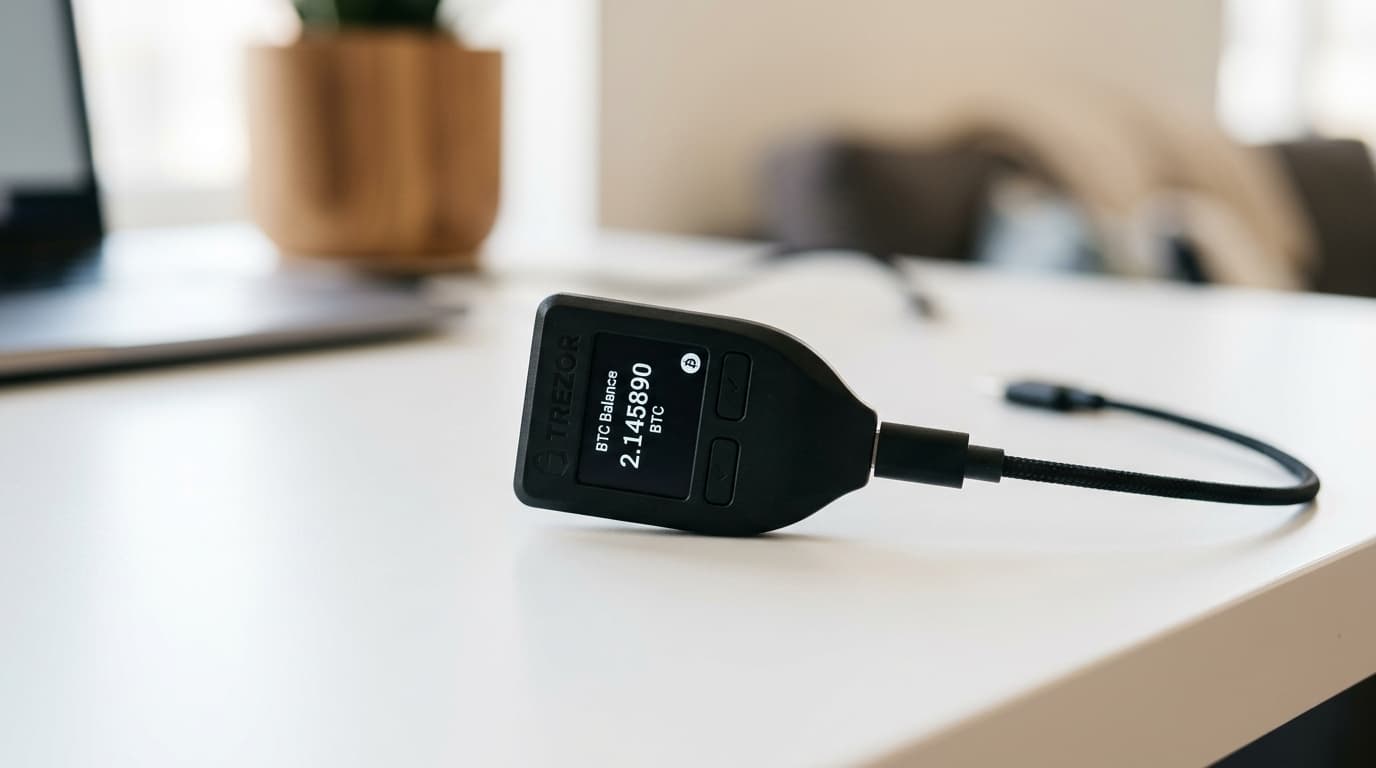
If you're using a hardware wallet like a Ledger or Trezor, you'll approve the connection on the device itself, adding another layer of security to the process.
Initiate the Verification
Once connected, select the addresses you want to include in your proof. You don't have to verify your entire holdings. If you're demonstrating collateral for a specific loan amount, you might only need to prove control over a subset of your addresses.
Hoseki will generate a unique message tied to the current date and your verification request.
Sign the Message
This is where the cryptographic magic happens. Your wallet will prompt you to sign the message Hoseki provided. On a hardware wallet, you'll see the message on your device screen and physically confirm the signature.
Signing a message is fundamentally different from signing a transaction. No Bitcoin moves. No fees are paid. You're simply creating a mathematical proof that only the holder of this private key could create.
Receive Your Verified Statement
After verification, Hoseki issues a proof-of-funds document. This includes the verified balance, a timestamp, and cryptographic evidence that ties the proof to your specific addresses without revealing those addresses to the document's recipients.
You can share this document directly with lenders, include it in loan applications, or provide access through Hoseki's sharing features.
What Lenders See
From the lender's perspective, Hoseki provides several verification options through its Verify API.
Lenders can send access requests via email or through integrated platforms like LendAPI, which added Hoseki integration in February 2026 specifically for lending workflows. When you approve these requests, lenders receive either a one-time statement or real-time balance access, depending on what you authorize.
Over 50 traditional lenders and mortgage brokers accepted Hoseki's proof-of-assets documentation as of 2022, and adoption has grown since then. The platform's partnership with Bitcoin-backed lenders like Ledn (established in 2022) demonstrated early use cases for this type of verification.
Privacy Considerations
Hoseki's approach protects your privacy in several ways:
Address privacy: The verification proves you control sufficient Bitcoin without necessarily revealing exact addresses to lenders. This prevents chain analysis of your holdings.
Balance granularity: You can choose whether to verify specific amounts or ranges rather than exposing your complete portfolio.
Non-custodial design: Because Hoseki never holds your keys, there's no honeypot of private keys for attackers to target.
That said, you should understand what you're sharing. Once you grant a lender access to real-time balance monitoring, they can see changes to your verified holdings. For one-time loan applications, a static proof might be more appropriate.
Limitations and Tradeoffs
Cryptographic proof isn't magic. Several limitations exist:
Exchange holdings: If your Bitcoin sits on an exchange, you can only prove what the exchange exposes through their API. You don't hold keys to exchange wallets, so you can't sign messages proving ownership, only prove your account balance.
Multi-signature setups: Complex custody arrangements with multiple signers may require coordination to generate proofs.
Lender education: Despite growing adoption, some traditional lenders still don't understand cryptographic proof and may insist on their familiar (if flawed) screenshot-based processes.
Beyond Personal Loans
While this guide focuses on individual loan applications, the same technology powers institutional transparency. Metaplanet adopted Hoseki in 2024 for corporate Bitcoin holdings disclosure. The Monochrome Bitcoin ETF uses it for real-time proof-of-reserves dashboards that investors can verify themselves.
Developers building fintech applications can integrate Hoseki's APIs directly, enabling custom verification workflows for underwriting and compliance without building cryptographic infrastructure from scratch.
Making the Case to Your Lender
If your lender hasn't encountered cryptographic proof before, you may need to explain why it's superior to screenshots:
- It's mathematically impossible to fake without controlling the Bitcoin
- It provides real-time or timestamped verification
- It's the same cryptographic standard that secures billions in Bitcoin transactions daily
Lenders who understand this tend to prefer it. Those who don't may need education, and sometimes the conversation itself signals that a lender isn't prepared to work with Bitcoin holders seriously.
Looking Forward
As Bitcoin becomes a more common component of personal and corporate balance sheets, the infrastructure for proving ownership without sacrificing security continues to mature. Cryptographic proof of reserves moves Bitcoin from the realm of "trust me" screenshots to verifiable, auditable documentation that traditional finance can understand and rely on.
For Bitcoin holders seeking loans, Hoseki offers a bridge between self-custody principles and the documentation requirements of the traditional financial system. You don't have to choose between keeping your keys and accessing credit.