
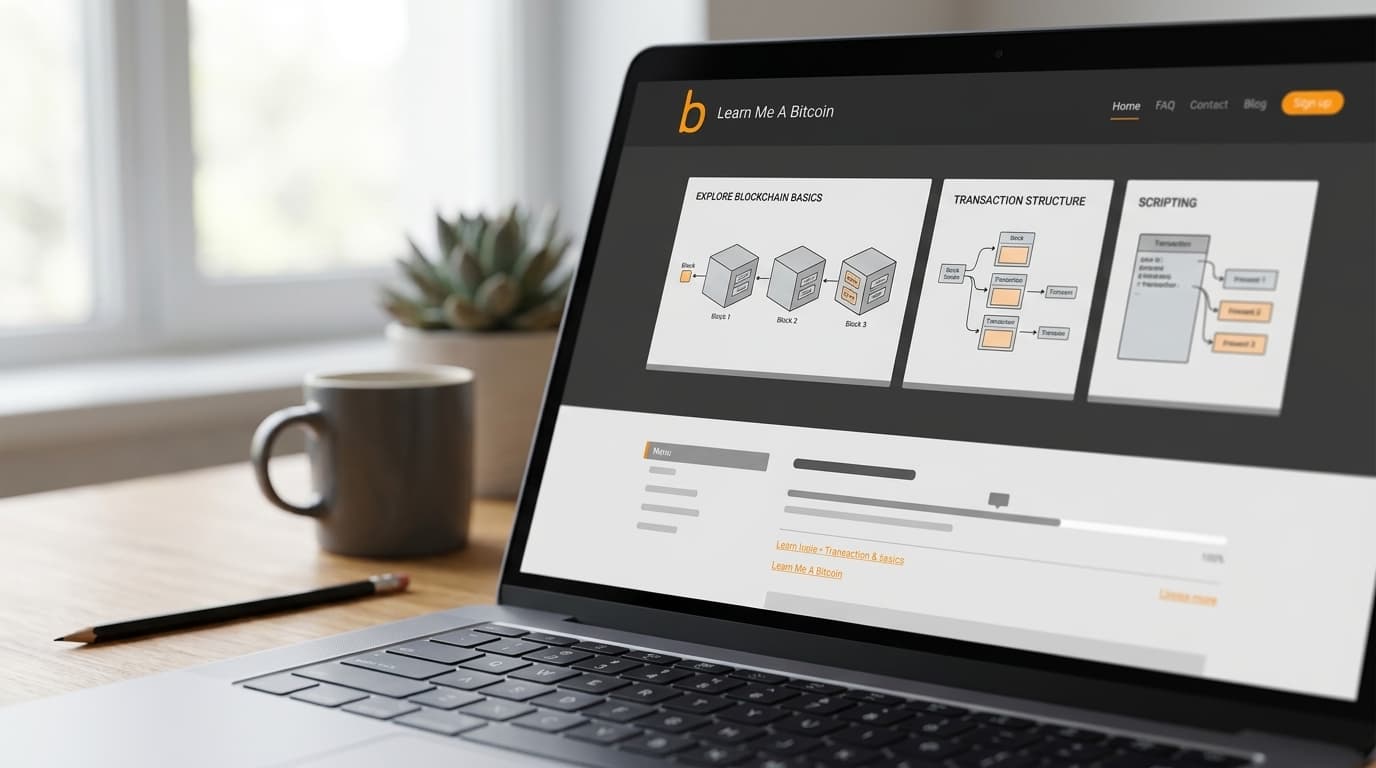
Learn Me A Bitcoin Review 2026, Technical Bitcoin Education That Actually Makes Sense
A research-based review of Learn Me A Bitcoin, the free technical education resource that teaches Bitcoin internals through clear visuals and code examples.
Most Bitcoin education falls into one of two camps: oversimplified explainers that leave you with surface-level understanding, or dense technical documentation that assumes you already know what you're trying to learn. Learn Me A Bitcoin has occupied a rare middle ground since 2015, and in 2026 it remains one of the most useful free resources for anyone who wants to understand how Bitcoin actually works under the hood.
Created by Greg Walker, the site takes a visual, hands-on approach to explaining Bitcoin's protocol internals. It's particularly valuable for developers and technically curious learners who find that reading code alongside explanations helps concepts stick better than abstract descriptions alone.
What Learn Me A Bitcoin Actually Offers
The site organizes content into four main sections, each serving a different purpose.
The Beginners section covers straightforward usage guides for people who just want to understand Bitcoin at a practical level. The Technical section is where the real depth lives, with detailed explanations of keys, addresses, transactions, scripts, blocks, and HD wallets. These pages include diagrams, code examples written in Ruby, and real-world tools that let you experiment with actual Bitcoin data.
The Tools section provides utilities for working with raw Bitcoin data, while the Explorer offers a basic blockchain explorer for looking up transactions and blocks. Everything interconnects, so you can follow rabbit holes from one concept to related topics without losing context.
The Teaching Approach
What distinguishes Learn Me A Bitcoin from alternatives like the Bitcoin Wiki or Andreas Antonopoulos's "Mastering Bitcoin" is its emphasis on showing rather than telling. Walker breaks down dense concepts like UTXOs, the mempool, and transaction fee mechanics into digestible explanations with accompanying visuals.
The technical content emphasizes hands-on coding over pure theory. You'll find guides on generating keys, decoding transactions, and building custom tools from scratch. This makes it particularly useful as a companion to the Bitcoin whitepaper, which can be impenetrable for readers without a cryptography background.
Recent updates have maintained this standard. Content on mnemonic seed explanations was added in late 2025, keeping the resource current with how people actually interact with Bitcoin wallets today.
Who Benefits Most
Learn Me A Bitcoin works best for a specific audience: developers who want to build Bitcoin applications, protocol enthusiasts who want to understand the system at a deeper level, and self-taught learners who prefer practical examples over academic explanations.
User feedback in forums like Bitcointalk and Reddit consistently describes the site as "simple, accurate, practical." A CryptoLinks review from September 2025 called it a top resource for turning dense topics into understandable concepts. The site has earned a reputation as a no-hype learning tool during a period when much Bitcoin content is wrapped in speculation and price predictions.
The site is less useful for complete beginners who just want to buy and hold Bitcoin, or for those looking for trading strategies and market analysis. It's education about the technology, not investment advice.
Limitations Worth Noting
The Ruby code examples may feel dated to developers working primarily in Python, JavaScript, or Rust. While the underlying logic translates across languages, some readers will need to mentally translate syntax as they follow along.
There's also no structured course or curriculum. Learn Me A Bitcoin is a reference resource, not a guided learning path. Self-directed learners thrive here; those who prefer hand-holding through a defined sequence might find it disorienting.
Finally, the site covers Bitcoin specifically. If you're looking for Ethereum, Lightning Network deep dives, or broader cryptocurrency education, you'll need to look elsewhere for those topics.
How It Compares to Alternatives
"Mastering Bitcoin" by Andreas Antonopoulos remains the definitive book-length technical reference, but it can be intimidating for readers who learn better through visual, web-based content. Learn Me A Bitcoin covers similar ground in a more approachable format, though with less exhaustive detail.
The Bitcoin Wiki offers encyclopedic coverage but lacks the pedagogical clarity of Walker's explanations. Chaincode Labs' seminars and Saylor Academy's Bitcoin courses provide more structured learning, but they require greater time commitment.
For developers who want to understand Bitcoin internals well enough to build things, Learn Me A Bitcoin hits a practical sweet spot: comprehensive enough to be useful, accessible enough to not be overwhelming.
The Bottom Line
Learn Me A Bitcoin has remained free since its launch in 2015, with no paid courses, premium tiers, or sponsorship-driven content. Greg Walker has continued maintaining and updating it through multiple Bitcoin market cycles.
For technically minded learners who want to understand Bitcoin at the protocol level, it's one of the best starting points available. The visual explanations, code examples, and interconnected reference structure make complex concepts genuinely comprehensible.
If you've read Bitcoin explainers that left you with more questions than answers, or if the whitepaper felt like reading a foreign language, Learn Me A Bitcoin offers a path through the complexity without dumbing things down. That's harder to pull off than it sounds, and Walker has been doing it well for over a decade.