
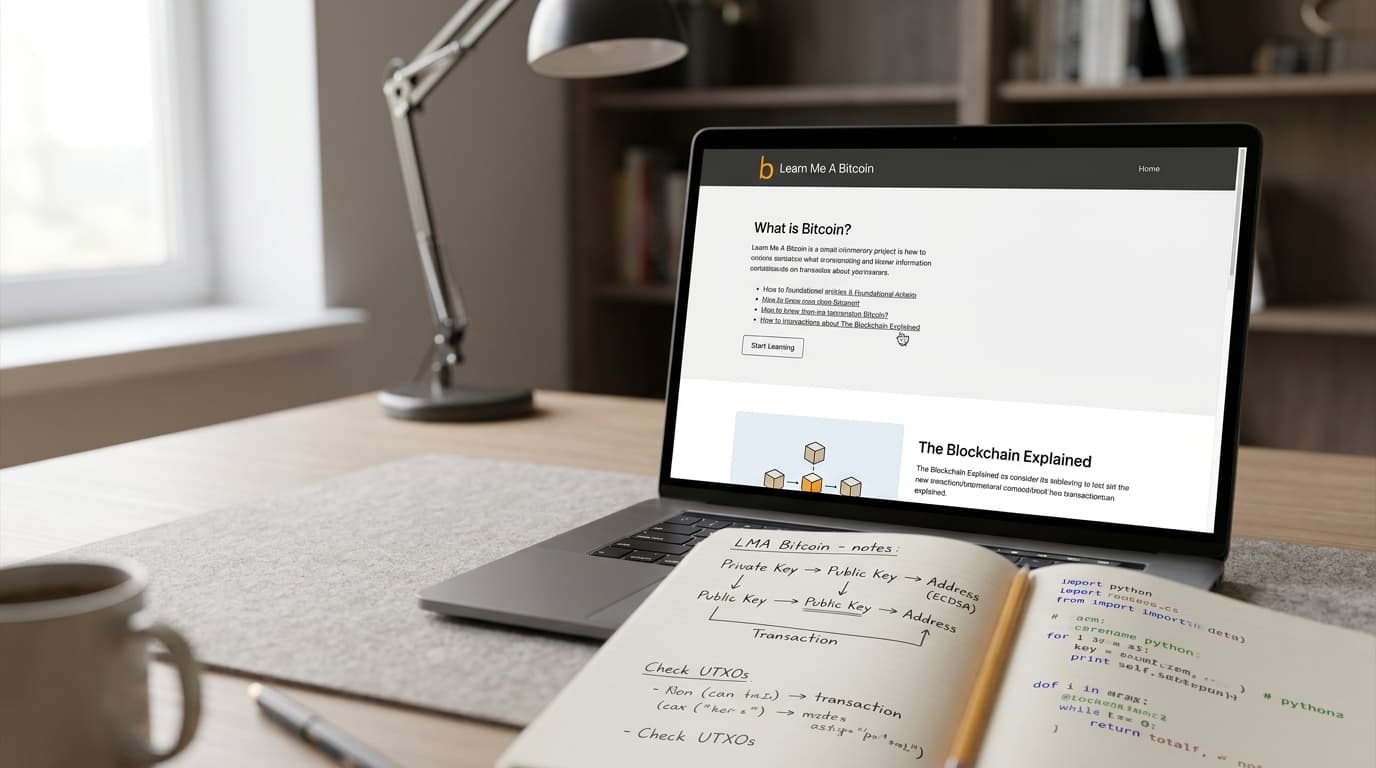
How to Use Learn Me A Bitcoin for Technical Interview Preparation
A practical guide to using Learn Me A Bitcoin's visual explanations and hands-on projects to prepare for blockchain developer interviews.
Most algorithm grinding won't help you explain how a Bitcoin transaction actually works. If you're interviewing for a role at a crypto exchange, wallet company, or protocol team, you'll face questions that LeetCode never anticipated: How does a UTXO model differ from account-based systems? Walk me through transaction signing. What happens when you broadcast a transaction to the network?
This is where domain-specific preparation becomes essential, and Learn Me A Bitcoin offers something unusual: a free, continuously maintained resource that teaches Bitcoin's internals through clear diagrams, hands-on coding projects, and raw blockchain exploration. Here's how to use it strategically for technical interview preparation.
Why Domain Knowledge Matters in Crypto Interviews
Recent interview reports from crypto companies reveal a shift away from pure algorithmic puzzles toward implementation-heavy, domain-specific rounds. A 2025 Reddit discussion about Coinbase's IC5 software engineer interview described rounds focusing on parsing crypto addresses and transaction formats, API design for blockchain operations, and well-structured code for practical tasks.
This doesn't mean you can skip data structures and algorithms entirely. Mainstream interview prep guidance still emphasizes platforms like LeetCode and HackerRank for foundational skills, and structured programs like CodePath's Technical Interview Prep pathway (updated June 2026) continue to focus on algorithmic challenges alongside communication skills.
The winning combination for crypto roles is general technical competence plus deep protocol fluency. Learn Me A Bitcoin addresses the second half of that equation.
Mapping the Site to Interview Preparation
Learn Me A Bitcoin is organized into four sections: Beginners, Technical, Tools, and Explorer. Each serves a distinct purpose in interview prep.
Start with the Technical Section
The Technical section positions itself as a "complete technical guide to bitcoin" for programmers. It covers keys, addresses, transactions, blocks, and the blockchain using simple text and diagrams. This is your primary study material.
For interview preparation, prioritize these topics in order:
- Keys and addresses: Understand how private keys generate public keys, and how addresses are derived. This comes up in questions about wallet architecture and key management.
- Transactions: Learn the structure of inputs, outputs, and scripts. Be able to explain what a UTXO is and why Bitcoin uses this model instead of account balances.
- Transaction signing: Understand how digital signatures prove ownership without revealing private keys. This is fundamental to any security-focused interview question.
- Blocks and mining: Know how transactions are batched, how proof-of-work functions, and what the blockchain actually looks like as a data structure.
Use the Beginners Section for Communication Practice
Technical interviews at companies like Bloomberg and Coinbase often test whether candidates can explain complex systems in simple terms. The Beginners section provides model explanations that you can study and adapt.
Practice explaining Bitcoin concepts at multiple levels of abstraction. Can you give an "explain like I'm five" version of how transactions work? Can you then drill down into the technical details if asked? This layered communication skill distinguishes strong candidates.
Build Projects Using the Recommended Milestones
Learn Me A Bitcoin recommends three milestone projects that map directly to interview-relevant skills:
- Generate your own private/public keys and addresses: This proves you understand cryptographic primitives, not just that you've memorized definitions.
- Decode a raw Bitcoin transaction: Parsing binary or hex-encoded data structures is exactly the kind of task that appears in domain-specific interview rounds.
- Create and sign a transaction to broadcast to the network: This end-to-end project demonstrates you can work with the actual protocol, not just talk about it.
The site recommends installing a Linux environment (the author prefers Xubuntu) and Bitcoin Core to work with raw blockchain data. This setup mimics the systems-oriented environment expected in backend and crypto-focused roles.
Leverage the Tools and Explorer Sections
The Tools section exposes command-line utilities for working with Bitcoin data. The Explorer section provides a basic blockchain explorer for manual inspection of blocks and transactions.
Use these for practice sessions where you:
- Look up a real transaction and explain each field
- Trace the inputs of a transaction back to their originating outputs
- Calculate transaction fees from raw data
- Identify different script types (P2PKH, P2SH, etc.)
This kind of hands-on exploration gives you concrete examples to reference in interviews. Instead of abstract descriptions, you can say "When I examined transaction X, I noticed that..." and demonstrate genuine familiarity with the protocol.
Building a Portfolio While Preparing
Greg Walker, the site's creator, explicitly encourages learners to build command-line tools and share them on GitHub. This advice doubles as interview preparation strategy.
Small, focused utilities make excellent portfolio pieces for crypto engineering roles:
- A key derivation tool that shows the full path from entropy to address
- A transaction decoder that pretty-prints raw transaction data
- A fee estimator that analyzes recent blocks
These projects demonstrate practical skills and give you talking points for behavioral interviews about past work.
Complementing Learn Me A Bitcoin with Other Resources
Because Learn Me A Bitcoin is a single-author project, its content reflects one coherent pedagogical perspective. This clarity is a strength for learning, but you should balance it with more formal or consensus-driven sources.
The site itself curates external references: the Bitcoin Developer Guide, Bitcoin Wiki, Bitcoin Stack Exchange, and Bitcoin Improvement Proposals (BIPs). Senior-level interviewers may expect familiarity with these sources, particularly relevant BIPs for any specialized topic.
Other resources that pair well with Learn Me A Bitcoin include:
- "Learning Bitcoin from the Command Line" (a comprehensive tutorial maintained through 2025) for deeper CLI practice
- "Mastering Bitcoin" by Andreas Antonopoulos for a more comprehensive reference text
- Bitcoin Script Explorer (open-source, updated in 2025) for understanding script execution if advanced script questions are likely
A Realistic Preparation Timeline
If you have four weeks before a crypto engineering interview, consider this allocation:
Week 1: Work through the Technical section's coverage of keys, addresses, and transactions. Set up a Linux environment with Bitcoin Core.
Week 2: Complete the first two milestone projects (key generation and transaction decoding). Start exploring real transactions using the Explorer section.
Week 3: Build the transaction signing project. Practice explaining concepts at multiple levels of abstraction using the Beginners section as a model.
Week 4: Review, polish your GitHub projects, and do mock explanations. Read relevant BIPs for any specialized topics the role requires.
This schedule assumes you're also maintaining your general algorithm practice in parallel. Learn Me A Bitcoin is a domain-depth complement, not a replacement for foundational interview skills.
What Learn Me A Bitcoin Won't Cover
The site is not explicitly marketed as an interview-prep platform. It's a learning resource for becoming a Bitcoin programmer, and its application to interviews is an emergent use-case.
This means it won't help you with:
- Standard algorithm and data structure questions
- System design beyond Bitcoin-specific architecture
- Behavioral interview preparation
- Other blockchain protocols (Ethereum, Solana, etc.)
For these areas, you'll need dedicated resources. But for the domain-specific rounds that increasingly define crypto engineering interviews, Learn Me A Bitcoin offers something valuable: a clear path from conceptual understanding to hands-on implementation, documented well enough that you can demonstrate genuine protocol fluency rather than surface-level familiarity.
In a competitive hiring market for specialized roles, that depth is often what separates candidates who get offers from those who merely pass the algorithm screens.