
American Bitcoin's 11,000 Miner Expansion Reveals What Industrial-Scale Mining Actually Looks Like
American Bitcoin activated 11,298 ASIC miners at its Drumheller facility, pushing its hashrate to 28.1 EH/s and showing how institutional mining operates.
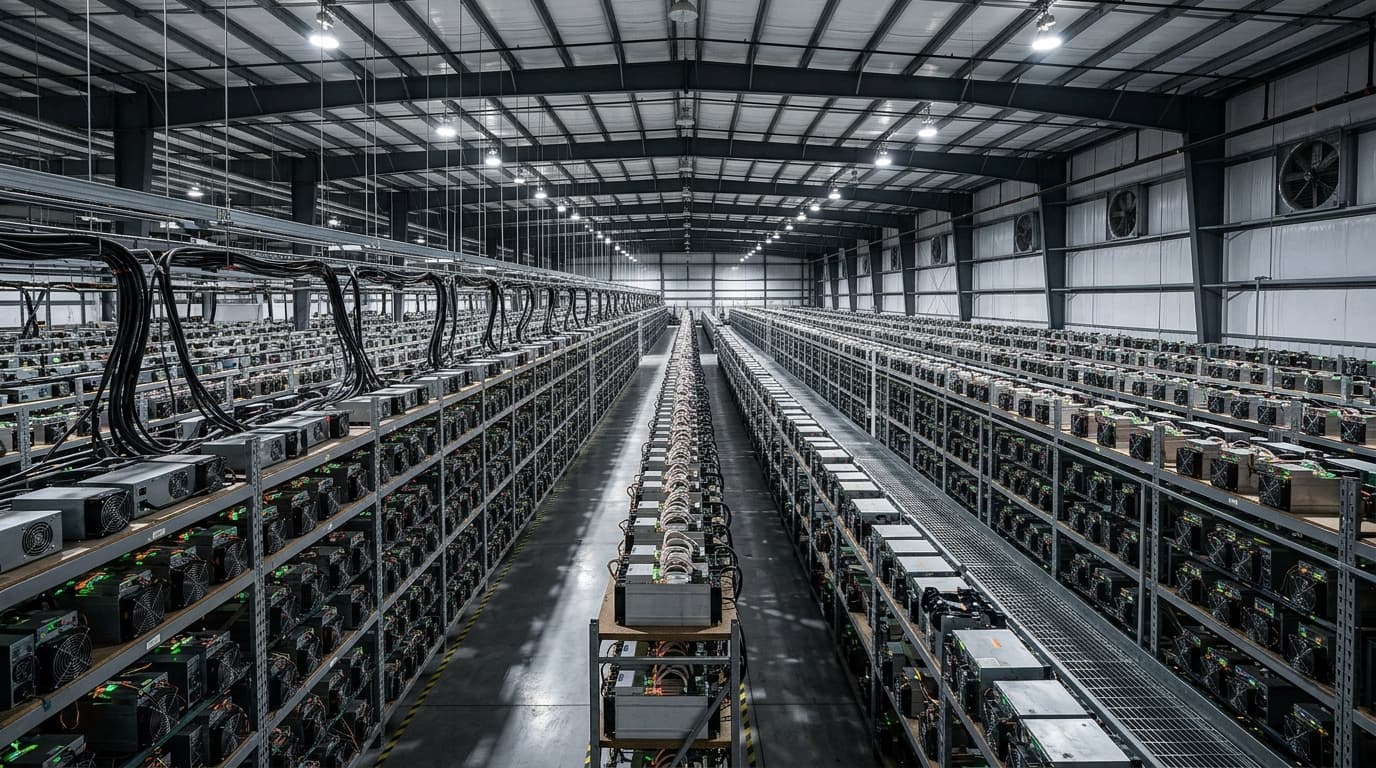
On April 21, 2026, American Bitcoin Corp. flipped the switch on 11,298 additional ASIC miners at its Drumheller facility in Alberta, Canada. The deployment added 3.05 exahashes per second to the company's operational capacity, a single-day expansion that would take most mining operations years to achieve.
The scale here is worth pausing on. We're talking about nearly 59,000 active miners now humming away across American Bitcoin's infrastructure, collectively producing 25.0 EH/s at an efficiency of 14.1 joules per terahash. The company's total owned fleet, including machines not yet energized, reaches 89,242 miners capable of 28.1 EH/s.
This is what institutional Bitcoin mining looks like in 2026.
The Numbers Behind Industrial Mining
American Bitcoin's expansion offers a useful window into how large-scale mining operations think about capacity planning. The company didn't just buy miners and plug them in. The Drumheller deployment was first announced on March 3, 2026, meaning nearly seven weeks passed between announcement and energization.
That timeline reflects the logistical complexity of scaling mining infrastructure: securing power agreements, configuring cooling systems, deploying networking, and stress-testing equipment before full activation. For retail miners dreaming of scaling up, this planning horizon is instructive.
The market noticed. American Bitcoin shares jumped 12-13% on April 22, climbing to around $1.41 following the activation announcement.
The Mine-and-Hold Strategy
What makes American Bitcoin's approach distinctive isn't just its scale but its treasury philosophy. The company reports holding over 7,000 BTC, valued at approximately $552 million based on prices above $79,000 in April 2026. Rather than selling mined bitcoin to cover operating costs, the company prioritizes accumulation.
Eric Trump, co-founder and Chief Strategy Officer, framed the expansion as strengthening "Bitcoin accumulation through disciplined scaling and low-cost production." The strategy bets that holding bitcoin will outperform selling it, a reasonable thesis when you can achieve 14.1 J/TH efficiency and access cheap Canadian power.
This mine-and-hold approach isn't unique to American Bitcoin. Several public miners have adopted similar strategies, treating their operations as both mining businesses and de facto bitcoin investment vehicles. Whether this outperforms a more traditional sell-to-cover model depends heavily on bitcoin's price trajectory and each company's cost basis.
What Retail Miners Can Learn
The gap between institutional and retail mining continues to widen, but the principles driving American Bitcoin's expansion apply at any scale.
First, efficiency matters more than raw hashrate. American Bitcoin's operational fleet runs at 14.1 J/TH, while its total owned equipment averages 16.0 J/TH. The company is prioritizing its most efficient machines for active deployment. Retail miners should similarly think hard about power costs per hash, not just total hashing power.
Second, capacity planning requires lead time. The seven-week gap between announcement and deployment represents aggressive execution for a project of this size. Smaller operations can move faster, but the principle holds: successful scaling requires infrastructure preparation before hardware arrives.
Third, treasury strategy deserves explicit attention. American Bitcoin has chosen accumulation. Individual miners should make their own deliberate choice about selling versus holding, based on their financial situation and conviction, rather than defaulting into either approach.
The Bigger Picture
American Bitcoin, majority-owned by Hut 8 Corp. and co-founded by Eric Trump and Donald Trump Jr. in March 2025, operates in a political environment that's been increasingly favorable to domestic mining. The company went public via Nasdaq merger in September 2025 and has moved quickly to scale since then.
But favorable conditions don't guarantee success. Bitcoin mining remains a brutally competitive business where efficiency advantages compound and stragglers get squeezed. The April 2024 halving cut block rewards in half, intensifying pressure on miners' cost structures. Companies that can operate profitably at 14 J/TH have a meaningful edge over those stuck at 20 J/TH or higher.
American Bitcoin's Drumheller expansion demonstrates that institutional miners continue betting heavily on bitcoin's future value, backing that bet with hundreds of millions in infrastructure investment. Whether that bet pays off depends on factors no one controls, but the scale of commitment is now impossible to ignore.