
How to Mine Bitcoin Without a Data Center: Three Practical Paths
DIY home Bitaxe, heat-reuse mining, and hosted ASICs compared. Real economics, comparison tables, and the decision framework most guides skip.
There are roughly sixteen large publicly traded Bitcoin miners in North America. If you want to mine Bitcoin at home for profit in fiat terms, you are competing against all of them. You will lose.
That framing is also incomplete. Industrial mining is critical Bitcoin infrastructure, pioneered by Bitcoiners ahead of the broader energization trade, securing the network with megawatt-scale operations that monetize stranded energy and provide demand response to grids. But it has almost nothing to do with how a normal person actually participates.
This guide covers the three paths that aren't industrial: a DIY home setup with a Bitaxe, heat-reuse mining that pays you back for heating your house, and hosted mining where someone else operates hardware you own. Each one fits a different person and a different goal. At the end there's a decision matrix to help you pick.
- Home mining is a decentralization contribution and, for solo miners, a lottery. Profit isn't realistic at residential power rates.
- Heat-reuse mining is the most underrated path in cold climates with electric heat. The math genuinely works.
- Hosted/colocation mining gives you hardware exposure without operating it. Avoid anything labeled "cloud mining", that's a contract, not a machine.
- Stratum V2 has been adopted by pools representing 75% of network hashrate. The decentralization win only matters if hashrate stays distributed.
- Marathon Digital mines Bitcoin at a loss based on its own financial statements. That's a fiat-funded operation, not a Bitcoin business. Hosting your own hardware avoids the same misalignment.
At a glance
The three non-industrial paths compared:
| Path | Cost to start | What you get | Profit reality | Best for |
|---|---|---|---|---|
| DIY home (Bitaxe) | $200–$400 | Open-source ASIC, real hashrate, solo-block lottery chance | Roughly $1–$2/mo gross at current difficulty | Decentralization conviction + curiosity |
| Heat-reuse mining | $1,500–$4,000 | Bitcoin miner that doubles as a space heater | Net positive in cold climates with electric heat | Cold-climate homeowners with electric heat |
| Hosted/Colocation | $5,000–$15,000 per ASIC | Own a machine, someone else operates it | Roughly net positive in current hashprice, dependent on operator | $5K+ to allocate, no facility, want hardware ownership |
The rest of the guide unpacks each row.
Why mine Bitcoin at all?
For most home miners, the answer is not profit.
Industrial operators with $0.03/kWh power contracts, immersion cooling, and ten thousand ASICs are the competition. They optimize for every basis point of efficiency. A home miner running a 3 kW ASIC on $0.10/kWh power breaks even at best and loses on most days.
If fiat profit is your goal, the simpler answer is to buy Bitcoin directly. You acquire more Bitcoin per dollar that way, and you keep the same upside if the price appreciates. Mining only makes sense if you also value something the buy-direct path can't give you: a decentralization contribution, heat reuse during cold months, or the long-odds chance of solo-mining a full block.
The actual case for home mining is decentralization. Bitcoin's settlement layer is censorship-resistant only if hashrate is geographically distributed and controlled by people who care about the network's properties, not concentrated in five public companies whose CFOs answer to fiat shareholders.
That distribution has been under threat. In 2014, GHash.io got 55–60% of the network. Peter Todd famously sold half his Bitcoin over it. Today the threat looks different: five public miners point at three pools, and those pools decide what transactions go into blocks.
Stratum V2 changes the pool-centralization story. Mining pools representing 75% of Bitcoin's hashrate have adopted the open-source protocol that lets individual miners build their own block templates instead of accepting whatever the pool operator chooses. This is a structural decentralization win. Censorship resistance at the protocol level got a massive upgrade.
But Stratum V2 only matters if hashrate is actually distributed at the operator level. If every miner sits in three industrial facilities, "miners build their own templates" is a polite fiction.
So the case for home mining at the structural level is: you're a vote for distributed hashrate. Your few terahashes don't move the network economically. They move the political and structural reality of who controls Bitcoin's settlement layer.
For more on the pool-level shift, see Major Mining Pools Join Stratum V2 (Antpool, Foundry).
Path 1: DIY home mining with a Bitaxe
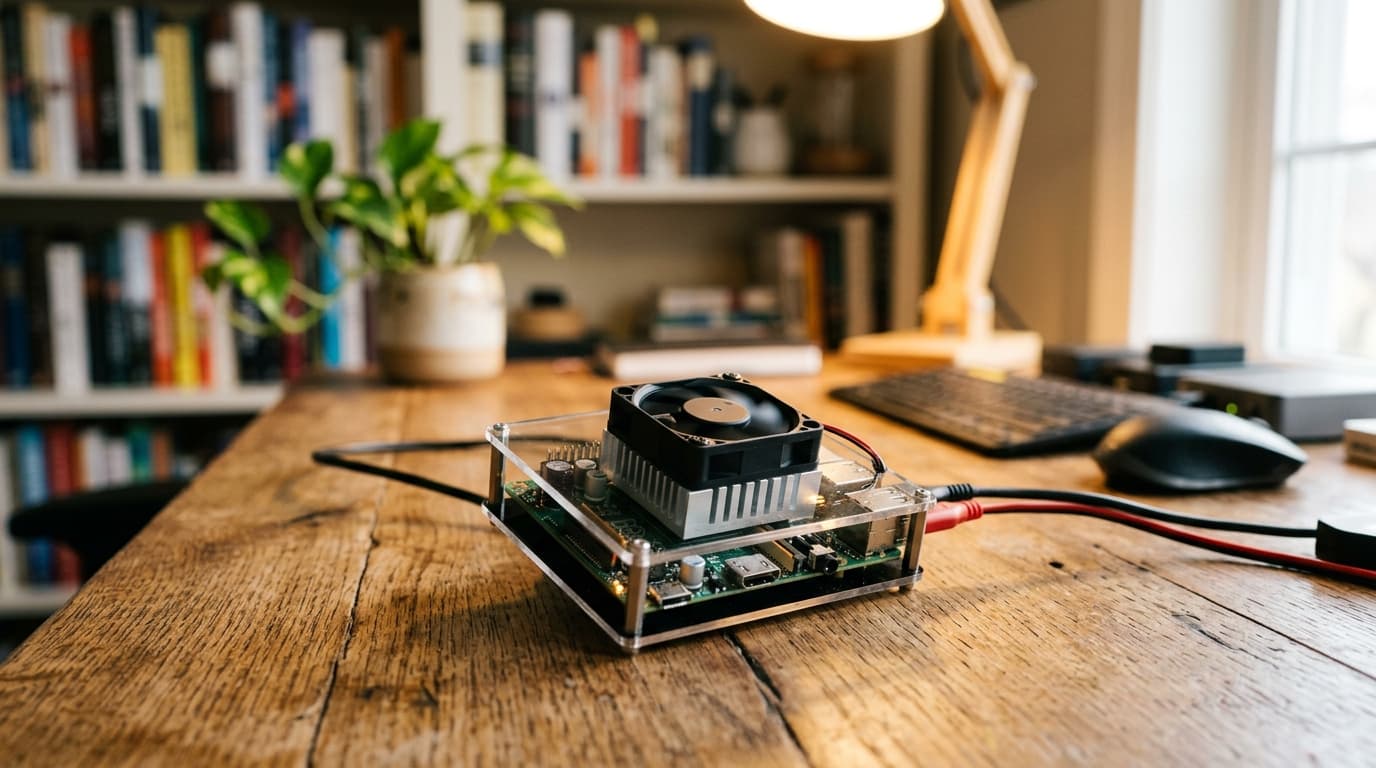
If you have a wall outlet, $200, and thirty minutes, you can run a Bitcoin miner from your desk.
The Bitaxe is fully open-source: hardware schematics, PCB layouts, and firmware are publicly available.
There is no company behind it. No marketing department, no investor deck, no quarterly earnings. Skot9000 designed the original, and a community of developers and contributors maintains it. Multiple shops produce and sell the units.
The current generation Bitaxe Gamma runs around 1.2 TH/s and draws about 17–18 watts. It is roughly 1,000x slower than an industrial Antminer S21, and roughly 1,000x more accessible.
How home mining hardware actually compares
| Hardware | Hashrate | Power draw | Approx price | Daily gross at current network | Best use case |
|---|---|---|---|---|---|
| NerdMiner v2 | ~50 GH/s | ~5W | $20–$40 | <$0.01 | Lottery-only solo, learning tool |
| Bitaxe Gamma | ~1.2 TH/s | ~17W | $200–$300 | $0.03–$0.06 | Desktop solo or small-pool contributor |
| Refurb Antminer S19 J Pro | ~104 TH/s | ~3 kW | $800–$1,500 | $2.50–$4.50 | Garage or workshop mining at scale |
| New Antminer S21+ | ~225 TH/s | ~3.5 kW | $4,000–$6,000 | $5.50–$10.00 | Serious home setup with proper cooling |
Numbers vary with network difficulty and hashprice. The pattern doesn't.
The honest economics
A Bitaxe Gamma running at $0.10/kWh costs about $0.04 a day in electricity and earns about $0.03–$0.06 in pool mining. Most days, you net out close to zero or slightly negative. Over a month, you might gain or lose a couple of dollars.
You are not getting rich. That is the point.
Solo mining is a lottery, not a salary. The mathematical expectation for a Bitaxe Gamma to find a Bitcoin block independently is roughly once every 80,000 years at current difficulty. But variance is real, a hobbyist with a Bitaxe in Detroit found a full block in 2024. Someone hits one every few months. It will probably not be you. But it will be someone.
If lottery odds aren't your thing, you point your Bitaxe at a pool like Ocean (the only pool that runs Stratum V2 by default and lets you build your own block templates), and you receive small daily payouts proportional to your hashrate contribution.
Getting started with home mining
The minimum setup is: order a Bitaxe at bitaxe.org/buy, configure it against your full Bitcoin node, set your wallet address, and plug it in. If you already run a node, you're 90% there.
Detailed walkthroughs for the specific units bitcoinproducts has reviewed:
- Bitaxe Review: what the unit is, how it performs in real use
- Cryptocloaks Bitaxe Review: Six Months of Home Solo Mining: long-term real-world data
- NerdMiner v2 Setup Guide for Home Bitcoin Mining: the cheaper lottery-only alternative
- Home Bitcoin Mining: Altair Tech + NerdMiner Setup Guide: combining hardware with noise mods
- Altair Tech Review: the Helios fan mod that makes garage mining tolerable
Run Stratum V2 yourself
This is the actionable freedom-tech move. Download the Stratum V2 reference implementation, configure your mining setup to build your own block templates, and you decide which transactions to include in blocks. Setup is about thirty minutes if you're already running a full node. This is what mining decentralization actually looks like in practice.
Path 2: Heat your house with mining hardware
Heat-reuse mining is the most underrated path in cold climates with electric heat.
The physics is straightforward. Electric resistive heaters convert ~100% of input electricity into heat. Bitcoin mining hardware converts ~100% of input electricity into heat. Same energy output, different secondary product: the miner produces hashes and earns Bitcoin while doing it.
If you already heat your home with electricity and you're going to spend the energy anyway, a Bitcoin miner is the most expensive heater on the market that pays you back for running it.
When the math actually works
Heat-reuse only makes sense under specific conditions:
- You heat with electricity (baseboard, radiant, heat pump). Natural gas is cheaper per BTU, so the relative savings shrink.
- You're in a cold climate with winters that drive >$1,500/year heating bills.
- You have a garage, workshop, basement, or dedicated room. Bedrooms are out: even purpose-built units run louder than a furnace.
- You have or can install a 240V dedicated circuit. Most 3+ kW ASICs require it.
Check three or four boxes and the math is genuinely compelling. Check fewer and it isn't.
Honest economics for heat-reuse mining
A 3 kW ASIC running eight hours a day during heating season at $0.12/kWh:
- Daily electricity cost: ~$2.88
- Daily Bitcoin earned (at current hashprice): ~$1.50–$3.00
- Net daily cost of heating that room: $0 to $1.50 (versus $2.88 for a stupid heater)
- Heating-season savings (4 months): $170–$345
In a colder climate running longer hours, those numbers scale up. A workshop heated by a 5 kW miner from October through April pays for the hardware in roughly one to two heating seasons.
Heat-reuse hardware compared
The category has matured. Several purpose-built options exist:
| Product | Power | Designed for | Heat distribution | Approx price |
|---|---|---|---|---|
| Exergy | 3–5 kW configurable | US homes, workshops | Forced-air, room-scale | $2,500–$4,000 |
| Heatbit | ~2 kW | Living spaces | Convection space heater | $1,500–$2,500 |
| 21 Energy | Various, up to 8 kW | European homes | Hydronic or forced-air | €2,500–€7,000 |
| Canaan Avalon Mini Heater | ~1 kW | Office, small space | Compact convection | ~$700 |
| DIY ASIC + enclosure | Variable | Garages, workshops | Open-air or ducted | $1,500–$5,000 + labor |
For US homes, Exergy is the cleanest option from a refinement-and-support standpoint. It's engineered to handle the heat output as a feature rather than a byproduct. See the Exergy Review and Exergy Bitcoin Mining Heater Setup Guide.
Real constraints to plan for
- Noise. Even purpose-built units run louder than a furnace. Plan for garages, basements, workshops. Bedrooms are non-starters.
- 240V circuits. Most efficient ASICs need 240V dedicated circuits. Budget $200–$500 for electrical work if your house isn't already wired.
- Heat distribution. A 3 kW miner dumps significant heat into a single room. If you need whole-house heating, you need multiple units or proper ducting.
- Summer. Most home mining heat-reuse setups idle during warm months. Plan accordingly.
Path 3: Hosted and colocation mining
If you want exposure to mining economics without running a facility, hosting is the answer.
There are two distinct contractual models worth separating because the structure matters.
Pure hosting vs Mining-as-a-Service
Two contractual models, one critical similarity. In pure hosting (Simple Mining, Compass Mining), you buy hardware separately, ship it to the provider's facility, and pay them a per-kWh rate to rack, power, cool, and maintain it. You receive pool payouts directly. In Mining-as-a-Service or MaaS (Sazmining), the provider procures the hardware on your behalf at market price, you own the physical machine, and they operate it at their facility and pay you in Bitcoin daily.
The critical similarity: you own the physical asset in both models. That's what separates legitimate hosting and MaaS from cloud mining, which is a contract for hashrate with often no underlying hardware. Cloud mining is almost always a scam or a thin-margin trap. Real hosting and MaaS give you legal claim to a specific machine.
Hosting providers compared
| Provider | Model | Electricity rate | Hardware ownership | Energy source | Notable feature |
|---|---|---|---|---|---|
| Simple Mining | Pure hosting | $0.07–$0.08/kWh | You buy/bring | US grid mix | Pay for uptime only; 98% avg uptime |
| Sazmining | MaaS | ~$0.06–$0.07/kWh | You buy from them | Mostly hydro/renewable | Renewable focus, full HW ownership |
| Compass Mining | Pure hosting | Varies by site ($0.06–$0.09) | You buy/bring | Mixed (varies by facility) | Largest US footprint, more sites |
See bitcoinproducts' detailed reviews:
- Simple Mining Review: US-based, founder-led, transparent
- Simple Mining Review 2026: Electricity Rate Analysis: economics deep-dive
- Sazmining Review: MaaS with renewable focus
Honest tradeoffs versus running it yourself
Versus DIY home mining at scale:
- You pay $0.02–$0.03 more per kWh (the operator's margin)
- You eat that overhead in exchange for: better uptime, professional cooling, longer hardware life, no operational headache
- You don't get to make the small operational decisions yourself
Versus buying Bitcoin mining stocks (HUT, IREN, CIFR, CLSK):
- Stocks are liquid; hosted hardware is illiquid
- Stocks are a paper claim on a company; hosting gives you a physical claim on a specific machine
- Stocks come with management risk. Marathon mines Bitcoin at a loss based on its own financial statements: a fiat-funded operation, not a Bitcoin business. Hosting your own hardware avoids that misalignment.
When industrial mining actually makes sense
For most readers, this section is about the path you won't take, but understanding why matters.
Industrial mining is real Bitcoin infrastructure. Bitcoiners have been ahead of the energization trade for years.
The next decade of energy buildout, driven by AI compute, reshoring, electrification, and demand growth, runs through the same dispatchable-load infrastructure that mining pioneered. Cipher Mining, Hut 8, Iris Energy, and Riot (Corsicana site) have secured energy and energized power positions of major value.
At Ten31, we've invested in operators like Giga Energy, Upstream Data, and Satoshi Energy precisely because mining as energy infrastructure is the bigger story.
But industrial mining means $1M+ in capex minimum, power purchase agreements, regulatory navigation, a 24/7 operations team, and expertise in HVAC and electrical infrastructure. It is a business, not a side project.
For everyone else, the industrial-scale exposure play is to invest in the operators who are doing it well, through public stocks, private fund investments (Ten31 is one path; others exist), or hosted mining at facilities those operators run. Becoming an industrial miner yourself is the wrong question.
Building a 5 MW site from scratch as a side project is a faster way to lose money than the network forfeits without you.
Decision matrix: pick your path
| If you... | Then path |
|---|---|
| Believe in decentralization, have $200, and an outlet | Bitaxe (Path 1) |
| Already heat with electricity in a cold climate | Heat-reuse mining (Path 2) |
| Have $5K–$50K, want hardware exposure without operating | Hosting / MaaS (Path 3) |
| Want mining exposure but can't operate or host | Mining stocks (HUT, IREN, CIFR) |
| Have energy expertise and $1M+ | Build it yourself (you don't need this guide) |
| Want a layered approach | Bitaxe at home + hosted at scale + equity for liquidity |
| None of the above appeals | Just stack sats; mining isn't a moral obligation |
Frequently Asked Questions
Is home Bitcoin mining profitable in 2026?▾
Not in fiat terms for most home setups at standard residential electricity rates. A Bitaxe at $0.10/kWh nets a few cents per day. A 3 kW ASIC in a garage at $0.10/kWh roughly breaks even on most days. The profitable home miner is the one who already heats with electricity and treats mining as a heating subsidy, that math works.
Is the Bitaxe profitable?▾
In fiat: no. It loses or breaks even on most home power rates. In sats: yes, it earns a small daily Bitcoin payout. The reason to run one is decentralization contribution and lottery-style solo mining, not income.
How does the Bitaxe compare to an Antminer S21 for home use?▾
Different categories of decision. The Bitaxe is ~1.2 TH/s, ~17W, $200, designed for desktop / open-source contribution. The Antminer S21 is ~200 TH/s, ~3 kW, $4–6K, designed for industrial racks. An S21 can run in a garage with proper noise mitigation (see Altair Tech), but it requires 240V circuits and is loud enough that location matters.
What's the best Bitcoin mining hosting service?▾
It depends on what you want. Simple Mining is the cleanest for straightforward US-based hosting with transparent uptime-only pricing at $0.07–$0.08/kWh. Sazmining is the cleanest for MaaS with hardware ownership on renewable-powered facilities. Compass Mining is the largest US-footprint option with more facility variety.
Avoid anything labeled "cloud mining" since that category is almost always a contract without underlying hardware.
Can I mine Bitcoin without buying any hardware?▾
Sort of, with caveats. The legitimate "no hardware" options are mining stocks (HUT, IREN, CIFR, CLSK) and Bitcoin mining ETFs. The "cloud mining contract" category is almost entirely scams. If a service is offering "hashrate" without specifying the physical hardware your contract is tied to, it's not what it claims to be.
Does mining Bitcoin to heat your house actually work?▾
In a cold climate with electric heating, yes, the math is genuinely compelling. Bitcoin mining hardware converts ~100% of electricity to heat, the same as a resistive heater, while earning Bitcoin as a secondary output. In a warm climate or with cheap natural gas heating, the math is weaker.
How much electricity does a home Bitcoin miner use?▾
- Bitaxe: 17–18 W (less than a lightbulb)
- NerdMiner v2: ~5 W
- Antminer S21 family: 2.5–4 kW
- Whatsminer M60S: ~3.4 kW
The large units need dedicated 240V circuits in most cases.
Is Bitcoin mining bad for the environment?▾
Mining incentivizes building generation capacity, monetizes stranded energy that would otherwise be flared, and provides demand response to grids that benefit from flexible load. The "Bitcoin mining wastes energy" framing treats energy as a fixed pie, which it isn't.
Should I mine Bitcoin or just buy Bitcoin?▾
For pure ROI, buying is more capital-efficient. For decentralization contribution, hands-on learning, and the lottery dimension of solo mining, mine. Most home miners do both.
What is Stratum V2 and why does it matter?▾
Stratum V2 is an open-source mining protocol that lets individual miners build their own block templates instead of accepting whatever their pool operator chooses. Pools representing 75% of network hashrate have adopted it. The practical effect: censorship resistance at the protocol level got a massive upgrade, but only if hashrate stays geographically distributed in the first place.
---
Marty Bent is the editor of Truth For The Commoner (TFTC), host of the TFTC podcast since 2017, and managing partner at Ten31. He runs a Bitaxe at home.